

Most people have never questioned the design of their toothbrush. One head, one row of bristles, a two-minute routine that most people still rush or skip entirely. That design works reasonably well if you have full manual dexterity, no sensory sensitivities, and a willing patient every morning. But for a significant portion of the population, including elderly residents in care homes, people with physical disabilities, and individuals with learning difficulties, the standard toothbrush is a daily obstacle. The 3D triple head toothbrush was designed specifically to remove that obstacle. This article explains exactly how it works, who it is right for, and how to use it correctly so that carers, dental professionals, and informed consumers can make a genuine comparison.
Table of Contents
- What Is a 3D Triple Head Toothbrush?
- Who Benefits Most from a 3D Triple Head Toothbrush?
- What the Evidence Says About Triple Head Toothbrushes
- How to Use a 3D Triple Head Toothbrush Correctly
- Triple Head vs. Standard Manual vs. Electric: A Practical Comparison
- Care Home Oral Hygiene: Why the Toothbrush Choice Matters More Than You Think
- Pairing with the Right Toothpaste for Sensitive and Special Care Patients
- Frequently Asked Questions
- References
What Is a 3D Triple Head Toothbrush?
A 3D triple head toothbrush has three bristle heads arranged in a U or cradle shape: one central head that cleans the outer (buccal) surface, and two flanking heads angled inward to clean the inner (lingual or palatal) surface and the biting (occlusal) surface at the same time. When the brush head is placed over a tooth, all three bristle pads make contact simultaneously. The result is that a single back-and-forth stroke achieves what a standard single-headed brush takes multiple repositions and technique adjustments to accomplish.
The “3D” in the name refers to this three-dimensional cleaning action, not a gimmick. The triple-headed toothbrush is designed to brush the occlusal, oral, and buccal surfaces of the tooth simultaneously. This is the core mechanical advantage and the reason the brush has genuine clinical relevance for specific populations, rather than just being a novelty product.
Different brands have produced versions of this design over the years under names like the Surround Toothbrush and similar product lines. The head dimensions, bristle softness, and handle ergonomics vary, but the three-sided cleaning principle remains consistent across the category.
| Key Insight | Explanation |
|---|---|
| Three-surface simultaneous cleaning | The brush contacts buccal, lingual, and occlusal surfaces in one stroke, reducing both time and technique demands. |
| Best suited to assisted brushing scenarios | Carers in care homes or parents of children with disabilities can achieve more complete cleaning per stroke, even with limited patient cooperation. |
| Evidence supports use for care-dependent patients specifically | Research from KU Leuven (2024/2025) found the triple-headed brush was effective for plaque removal and had a shorter brushing time, making it a practical choice for residential care settings. |
| Not proven superior for healthy adults with full dexterity | In populations without physical or dexterity limitations, clinical studies found no significant difference in plaque removal compared to a conventional single-headed brush. |
| Reduces brushing time | Shorter brushing duration matters when a resident is distressed or resistant. Getting the job done faster with adequate coverage is a real clinical benefit in care settings. |
| Toothpaste choice still matters | The brush design solves the mechanical problem. If the patient refuses brushing because of strong mint flavour or foaming toothpaste, an unflavoured non-foaming formula is needed alongside it. |
| Interproximal cleaning is not covered | Like all toothbrushes, the triple head design does not clean between teeth. Interdental brushes or floss remain necessary as a complement. |
Who Benefits Most from a 3D Triple Head Toothbrush?
The honest answer is that the 3D triple head toothbrush is not for everyone, and claiming otherwise does the product a disservice. A 2025 study published in the International Journal of Dental Hygiene found that the triple-headed manual toothbrush was not only effective in plaque removal, but also had a shorter brushing time and was easy to use, being an adequate alternative for care-dependent patient groups. That framing is precise: care-dependent patients. The brush was not found to outperform standard manual brushes in healthy adults with full dexterity.
The populations who genuinely benefit fall into several clear categories:
Elderly Residents in Care Homes
Oral hygiene in residential care is consistently poor, not because carers do not care, but because the task is genuinely difficult. In residential care, tooth brushing with a manual toothbrush can be challenging because of technical difficulties, time consumption, and poor patient cooperation, resulting in sub-optimal cleaning. A resident who turns their head, bites down on the brush, or can only tolerate a few seconds of brushing will receive far more coverage from a triple head design than from a conventional brush held at varying angles.
People with Physical Disabilities and Limited Dexterity
The triple-headed toothbrush is claimed to result in a shorter brushing time, which could be very useful for certain patients with limited dexterity who find it difficult to use a conventional single-headed toothbrush. For someone with Parkinson’s disease, post-stroke motor impairment, rheumatoid arthritis in the hands, or cerebral palsy, the demand placed on fine motor control by a single-headed brush is significant. The triple head design reduces the number of precise movements needed to cover all tooth surfaces.
Children and Adults with Learning Disabilities or Autism
For young children and those with learning disabilities, the triple-headed design helps guide the brushing action of those learning to clean their teeth. As they attempt independent brushing, more surface is cleaned with each stroke of the brush. A parent or support worker can also use the brush to assist brushing with less repositioning, reducing the duration of an activity that many individuals with sensory sensitivities find aversive.
People with Low Oral Brushing Tolerance
Some individuals, including those with dysphagia, dementia, severe anxiety, or significant gag reflexes, can only tolerate brief brushing contact. Getting the most out of each second of brushing contact is exactly what the 3D triple head design provides. Fewer strokes for equivalent coverage means the window of cooperation does not have to be long to be effective.
What the Evidence Says About Triple Head Toothbrushes
The research picture is more nuanced than marketing copy tends to suggest. There are genuine findings worth acting on, and there are also limitations that a responsible clinician should understand.
Where the Evidence Is Positive
A randomised single-blind crossover study published in the International Journal of Dental Hygiene found that the triple-headed manual toothbrush was effective in plaque removal, had a shorter brushing time, and was easy to use, making it an adequate alternative for care-dependent patient groups. This is meaningful. It means that in the setting where the brush was specifically designed to be used, it performs well on the outcomes that matter: plaque removal and time efficiency.
Earlier research on children with mild mental disabilities also found the triple-headed manual brush to be competitive with other brush types for plaque removal. A clinical study evaluated the efficacy of plaque removal of three different toothbrushes on mentally disabled children, comparing a manual triple-headed brush against a conventional manual toothbrush and an oscillating-rotating electric toothbrush. The design held its own against more technically demanding alternatives in a population where simplicity of use matters.
Where the Evidence Has Limits
The principal finding of one randomised controlled clinical trial was that the triple-headed manual toothbrush was not superior to the conventional manual toothbrush in removing dental plaque in a cohort of healthy adult population with no physical or orthodontic limitations. This does not make the brush useless. It makes the brush correctly positioned: a tool for a specific need, not a universal upgrade.
A professional consensus statement published in 2024 reinforced this position. There is limited evidence to suggest the use of a triple-headed manual toothbrush instead of a single-headed manual toothbrush with respect to plaque removal for care-dependent individuals. “Limited evidence” here means the evidence that does exist points in a positive direction, but the body of research is not yet large. Clinicians working in care settings can use the brush with confidence, while recognising that more research is still being done.
The case for the triple head toothbrush is not that it cleans better for everyone. It is that it cleans adequately for people who cannot achieve adequate cleaning any other way. That is a different, and more important, argument.
Pro tip: When trialling a 3D triple head toothbrush in a care home setting, introduce it to one resident at a time and document their cooperation and comfort level over two weeks. Anecdotal comparison to their previous routine is often the clearest evidence you will have about whether it is working for that individual.
How to Use a 3D Triple Head Toothbrush Correctly
Using the brush incorrectly removes most of its advantage. The triple head design requires a different technique from a standard manual brush, and getting carers or patients to abandon their ingrained habits takes a brief but deliberate training moment.
Step 1: Apply Toothpaste to the Central Head
Apply a pea-sized amount of toothpaste to the central (outer-facing) bristle pad. For individuals who struggle with foaming or strong flavours, an unflavoured non-foaming toothpaste is the appropriate pairing. This is not a trivial detail: if the patient rejects the toothpaste, no brush design will help.
Step 2: Place the Head Over the Tooth Rather Than Against It
This is the most important habit change. With a standard brush, the user presses bristles against the outer surface of the tooth at an angle. With the triple head brush, the user places the cradle of the head over the tooth so all three pads make contact. Think of it as placing the tooth inside the brush, not pressing the brush against the tooth. Getting this placement right is what delivers the three-surface cleaning in a single action.
Step 3: Use Short Back-and-Forth Strokes
Once the brush is correctly seated over a tooth or group of teeth, use short, gentle back-and-forth strokes. Excessive pressure is unnecessary and counterproductive: the three-pad design works through surface contact, not force. For patients with tender gums, the reduced pressure needed is itself a benefit.
Step 4: Work Systematically from Back to Front
Move from the rear molars toward the front teeth, staying on one arch before switching to the other. The triple head design covers more surface per stroke, so the total number of strokes needed is reduced, but a systematic approach still prevents missed patches, particularly at the very back molars where positioning is hardest.
Step 5: Do Not Skip the Gum Line
A common mistake with any toothbrush in assisted brushing is concentrating on the crowns of the teeth and avoiding the gum margin. The gum line is where plaque accumulates and where periodontal problems begin. Tilt the brush slightly so the inner pads engage the gingival margin on each surface, not just the open tooth surface.
Pro tip: For carers assisting residents who resist brushing, approach from beside or behind rather than face-on. Holding the brush in the resident’s sightline can trigger a defensive response. A calm, side-on approach with the triple head brush allows you to place and sweep more efficiently before any resistance builds.
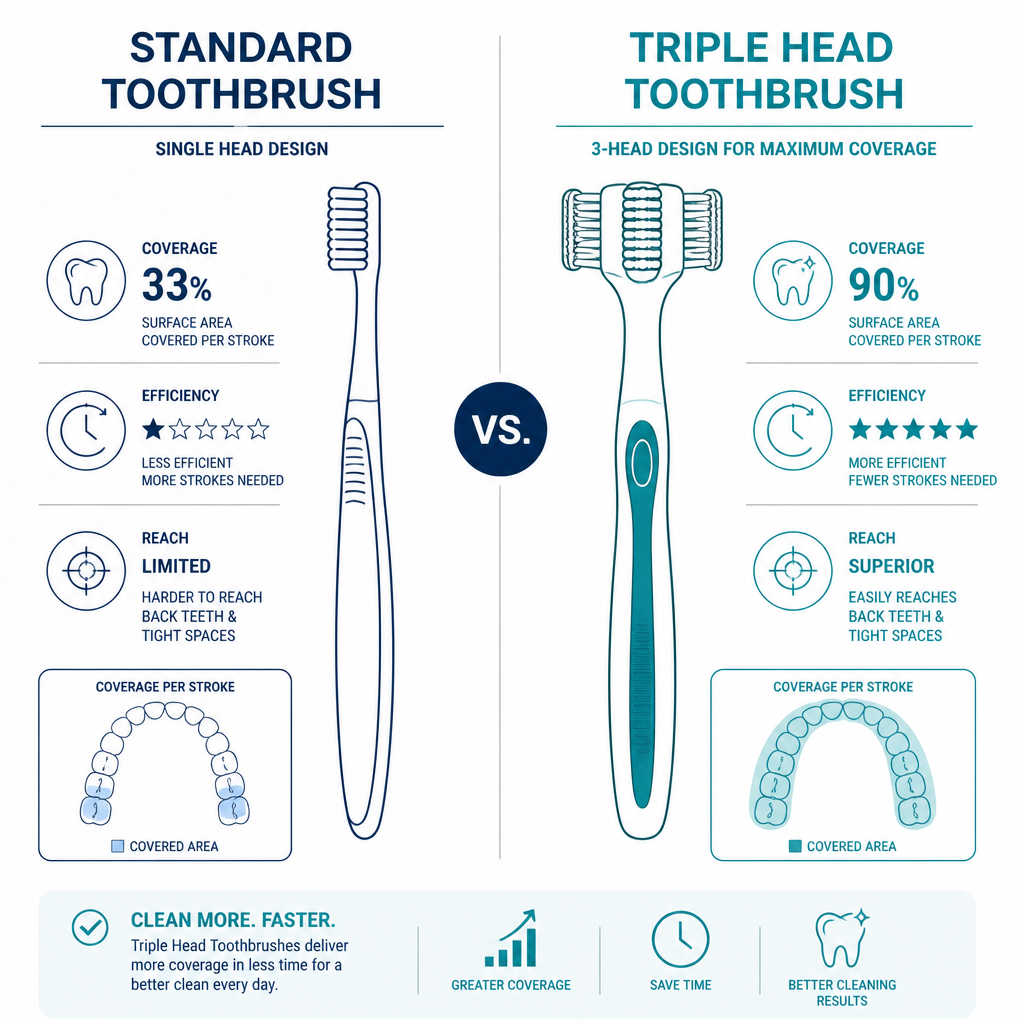
Triple Head vs. Standard Manual vs. Electric: A Practical Comparison
The question clinicians and carers actually ask is not whether a triple head toothbrush is good in the abstract, but whether it is the right choice for this patient given the alternatives. Here is a direct, practical comparison across the three main options in special care and care home settings.
| Factor | 3D Triple Head Manual | Standard Manual (e.g. super soft single head) | Oscillating-Rotating Electric |
|---|---|---|---|
| Technique demand on carer/patient | Low. Placement over the tooth does most of the work. | High. Correct angle, stroke type, and tooth-by-tooth repositioning all required. | Medium. Correct pressure and placement needed; rotation does the cleaning action. |
| Brushing time needed | Shorter. Three surfaces covered per stroke reduces total time required. | Standard two minutes recommended, which is rarely achieved in care settings. | Two minutes recommended with a timer on most devices. |
| Suitability for patients who bite or resist | Good. Quick placement and sweep means less exposure time per tooth segment. | Poor. Repositioning prolongs contact time, increasing opportunity for resistance. | Poor to moderate. Vibration and noise often increase resistance in dementia and sensory-sensitive patients. |
| Gum sensitivity tolerance | Good with soft bristles. Low pressure needed means less gum trauma risk. | Good if a super soft, small-head brush is chosen. Technique errors increase trauma risk. | Variable. Oscillating action can be too aggressive for very tender gums if pressure is not controlled. |
| Cost and care home logistics | Moderate per brush. No charging, no replacement heads at electric-device prices. | Low. Standard brushes are inexpensive and easy to stock in bulk for NHS or care settings. | Higher. Devices need charging, replacement heads are an ongoing cost, and devices can be lost or damaged. |
| Evidence base | Positive for care-dependent populations. Not superior for healthy adults without limitations. | Strong general evidence base. Technique quality determines outcome. | Good for motivated users with dexterity. Less clear advantage when patient cooperation is limited. |
The honest position: for a motivated, dexterous adult without specific care needs, a well-chosen super soft standard toothbrush with correct technique is perfectly adequate. For carers assisting residents in care homes, for parents supporting a child with a learning disability, or for anyone whose brushing window is short and cooperation is unpredictable, the 3D triple head toothbrush deserves serious consideration.
Care Home Oral Hygiene: Why the Toothbrush Choice Matters More Than You Think
Oral health in care homes is frequently treated as a lower-priority task compared to medication, mobility, and personal care. The consequences of this de-prioritisation are significant: dental pain, infection, difficulty eating, and a documented link between poor oral health and systemic conditions including pneumonia in older adults.
The barrier in care settings is rarely awareness. Most carers know oral hygiene matters. The barrier is time, patient cooperation, and the fact that a standard toothbrush combined with strong-flavoured toothpaste and a two-minute technique requirement simply does not fit the reality of assisted mouth care for a resident with dementia or significant physical dependency.
The Compliance Problem in Assisted Brushing
Residents living with dementia often resist toothbrushing actively. Research confirms that people living with dementia have a higher rate of tooth decay, and that they are more likely to resist tooth brushing, often as a response to fear or a previous bad experience. A toothbrush that reduces the time any individual tooth needs to be brushed while still achieving three-surface coverage directly addresses this problem. The triple head design does not eliminate resistance, but it compresses the window in which resistance can derail the whole routine.
Combining the Right Brush with the Right Toothpaste
Even the most effective brush design will fail if the patient refuses to open their mouth when they smell or taste the toothpaste. Strong mint flavours trigger refusal in a significant proportion of residents, particularly those with dementia, dysphagia, or sensory processing differences. Foaming agents in standard toothpaste can cause distress in residents who cannot spit effectively and create aspiration risk. An unflavoured, non-foaming toothpaste resolves both problems simultaneously and is the appropriate clinical pairing for assisted brushing in any care setting.
oraNurse produces an unflavoured, non-foaming toothpaste in multiple fluoride strengths specifically designed for this use case, and it is available through NHS supply chain. Using it alongside a 3D triple head toothbrush addresses both the mechanical challenge (coverage and time) and the sensory challenge (taste and foam) in one joined-up approach.
Pairing with the Right Toothpaste for Sensitive and Special Care Patients
A toothbrush is only one half of the brushing equation. In special care contexts, the toothpaste is often the variable that determines whether brushing happens at all. Standard flavoured, foaming toothpastes carry two specific risks for vulnerable populations: they can trigger sensory refusal before the brush has done its job, and the foam can be an aspiration risk for individuals with dysphagia or an impaired swallowing reflex.
Fluoride Strength Needs to Match the Patient’s Risk Profile
Vulnerable adults and care home residents often have high caries risk due to dry mouth (frequently caused by medication), reduced saliva production, and irregular brushing. The fluoride content of the toothpaste used should reflect this risk. A standard over-the-counter toothpaste may not provide adequate protection. Toothpastes formulated for clinical use come in different fluoride concentrations, allowing a dentist or hygienist to match the prescription to the individual patient’s risk assessment.
The Unflavoured Advantage
For patients with sensory sensitivities to strong flavours, including many autistic individuals, those with dementia, and patients on medications that cause taste distortion, the decision to use an unflavoured toothpaste is clinical, not cosmetic. An unflavoured formula removes the most common single barrier to accepting toothbrushing. Paired with a 3D triple head design that shortens the brushing time, the combined effect is a genuinely more accessible oral hygiene routine.
Pro tip: If you are introducing a 3D triple head toothbrush to a patient who has previously refused brushing, trial it first with a dry brush for one or two sessions. Let them feel the sensation of the three-sided contact before introducing toothpaste. Reducing the number of new variables at once increases the chance of acceptance.
Frequently Asked Questions
Is a 3D triple head toothbrush suitable for someone with braces or orthodontic appliances?
The triple head design can be awkward around fixed orthodontic brackets because the U-shaped cradle needs clear access to surround the tooth. For patients with braces, a standard soft single-headed toothbrush with specific orthodontic brushing technique tends to give better access to clean around brackets and wires. Consult an orthodontist before switching the brushing tool during active treatment.
Can I use a 3D triple head toothbrush independently if I have limited dexterity?
Yes, it is specifically designed for this. Because the brush surrounds the tooth rather than requiring precise angled contact, the technique demand is lower than a standard brush. Users with arthritis, tremor, or reduced grip strength often find it easier to achieve adequate coverage with fewer precise movements. You may also benefit from adding a foam grip or adaptive handle if the standard handle is difficult to hold securely.
How often should the brush head be replaced?
The same general guidance that applies to standard toothbrushes applies here: replace when the bristles show visible splaying or wear, and at minimum every three months. In care home settings where the brush is used under assisted conditions, bristle wear may occur faster due to variations in pressure. Inspect the brush head regularly rather than relying solely on a fixed replacement schedule.
Does the triple head toothbrush clean between the teeth?
No. Like all toothbrushes, the triple head design does not access the interproximal spaces between teeth. This is not a design flaw specific to triple head brushes: no toothbrush design covers this area. Interdental brushes, floss, or water flossers remain necessary as a complement to toothbrushing for complete plaque control, including for patients who use a triple head design.
Is there a paediatric version of the 3D triple head toothbrush available?
Yes, paediatric versions with smaller head dimensions are available from several manufacturers. These are particularly relevant for children with learning disabilities, autism, or sensory sensitivities who resist brushing or have parents who struggle to achieve adequate coverage during assisted brushing. The principle of the design is the same: three-surface simultaneous contact to reduce the number of strokes and the time the child needs to cooperate.
What toothpaste is best to use with a 3D triple head toothbrush for a care home resident?
For care home residents, the clinical recommendation is an unflavoured, non-foaming toothpaste with an appropriate fluoride strength matched to the individual’s caries risk. Standard mint-flavoured toothpastes frequently cause refusal in residents with dementia or sensory sensitivities, and foaming formulas carry aspiration risk in those with swallowing difficulties. oraNurse’s unflavoured toothpaste range is specifically formulated for this clinical context and is available through NHS supply chain.
Will a 3D triple head toothbrush clean better than my standard electric toothbrush?
For a fully able adult with good dexterity and no special care needs, probably not. A quality oscillating-rotating electric toothbrush used correctly is highly effective for independent brushers. The triple head manual brush is not trying to compete in that context. It is the better tool specifically when brushing time is constrained, patient cooperation is limited, or the person brushing or being brushed cannot manage the multi-step technique a conventional brush demands.
Have you used a 3D triple head toothbrush in a care setting or with a patient who had previously refused brushing? We would like to hear what worked and what did not.
References
- PubMed Central: Evaluation of plaque removal by a single-headed versus a triple-headed manual toothbrush using different plaque assessment tools (crossover study, 2024)
- International Journal of Dental Hygiene: Randomised crossover study comparing triple-headed and single-headed toothbrushes in residential care settings (De Almeida Mello et al., 2025)
- PubMed Central: Development of Tooth Brushing Recommendations Through Professional Consensus, including evidence summary for care-dependent individuals (2024)
- PubMed: Clinical evaluation of plaque removal using triple-headed manual toothbrush in children with mental disabilities
- BMC Oral Health: Randomised controlled clinical trial evaluating plaque removal by triple-headed versus conventional manual toothbrush in healthy adults