
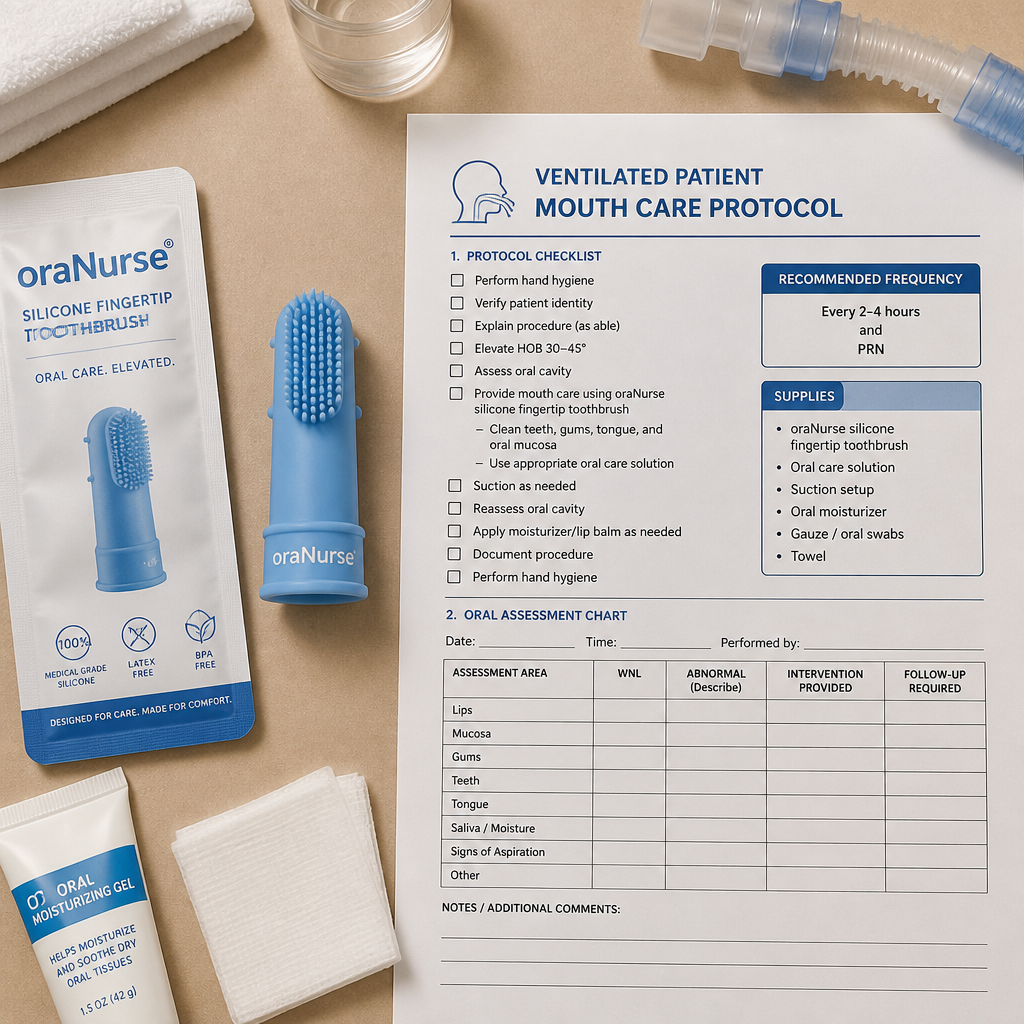
Ventilated patients in the ICU cannot advocate for their own oral health. They cannot rinse, spit, or flag discomfort. Within 48 hours of intubation, the oral environment shifts dramatically: saliva flow drops, gram-negative bacteria colonise the oropharynx, and the risk of aspiration of contaminated secretions into the lower respiratory tract becomes a clinical reality. ICU mouth care nursing is not a comfort measure bolted onto the end of a care round. It is an infection control intervention with a direct bearing on patient mortality, length of stay, and the incidence of ventilator-associated pneumonia (VAP). This protocol sets out what to do, in what order, with what equipment, and why each step matters.
Table of Contents
- Why Oral Care in ICU Matters
- Quick Takeaways
- The Oral Environment in Mechanically Ventilated Patients
- Step-by-Step ICU Mouth Care Protocol
- Toothpaste and Product Selection for Ventilated Patients
- Oral Health Assessment in Critical Care
- Common Protocol Failures and How to Fix Them
- Frequently Asked Questions
- References
Why Oral Care in ICU Matters
VAP is defined as pneumonia that develops in a patient who has been receiving mechanical ventilation for more than 48 hours. It is one of the most serious healthcare-associated infections in critical care, associated with increased mortality, prolonged mechanical ventilation, and extended ICU stays. The causal link between oral colonisation and VAP is well established: pathogenic bacteria accumulate on teeth, mucosa, and the endotracheal tube cuff, then migrate into the lungs via micro-aspiration.
Evidence from a UK-based study published in a peer-reviewed intensive care nursing journal found that written oral care protocols were available for only 65% of intubated patients across ICUs in England, Wales, and Northern Ireland, and that just 73% of patients received any oral care within a 24-hour period. That means more than one in four ventilated patients received no documented mouth care on any given day. This is not a resourcing problem in isolation; it is a knowledge and protocol gap that better structured nursing practice can close.
Effective oral hygiene in the ventilated patient is an infection control intervention first and a comfort measure second. Treating it as optional is a clinical error with measurable consequences.
Quick Takeaways
| Key Insight | Explanation |
|---|---|
| Oral care frequency matters as much as technique | Mouth care should be performed at minimum every four to six hours in ventilated patients. Ad hoc or once-daily care is insufficient to control bacterial load. |
| Toothbrushing reduces VAP risk beyond antiseptic rinse alone | Research comparing chlorhexidine wash with and without toothbrushing found significantly lower VAP incidence, mortality, and ICU stay length when brushing was included. |
| Non-foaming toothpaste is the correct product choice | Standard SLS-containing toothpaste creates foam that poses an aspiration hazard. Unflavoured, non-foaming toothpaste removes both the aspiration risk and the sensory barrier for patients with altered tolerance. |
| Suction must precede brushing, not follow it | Suctioning pooled secretions before introducing any toothbrush or swab prevents pushing contaminated material further into the oropharynx during oral care. |
| Oral assessment on ICU admission is the baseline | A structured oral health assessment at admission establishes the patient’s baseline and flags pre-existing pathology that may complicate care or increase infection risk. |
| Foam sticks alone are not sufficient for plaque removal | Foam sticks (oral swabs) are useful for moisturising and applying solutions but do not provide the mechanical action needed to disrupt dental plaque. They should supplement, not replace, toothbrushing. |
| Protocol availability does not equal protocol adherence | Having a written protocol in place is only the first step. Regular audit, staff education, and embedded documentation within care records drive actual compliance. |
The Oral Environment in Mechanically Ventilated Patients
The ICU oral environment is hostile to tissue health and favourable to pathogenic colonisation. Oral intubation itself is a significant physical disruptor: the endotracheal tube obstructs access to much of the oral cavity, creates pressure trauma on the lips and mucosa, and when combined with mouth props and fixation tape, makes systematic cleaning genuinely difficult. On top of this, most ventilated patients are receiving sedation or muscle relaxants that suppress the normal physiological activities of swallowing, salivation, and jaw movement.
Xerostomia (dry mouth) is almost universal in this population. Reduced salivary flow removes one of the mouth’s primary natural defences: saliva contains antimicrobial proteins, buffers oral pH, and mechanically washes the mucosal surfaces. Without it, mucosa dries, cracks, and becomes vulnerable to ulceration and secondary infection. The bacterial flora shifts from predominantly gram-positive oral commensals toward anaerobic gram-negative organisms associated with respiratory pathology.
Patients in the ICU are also frequently nil by mouth or on enteral feeding, which eliminates the mechanical cleansing effect of food and the saliva stimulation that eating normally provides. Medications including opioids, antihistamines, and some antihypertensives further reduce salivary flow. The result is an oral environment that deteriorates predictably and rapidly without active, structured nursing intervention.
Step-by-Step ICU Mouth Care Protocol
The following protocol reflects current evidence-based practice for ventilated patient oral hygiene in adult critical care settings. It should be performed by a registered nurse or a healthcare assistant working under direct supervision, using a two-person technique where possible. Frequency should be a minimum of every four to six hours across a 24-hour period.
Equipment Preparation
Before approaching the patient, assemble: a small-headed, soft-bristled toothbrush; unflavoured, non-foaming fluoride toothpaste; a Yankauer suction catheter and suction source; oral swabs or foam sticks for moisturising; a lip lubricant; a water-resistant disposable sheet; and gloves plus eye protection for the nurse. If an antiseptic agent is indicated per local policy, have it ready to apply as directed.
Positioning
Raise the head of the bed to 30 to 45 degrees unless clinically contraindicated. This reduces the risk of aspiration during oral care and is a component of the broader VAP prevention bundle. Confirm the endotracheal tube cuff pressure is within the recommended range before commencing, as adequate cuff inflation reduces micro-aspiration of secretions from above the cuff.
Suction First
Using the Yankauer catheter, suction pooled secretions from the oropharynx, around the endotracheal tube, and from the buccal sulci before introducing any cleaning device. This step is non-negotiable. Proceeding to brush without prior suction risks pushing colonised secretions further into the oropharynx. Take care not to stimulate a gag reflex or dislodge the tube during suctioning.
Toothbrushing
Apply a small amount of unflavoured, non-foaming toothpaste to the toothbrush. Use a small-headed brush to access the posterior teeth and the areas immediately adjacent to the endotracheal tube fixation. Brush all tooth surfaces methodically: outer surfaces, inner surfaces, and chewing surfaces, using gentle circular or modified Bass technique movements. Brush for a minimum of two minutes. A second nurse holding the tube and monitoring tube position significantly reduces risk during this step. After brushing, suction again to remove dislodged debris and residual toothpaste.
Pro tip: A toothbrush with a very small head, such as the oraNurse super soft small-headed brush, allows access to the posterior oral cavity without requiring wide mouth opening and reduces tissue trauma around the tube fixation site.
Mucosal and Tongue Care
Using moistened oral swabs, clean the buccal mucosa, hard palate, gums, and tongue systematically. This removes debris from surfaces that a toothbrush cannot reach adequately and applies moisture to tissues at risk of drying. Discard each swab after a single pass to avoid redistributing contaminated material. Do not use lemon and glycerine swabs, which are acidic and can demineralise enamel over time.
Lip Care
Apply a water-based lip lubricant to both upper and lower lips. Cracked, fissured lips are a common finding in ventilated patients and represent both a source of discomfort and a potential entry point for infection. Lip care is a simple, low-cost step that is frequently omitted from oral care rounds.
Documentation
Record the oral care episode in the patient’s care record, including the time, the products used, and any abnormal findings. If the mouth assessment tool used by your unit reveals a change from baseline, escalate appropriately and document the action taken. Consistent documentation is what turns individual good practice into auditable, team-wide protocol adherence.
Toothpaste and Product Selection for Ventilated Patients
Standard mint toothpaste is unsuitable for use in ventilated patients, and this point is more significant than it might first appear. The two problematic components are the flavouring and the foaming agent. Strong mint or spearmint flavours are a significant sensory issue even for patients with reduced consciousness, and the sodium lauryl sulphate (SLS) present in most consumer toothpastes generates foam that cannot be reliably swallowed or evacuated by a compromised patient. In a setting where aspiration risk is already the central clinical concern, introducing an SLS-foaming toothpaste is a directly counterproductive choice.
Unflavoured, non-foaming toothpaste resolves both problems simultaneously. It provides the necessary fluoride protection without generating foam, and its absence of strong flavour makes it tolerable for patients with nausea, altered taste, or sensory sensitivities. oraNurse toothpaste is formulated specifically to meet this need: no artificial flavouring, no SLS, and available in appropriate fluoride strengths for adults, including 1450ppm fluoride for adults and children over three years of age. It is available through NHS Supply Chain, making Trust-level procurement straightforward.
For patients with very dry, sore, or ulcerated mucosa, a dry mouth gel applied to mucosal tissues after cleaning provides lubrication and comfort. For patients with clinically assessed dry mouth, a product such as BioXtra, which is designed to supplement salivary function, may be appropriate where clinically indicated.
Pro tip: When preparing oral care kits for a shift, pre-loading each kit with a small-headed toothbrush and a unit-dose tube of unflavoured non-foaming toothpaste reduces decision-making at the bedside and improves consistency across the nursing team. oraNurse is available in small tube sizes suited to this approach and can be ordered via NHS Supply Chain or through any pharmacy.
Oral Health Assessment in Critical Care
Structured oral assessment is the foundation of any functional oral care protocol, yet evidence from UK ICUs shows it remains inconsistently performed. A UK-based point-prevalence survey across ICUs in England, Wales, and Northern Ireland found that only 44% of ventilated patients had received an oral assessment in the preceding 24 hours, and assessment methods varied widely between units. Without a baseline and a repeatable assessment framework, deterioration goes undetected and care cannot be meaningfully escalated.
A validated assessment tool, such as the Beck Oral Assessment Scale (BOAS) or a tool aligned with the Mouth Care Matters framework, should be used at ICU admission and repeated at each care episode or at least once per shift. Assessment should cover: lip condition (moisture, cracking, bleeding); mucosal condition (colour, ulceration, coating); tongue condition (moisture, coating, lesions); gingival condition (bleeding, swelling, recession); and tooth condition (plaque, debris, obvious pathology). Any deterioration from baseline requires documentation and escalation to the appropriate clinician.
The practical reality in many ICUs is that oral assessment is either not done or is recorded only as a binary “mouth care given” tick without qualitative detail. This creates invisible deterioration. Building the assessment into the existing shift documentation system, rather than running it as a separate process, significantly improves completion rates.
Common Protocol Failures and How to Fix Them
Most ICU oral care failures do not arise from lack of knowledge at the individual nurse level. They arise from system-level problems: inconsistent product availability, protocols that exist on paper but are not embedded in practice, and the persistent (and incorrect) cultural assumption that mouth care is a lower-priority task that can be deferred when the patient is clinically unstable.
Foam Sticks as the Sole Cleaning Method
Foam sticks are widely used and widely misunderstood. They are appropriate for moisturising mucosal surfaces and applying agents to hard-to-reach areas. They do not provide the mechanical disruption needed to remove dental plaque. A UK survey of oral care practices in ICUs found that some units were using foam sticks as the primary or sole cleaning method. This approach fails to address the plaque biofilm that is the source of the pathogenic colonisation driving VAP risk. The fix is straightforward: toothbrushing must be standard, and foam sticks used as an adjunct.
Infrequent Care Intervals
Once-daily or twice-daily oral care is inadequate in a ventilated patient. Bacterial recolonisation of tooth surfaces occurs within hours of cleaning. A minimum interval of four to six hours is supported by current practice guidance, meaning oral care should be integrated into the regular care round at least four times across a 24-hour period. Where a patient is unstable, the temptation to deprioritise mouth care is understandable but clinically incorrect: the more compromised the patient, the greater the infection risk from a colonised oral environment.
Inappropriate Product Choice
The continued use of standard flavoured, foaming toothpaste in ICU settings reflects procurement inertia rather than clinical reasoning. Units that stock only one type of toothpaste for the whole hospital will default to a product designed for healthy adults brushing their own teeth. The oral care protocol should specify the required product properties (unflavoured, non-foaming, appropriate fluoride strength) and the procurement pathway should reflect this.
No Audit of Compliance
A written protocol that is never audited is effectively decorative. Monthly point-prevalence audits, structured around the same questions used in published UK ICU surveys (Was an assessment documented? Was oral care delivered within the last six hours? Was the correct product used?), create the feedback loop needed to sustain improvement. The audit data should be shared with the team, not buried in a quality report.
Frequently Asked Questions
How often should oral care be performed for a ventilated patient in ICU?
Oral care should be performed at minimum every four to six hours, which equates to at least four episodes across a 24-hour period. Some clinical guidelines recommend two-hourly moisturising of the oral cavity between full care episodes, particularly for patients with severe xerostomia. The key principle is that bacterial recolonisation is rapid, so the interval between full cleaning episodes should never exceed six hours without clinical justification.
Is chlorhexidine routinely recommended for ICU oral care in the UK?
The role of chlorhexidine in ICU oral care has been debated in the literature, with some systematic reviews questioning the benefit when used as a routine rinse without toothbrushing. Where chlorhexidine is used, it should be considered as part of a broader oral care bundle rather than as a standalone intervention. Local infection control and pharmacy policies should guide its use, concentration, and frequency. Chlorhexidine is not a substitute for mechanical plaque removal through toothbrushing.
Can a healthcare assistant perform oral care on a ventilated patient?
Yes, with appropriate training and clear protocols in place. The Mouth Care Matters programme, developed to support hospital-wide oral hygiene improvement, was specifically designed to make structured oral care delivery accessible to nursing staff and healthcare assistants without dental backgrounds. Toothbrushing adjacent to an endotracheal tube carries a risk of tube displacement, so a two-person technique, with one nurse stabilising the tube and one performing the oral care, is recommended for this aspect of the procedure.
Why is standard mint toothpaste unsuitable for ventilated ICU patients?
Standard toothpaste presents two specific problems in ventilated patients. First, the foaming agent sodium lauryl sulphate (SLS) generates foam that the patient cannot reliably swallow or clear, creating an aspiration risk. Second, the strong artificial mint flavour is poorly tolerated by patients with altered consciousness, nausea, or sensory sensitivities. Unflavoured, non-foaming toothpaste, such as oraNurse, provides the required fluoride protection without either of these hazards. It is available at 1450ppm fluoride for adults and can be procured through NHS Supply Chain.
What is the correct cuff pressure for an endotracheal tube during oral care?
Endotracheal tube cuff pressure should be maintained within the range specified by your unit’s VAP prevention bundle, typically cited as 20 to 30 centimetres of water. Cuff pressure should be checked before commencing oral care, not assumed to be correct from the previous recording. Adequate cuff inflation is a component of the VAP prevention bundle because it creates a mechanical barrier against the micro-aspiration of subglottic secretions. This falls within the nursing assessment step that precedes oral cleaning, not within the oral care procedure itself.
What assessment tool should be used for oral health in ICU patients?
Several validated tools exist, including the Beck Oral Assessment Scale (BOAS) and tools adapted from the Mouth Care Matters programme. The key requirement is that the tool used is structured, consistently applied by all team members, and embedded within the existing shift documentation rather than maintained as a separate form. The specific tool matters less than its consistent use. Any tool should cover the lips, mucosa, tongue, gums, and teeth, and record findings in enough detail to identify deterioration over time.
Where can oraNurse products be obtained for use in NHS settings?
oraNurse unflavoured non-foaming toothpaste is available through NHS Supply Chain, which makes it accessible for Trust-level procurement without requiring individual prescriptions. It can also be ordered through any pharmacy. The range includes both 1000ppm fluoride (appropriate for children aged 0 to 3 years) and 1450ppm fluoride (appropriate for children over 3 years and adults), meaning a single supplier can cover the full patient age range encountered across hospital wards and ICU settings.
References
- British Journal of Nursing: The importance of oral hygiene for patients on mechanical ventilation
- PubMed: Oral care practice variation across ICUs in England, Wales and Northern Ireland
- PMC: Impact of toothbrushing and moisturising gel on VAP incidence in mechanically ventilated patients
- Nursing in Critical Care: Oral care methods and protocol use in UK intensive care units
- Intensive and Critical Care Nursing: Enhanced oral care bundle with chlorhexidine gluconate and VAP reduction in a UK ICU