

Multiple sclerosis affects far more than movement and cognition. For a significant number of people living with MS, maintaining basic oral hygiene has become one of the most underestimated daily challenges they face. Oral care with multiple sclerosis is complicated by fatigue, grip weakness, tremor, coordination problems, facial pain, and the dry mouth that many MS medications produce as a side effect. One study found that close to 90 percent of 500 people living with MS had some form of facial or mouth-related symptom, including numbness or pain. Yet oral health is rarely discussed at MS appointments, and most dental practices are not equipped to adapt their advice. This article sets that right, with practical guidance for people with MS, their caregivers, and the healthcare professionals supporting them.
Table of Contents
- Quick Takeaways
- Why MS Directly Affects Oral Health
- The Real Barriers to Toothbrushing with MS
- Choosing the Right Toothbrush for MS
- Toothpaste That Works with MS, Not Against It
- Managing Dry Mouth Caused by MS Medications
- Caregiver-Assisted Oral Hygiene
- Working With Your Dental Team When You Have MS
- Frequently Asked Questions
- References
Quick Takeaways
| Key Insight | Explanation |
|---|---|
| Fatigue is the biggest oral hygiene barrier for people with MS | Even a two-minute brushing routine can be exhausting. Timing brushing for energy peaks, and sitting down to brush, preserves more of that energy for the task itself. |
| Many MS medications cause dry mouth | Anticholinergics, antidepressants, and muscle relaxants all reduce saliva flow. Less saliva means more acid on enamel and faster bacterial growth, raising decay risk sharply. |
| Trigeminal neuralgia can make brushing acutely painful | People with MS experience trigeminal neuralgia at higher rates than the general population. Soft bristles, small brush heads, and unflavoured toothpaste reduce the triggers. |
| Super soft, small-headed toothbrushes reduce trauma and fatigue | Firmer bristles require more pressure from an already weakened grip. A super soft brush cleans effectively with minimal force and reaches awkward angles more easily. |
| Unflavoured, non-foaming toothpaste removes a significant sensory barrier | Strong mint flavours and foaming agents are sensory triggers that can shorten brushing time or cause nausea. An unflavoured, SLS-free formula removes this obstacle entirely. |
| Silicone fingertip toothbrushes are a practical caregiver tool | When dexterity is severely limited, a silicone fingertip brush gives the caregiver better control and applies less unintended pressure than a conventional handle brush. |
| Fluoride strength matters, especially with dry mouth | Adults and children over three should use a 1450ppm fluoride toothpaste. Reduced saliva means less natural enamel protection, making adequate fluoride concentration non-negotiable. |
Why MS Directly Affects Oral Health
Multiple sclerosis disrupts the central nervous system in ways that ripple directly into the mouth. The disease-related inflammation that drives MS also contributes to heightened gum inflammation, meaning that MS and periodontal disease form a particularly damaging combination. Research reviews have found associations between MS and several oral health concerns, particularly dry mouth, periodontal disease, temporomandibular disorders, altered facial sensation, and trigeminal neuralgia.
Trigeminal neuralgia is a condition that causes sharp, severe facial pain along the trigeminal nerve. People with MS experience it at disproportionately higher rates than the general population, and for anyone with this condition, the simple act of brushing teeth can trigger an acute pain episode. This is not an inconvenience; it is a genuine clinical barrier to oral hygiene.
Beyond direct neurological effects, there is the issue of immune function. MS involves an abnormal immune response, and this reduced immune competence raises the risk of both tooth decay and gum disease independently of how well a person manages their brushing routine. The biology of MS makes the mouth more vulnerable. The physical symptoms of MS then make it harder to defend against that vulnerability. Those two factors compound each other in a way that dental teams need to understand and address proactively.

The Real Barriers to Toothbrushing with MS
The barriers to effective toothbrushing with MS are not one problem. They are several overlapping problems, and the solution to each one is different. Understanding which barrier is most active for a particular person determines which adaptations will actually help.
Fatigue and Energy Management
Fatigue is consistently identified as one of the most disabling MS symptoms, and its impact on oral hygiene is direct. Brushing twice a day for two minutes is not a trivial energy expenditure when a person is managing neurological fatigue. People with MS often shorten their brushing routine when tired, skip flossing entirely, or avoid the bathroom altogether when they do not feel safe standing at the sink.
The practical solution is not to push through. It is to adapt. Sitting down to brush, resting the elbow on the counter for stability, and brushing at the highest-energy point of the day, rather than last thing at night when fatigue is worst, all reduce the functional load of the task without compromising its effectiveness.
Grip Weakness, Tremor, and Coordination
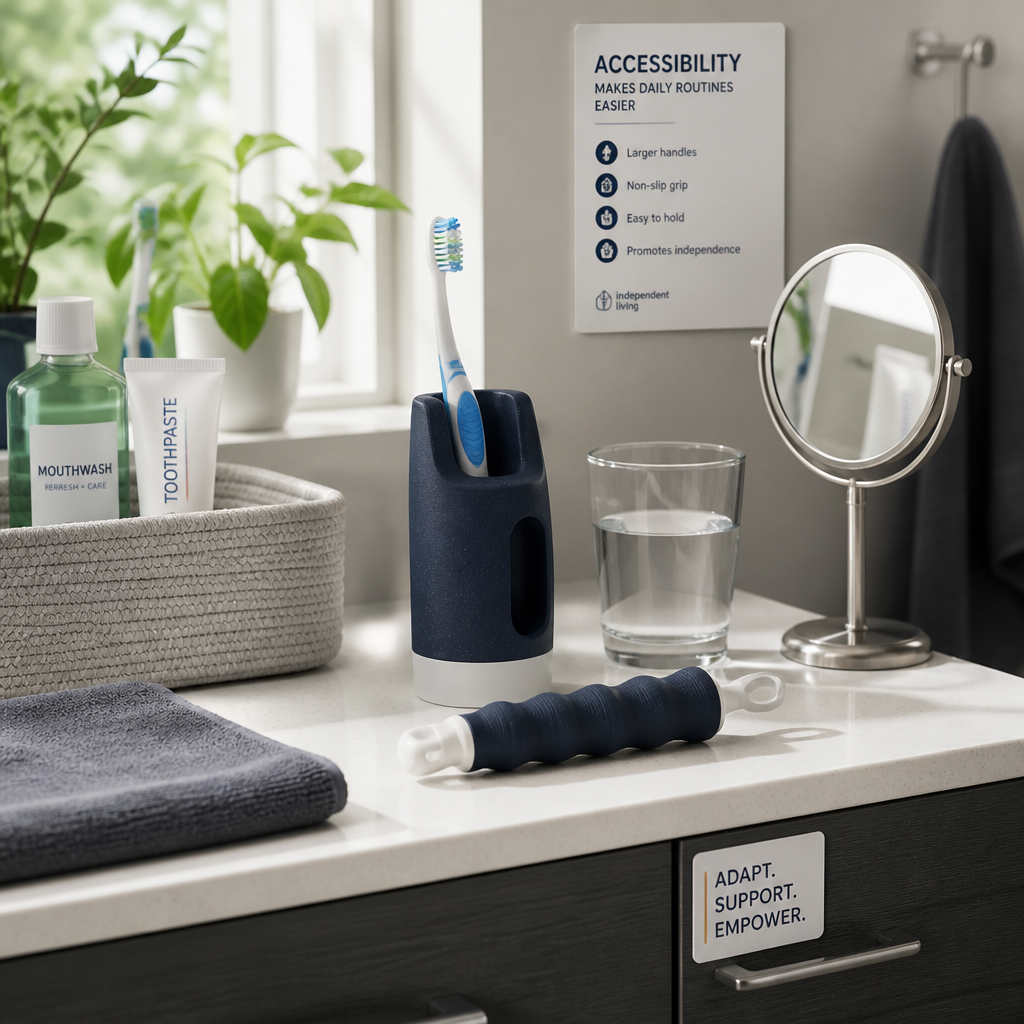
Hand tremor, reduced grip strength, and impaired coordination make it difficult to hold and manoeuvre a toothbrush accurately. People with these symptoms often apply uneven pressure or miss areas entirely. A built-up handle, achieved by sliding foam tubing over the brush handle or using a brush with a naturally wider grip, helps significantly. Some people find that wearing a weighted glove while brushing reduces tremor enough to improve control.
Sensory Changes in the Mouth
Numbness and altered sensation in the mouth and face mean that some people with MS genuinely cannot feel whether they are brushing effectively. They cannot gauge pressure or detect when the brush is positioned incorrectly. This is where using a toothbrush with very soft bristles becomes protective: it reduces the risk of inadvertently damaging gum tissue through uncontrolled pressure when sensation is unreliable.
Mood, Depression, and Motivation
Depression affects a large proportion of people living with MS. Depression directly reduces motivation to maintain self-care routines, including oral hygiene. This is not laziness or neglect. It is a documented clinical consequence of the condition. Dental and healthcare teams need to factor this in rather than defaulting to a lecture about brushing twice a day.
Oral health is part of overall health, and for people living with complex neurological conditions, the barriers to maintaining it are real, physical, and not resolved by generic advice. Adapting the tools, the timing, and the technique is what actually makes the difference.
Choosing the Right Toothbrush for MS
The right toothbrush for someone with MS depends on the specific symptoms most affecting their dexterity and comfort. There is no single correct answer, but there are clear principles that narrow down the options considerably.
Super Soft Bristles Are Not Optional
Super soft bristles are the starting point for almost everyone with MS, not a premium upgrade. When grip is unreliable, when tremor means pressure varies unpredictably, or when the gag reflex is heightened and brushing needs to be done quickly, firmer bristles cause more trauma. A super soft brush cleans effectively at lower pressure, which is exactly what someone with a weakened or uncontrolled grip needs.
The oraNurse super soft toothbrush has a small head designed to access all areas of the mouth, including the back molars, without requiring precise positioning. For people with limited mouth opening due to muscle spasm or TMJ involvement, a small-headed brush makes a substantial practical difference. It can be ordered from any pharmacy in the UK.
Electric Toothbrushes: Useful, But Not Universal
An electric toothbrush removes the need for the scrubbing motion, which helps when arm and wrist movement is limited. However, the vibration of an electric brush can be poorly tolerated by people with sensory hypersensitivity, can aggravate trigeminal neuralgia in some cases, and requires a degree of grip strength to handle safely. Electric brushes are a reasonable recommendation for many people with MS, but they are not the default answer for every person with every symptom profile.
Silicone Fingertip Toothbrushes for Severe Dexterity Loss
When dexterity is severely compromised, or when a caregiver is performing assisted toothbrushing, a silicone fingertip toothbrush can be genuinely useful. It gives the user or caregiver precise control without the unpredictability of a handled brush. The oraNurse silicone fingertip toothbrush is designed for exactly this context and is particularly practical in care settings where the person being cared for has significant physical limitations.
Pro tip: If electric toothbrush vibration is uncomfortable due to sensory sensitivity or trigeminal neuralgia, try a manual super soft brush first. Many people with MS find that the reduced sensory input of a soft manual brush, used seated with a supported arm, is more manageable and less painful than an electric option.
Toothpaste That Works with MS, Not Against It
Toothpaste seems like a minor detail. In practice, for people with MS, the wrong toothpaste can turn a manageable brushing routine into an ordeal that gets abandoned.
Why Strong Flavours Are a Real Problem
Mint flavours, particularly peppermint and spearmint, activate cold-sensing receptors in the mouth. For people with sensory processing differences or oral hypersensitivity, this creates an intense, disorienting sensation that shortens brushing time and can trigger a gag reflex. For someone already managing fatigue and coordination problems, a toothpaste that causes them to stop brushing early is actively making their oral health worse.
An unflavoured toothpaste removes this barrier entirely. There is no flavour to overwhelm the senses. Brushing can be completed at a pace that is dictated by the person’s needs, not by a need to get a strong taste out of their mouth quickly.
Foaming Agents and Nausea
Sodium lauryl sulphate (SLS), the detergent responsible for the foam in most standard toothpastes, is a known irritant. In a dry oral environment, which is extremely common among people with MS on multiple medications, SLS is significantly more irritating because reduced saliva cannot dilute and neutralise its effects. For people prone to nausea or who have a heightened gag reflex, a foaming toothpaste can cut brushing time dramatically or make toothbrushing genuinely aversive.
oraNurse unflavoured non-foaming toothpaste is SLS-free and produces no foam. Because the paste stays present on tooth surfaces throughout brushing rather than being swept away in foam, fluoride contact time with enamel actually increases. This is particularly important for people with MS who may be brushing for shorter periods than recommended.
Getting Fluoride Concentration Right
Adults and children over three should be using a 1450ppm fluoride toothpaste. oraNurse is available in both 1000ppm (recommended for children aged 0 to 3) and 1450ppm (recommended for children over 3 and adults). For people with MS-related dry mouth, the 1450ppm formula is the right choice. Reduced saliva means reduced natural enamel protection, so the fluoride in the toothpaste has to work harder. Using a lower-fluoride option when dry mouth is present is a missed opportunity for meaningful protection.
Pro tip: oraNurse toothpaste can be ordered from any pharmacy in the UK. You do not need a prescription. If you are supporting someone with MS in a care setting, it is also available through NHS supply chain for healthcare facilities, making it a practical option for institutional oral care protocols.
Managing Dry Mouth Caused by MS Medications
Dry mouth (xerostomia) is one of the most consequential oral health problems associated with MS, and it is largely driven by medication. Anticholinergic drugs, antidepressants, muscle relaxants, and some disease-modifying therapies all reduce saliva flow as a side effect. Research into the oral health of people with MS has consistently found dry mouth to be among the most frequently reported symptoms, identified by a substantial proportion of study participants.
Saliva is the mouth’s first line of defence against bacteria and acid. It neutralises the pH in the mouth after eating, washes away food debris, and provides minerals that support enamel remineralisation. Without adequate saliva, all of these protective mechanisms are compromised, and the risk of rapid tooth decay rises significantly.
Practical management of dry mouth includes sipping water frequently rather than large amounts at intervals, avoiding sugary or caffeinated drinks that worsen dryness, and choosing a toothpaste specifically formulated to be gentle in a dry oral environment. For people with MS experiencing significant dry mouth symptoms, Bioxtra products are worth discussing with a dental professional, as the range is specifically designed to support saliva function and provide lasting oral moisture relief.
A non-foaming, SLS-free toothpaste is particularly important for anyone with dry mouth. SLS is significantly more irritating when saliva is reduced. Switching to an SLS-free formula is one of the most immediately impactful changes a person with MS-related xerostomia can make to their daily routine.
Caregiver-Assisted Oral Hygiene
When MS progresses to the point where a person cannot manage independent toothbrushing, caregiver assistance becomes necessary. This is one of the most underserved areas in MS oral care guidance, and it creates real challenges for the caregivers involved.
Caregivers attempting to brush someone else’s teeth using a standard toothbrush often find it difficult to position the brush correctly, apply appropriate pressure, and reach all surfaces. They also face the challenge of the person’s potentially limited mouth opening, heightened gag reflex, or discomfort from sensory sensitivity.
A silicone fingertip toothbrush addresses the positioning problem directly. By fitting over the caregiver’s finger, it allows much more intuitive and controlled movement around the mouth. Pressure can be regulated more naturally because the caregiver can feel through the silicone what they are touching. For people with a heightened gag reflex or trigeminal sensitivity, this can feel noticeably less intrusive than a handled brush.
Pairing the fingertip brush with an unflavoured, non-foaming toothpaste is the practical combination for caregiver-assisted oral hygiene. The absence of strong flavour and foam means the person being cared for is less likely to gag or resist, which makes the process more effective and less distressing for everyone involved.
Healthcare professionals working in MS care, care homes, or NHS settings should include oral hygiene technique in caregiver training. The mouth is often the last thing covered in personal care protocols, but the consequences of neglecting it accumulate quickly.
Working With Your Dental Team When You Have MS
People with MS face a specific set of challenges when attending dental appointments that go beyond the oral health issues themselves. Limited mobility, fatigue from travelling, difficulty staying in a reclined position, a heightened gag reflex, and the stress of clinical environments can all make dental attendance harder and less frequent than it needs to be.
MS symptoms can also be confused with dental pathology. Facial pain from trigeminal neuralgia, altered sensation in the jaw, and muscle tightness affecting the temporomandibular joint can all present in ways that look like dental problems. A dentist who is not familiar with MS may investigate for dental causes before considering the neurological ones. This is worth flagging at appointments proactively.
Practical steps for dental appointments with MS include scheduling appointments at times of day when energy is highest, requesting a longer appointment to allow for rest breaks, asking in advance about accessible facilities, and telling the dental team which specific symptoms are most likely to affect the appointment. A dentist who knows about tremor, limited mouth opening, or trigeminal neuralgia can adapt their approach significantly.
For people who find conventional dental appointments very difficult, NHS dental care is available and some practices have enhanced facilities for patients with complex needs. It is always worth calling ahead rather than assuming a standard appointment will work.
Frequently Asked Questions
Can MS cause tooth decay directly?
MS does not cause tooth decay directly, but it creates conditions that make decay much more likely. Reduced immune function, dry mouth from medications, shorter or less effective brushing due to fatigue and dexterity problems, and dietary changes linked to difficulty cooking all combine to raise the risk substantially. Addressing each of these contributing factors systematically is more effective than simply telling someone with MS to brush more carefully.
What fluoride strength of toothpaste is right for adults with MS?
Adults with MS should use a 1450ppm fluoride toothpaste. The increased risk of decay, particularly when dry mouth from MS medications is a factor, means that lower-fluoride options are not appropriate for most adults in this group. oraNurse unflavoured non-foaming toothpaste is available at 1450ppm and can be ordered from any pharmacy without a prescription.
Is an electric toothbrush always better for people with MS?
Not always. Electric toothbrushes remove the need for scrubbing motion and can be helpful when arm movement is limited. However, the vibration can aggravate sensory hypersensitivity or trigeminal neuralgia in some people with MS. A super soft manual brush with a built-up handle, used while seated, is a better starting point for people with these sensory challenges. The right tool depends on which MS symptoms are most active for that individual.
Why does toothpaste flavour matter for people with MS?
Strong mint flavours activate cold-sensing receptors in the mouth. For people with MS-related oral sensory changes, this can produce an intense, overwhelming sensation that causes them to stop brushing early, spit frequently, or find the experience aversive enough to avoid altogether. An unflavoured toothpaste removes this trigger. For people with a heightened gag reflex, the absence of a strong flavour stimulus also reduces the likelihood of gagging during brushing.
How can I help someone with advanced MS maintain oral hygiene if they cannot brush independently?
A silicone fingertip toothbrush gives caregivers better positional control and more natural pressure regulation than a conventional handled brush. Pairing it with an unflavoured, non-foaming toothpaste reduces the risk of triggering a gag reflex in the person being cared for. Scheduling oral hygiene during the person’s most comfortable and cooperative time of day, keeping the session brief, and using gentle, predictable movements all improve compliance. If you are a healthcare professional, ask about specialist oral hygiene training for carers in MS care settings.
Does dry mouth from MS medication increase the need for fluoride?
Yes, significantly. Saliva naturally neutralises acid and provides minerals that protect enamel. When saliva is reduced by MS medications, enamel is more exposed to acid attack and the remineralisation process is impaired. Adequate fluoride in toothpaste becomes more important, not less, in this situation. Using the correct concentration consistently, twice daily, is one of the most effective steps a person with MS-related dry mouth can take to protect their teeth.
If you are living with MS or supporting someone who is, we would genuinely like to hear what oral care challenges matter most to you and which solutions have made a real difference in practice.
We would love your feedback and any insights you would share with others. What perspective would you add?
References
- MS Society UK: Oral health guidance for people living with multiple sclerosis
- MS Views and News: How MS can affect oral health, including dry mouth and gum symptoms
- Decisions in Dentistry: Oral health risks in patients with multiple sclerosis, a clinical overview
- PMC peer-reviewed scoping review: Barriers to dental care access for people with MS
- Penn Dental Medicine: Daily dental care tips and MS-specific considerations for patients and clinicians