

People with learning disabilities experience significantly poorer oral health than the general population, yet this gap is almost entirely preventable. The barriers are real, but they are not insurmountable. Challenging behaviour during brushing, refusal of toothpaste, gagging, and inability to rinse are daily realities for carers in supported living, residential, and community settings. What is missing from most oral care guides is specific, practical advice on oral health learning disabilities that actually accounts for those realities. This guide gives you exactly that: product choices, techniques, positioning strategies, and a clear rationale for every recommendation.
Table of Contents
- Quick Takeaways
- Why Oral Health Matters More in Learning Disability Settings
- Common Barriers Carers Face Every Day
- Choosing the Right Products for Assisted Oral Care
- Toothbrushing Techniques for Assisted Care
- Building Routine and Trust With Reluctant Individuals
- Fluoride Dosing: Getting It Right for Vulnerable Adults
- Working With Dental Teams and NHS Services
- Frequently Asked Questions
- References
Quick Takeaways
| Key Insight | Explanation |
|---|---|
| Challenging behaviour may signal dental pain | Untreated toothache or abscesses can manifest as distressed or aggressive behaviour. Always consider oral pain as a cause before attributing it to the disability itself. |
| Unflavoured, non-foaming toothpaste removes two of the biggest barriers at once | Mint flavour and foaming agents are the most common reasons for toothpaste refusal. Switching to an unflavoured non-foaming formulation is frequently the single most impactful change a carer can make. |
| Nearly 1 in 10 people with intellectual disabilities has dysphagia | This means an increased risk of choking or gagging during brushing. Positioning and product choice both need to account for this, not just technique. |
| Do not start with two minutes of brushing | If an individual tolerates five seconds today, that is the goal. Build from there. Ending sessions before distress peaks builds positive associations over time. |
| Adults need at least 1,350ppm fluoride toothpaste | Carers and individuals often choose the lowest available fluoride concentration, assuming it is safer. For most adults, this is counterproductive. NHS guidance is clear on the minimum effective dose. |
| Consistency across carers is as important as technique | If three different carers use three different products in three different sequences, the individual has no stable routine to adapt to. Standardise the approach across the whole team. |
| A sextant approach helps when full mouth brushing is not possible | Dividing the mouth into six sections and logging which areas were brushed each session ensures all surfaces are covered over time, even with a resistant individual. |
Why Oral Health Matters More in Learning Disability Settings
Adults with learning disabilities are more likely to have poorer oral health outcomes than the general population, and the consequences of poor oral hygiene in this group are more severe. Dental caries and periodontal (gum) disease are the two dominant oral diseases. Both are largely preventable. Both are also largely irreversible once established. That asymmetry means prevention is not just the best strategy; it is the only realistic one.
What makes learning disability settings distinct is not the diseases themselves, but the layers of difficulty that sit between an individual and effective daily oral care. Cognitive differences may affect understanding of why oral hygiene matters. Physical limitations may affect the ability to hold a brush or spit reliably. Sensory processing differences may make the experience of brushing genuinely distressing rather than mildly unpleasant. Add in high rates of medication use, many of which cause dry mouth and increase caries risk, and you have a population with compounding vulnerabilities.
There is also a specific and serious risk that gets underreported: the link between dental pain and behaviour. A person with a learning disability who cannot communicate pain reliably may instead show agitation, self-injurious behaviour, sleep disturbance, or changes in eating habits. These presentations are sometimes managed as behavioural issues for extended periods before anyone considers an oral health cause. This is not a hypothetical risk. It is a documented pattern that carers and healthcare professionals need to keep at the front of their minds.
Common Barriers Carers Face Every Day
Public Health England has identified multiple barriers to both good oral care and accessing dental services for people with learning disabilities. Understanding which barrier you are dealing with in any individual case determines which intervention is likely to help.
Physical Barriers
The physical barriers are concrete: inability to rinse reliably, difficulty getting a toothbrush into the mouth without triggering a gag reflex, reduced hand dexterity, and an oversensitive mouth. Research has documented that nearly 10% of people with intellectual disabilities have dysphagia, which increases the risk of choking or gagging during toothbrushing. This is not a minor inconvenience. It means standard toothpaste instructions, which assume spitting and rinsing, do not apply without modification.
Sensory Barriers
Sensory barriers are often invisible to carers who do not have sensory processing differences themselves. The four most commonly problematic triggers during oral hygiene are flavour, foam, brush texture, and smell. Mint, the dominant flavour in almost all commercial toothpastes, is a powerful oral stimulant. For many individuals with learning disabilities and associated sensory sensitivities, the cooling and burning sensation of mint is not refreshing. It is overwhelming. Foam from sodium lauryl sulphate compounds this, expanding inside the mouth in a way that many individuals find intolerable.
Systemic and Access Barriers
Beyond the individual, there are system-level barriers: no access to a regular dentist, complex referral pathways to specialist services, long waiting times, and dental environments that are not adapted for people with significant support needs. These factors mean that preventive daily care by carers is not supplementary to dental care. In many cases, it is the primary line of defence against tooth loss.
When an individual cannot communicate their pain verbally, the mouth is one of the first places a carer should look when behaviour changes unexpectedly. Oral pain presenting as challenging behaviour is not a rare event in learning disability services. It is a common one that is routinely missed.
Choosing the Right Products for Assisted Oral Care
Product selection for assisted oral care in learning disability settings is not about choosing the most popular product in the pharmacy aisle. It is about matching the product to the specific sensory and physical profile of the individual. Getting this wrong means the individual refuses, the routine breaks down, and oral health deteriorates. Getting it right means a predictable, tolerable routine that protects teeth and gums over the long term.
Toothpaste: Why Unflavoured Non-Foaming Formulations Are the Starting Point
For individuals with sensory sensitivities, switching to a completely unflavoured toothpaste is consistently the single most impactful change a carer can make. oraNurse unflavoured toothpaste contains no mint, no flavouring, and no sodium lauryl sulphate, removing two of the most potent oral sensory triggers simultaneously. Carers in residential settings report that this switch alone reduces distress during assisted toothbrushing and improves the thoroughness of the clean achieved.
oraNurse is available in multiple fluoride concentrations, including formulations suitable for children and adults, which means you can match the fluoride dose to the clinical need without compromising on tolerability. This matters because many carers who discover unflavoured toothpaste for the first time default to the lowest available concentration, assuming it is the safest choice. For most adults, the opposite is true.
Pro tip: If you are introducing unflavoured toothpaste to someone who has previously refused all toothpaste, start with a tiny, grain-of-rice-sized amount on the brush. The goal is acceptance of the product, not a full clean. Tolerance builds from there.
Toothbrush: Small Head, Super Soft Bristles
A toothbrush with a small head and super-soft bristles is consistently better for assisted care. A small head gives the carer more control when accessing posterior teeth in a person who cannot fully open their mouth or keep it open reliably. Super-soft bristles reduce pressure on tender gums and lower the chance of triggering a gag reflex at the back of the mouth. oraNurse super-soft toothbrushes are designed specifically with this in mind, offering the combination of small head size and bristle softness that most standard pharmacy toothbrushes do not provide.
Silicone Fingertip Brushes: The Starting Point for High Defensiveness
For individuals with strong oral defensiveness who will not accept any toothbrush, a silicone fingertip toothbrush offers a transitional tool. Used dry or with a minimal amount of unflavoured paste, it allows the carer to clean tooth surfaces and gum margins with more tactile control than a handled brush, reducing the surprise element that often triggers defensive responses. The silicone material is softer and less intrusive than nylon bristles, and the fingertip design gives the individual a clearer sense of where the carer’s hand is at all times.
The sequence for severe oral defensiveness is clear: start with a dry fingertip brush to establish basic tolerance, then introduce unflavoured paste in a tiny amount, then progress to a super-soft handled toothbrush as tolerance grows. This is not a quick process. It may take weeks or months. But it produces durable results because it respects the individual’s threshold rather than forcing them past it.
Comparison: Toothpaste Options for Learning Disability Care Settings
| Toothpaste Type | Sensory Suitability | Clinical Considerations for LD Settings |
|---|---|---|
| oraNurse Unflavoured Non-Foaming (available in multiple fluoride strengths) | Excellent. No mint, no SLS foam, neutral smell. Suitable for individuals with severe sensory sensitivities, dysphagia, or complete toothpaste refusal. | Available through NHS supply chain. Fluoride strength can be matched to clinical risk level. Non-foaming formulation safer for individuals who cannot spit reliably. |
| Standard flavoured fluoride toothpaste (most supermarket brands) | Poor for many LD individuals. Mint is a powerful oral stimulant. Foaming action causes distress in individuals with sensory sensitivities. | Often the reason brushing routines break down entirely. Not the right choice for individuals with known sensory sensitivities or oral defensiveness. |
| “Sensitive” or “gentle” commercial toothpastes | Variable. Many still contain mint and SLS. The “sensitive” label refers to tooth sensitivity, not sensory processing sensitivity. | Do not assume these are suitable. Always check the ingredient list for flavouring and SLS. Most will still trigger the same refusal responses as standard toothpaste. |
Toothbrushing Techniques for Assisted Care
Technique in assisted toothbrushing is about positioning, consistency, and pacing, not just the motion of the brush. Carers who approach assisted brushing as something to get through quickly tend to produce more resistance, not less. The individual’s nervous system needs time to adapt to each contact, and rushing past that adaptation window escalates distress.
Positioning the Individual and the Carer
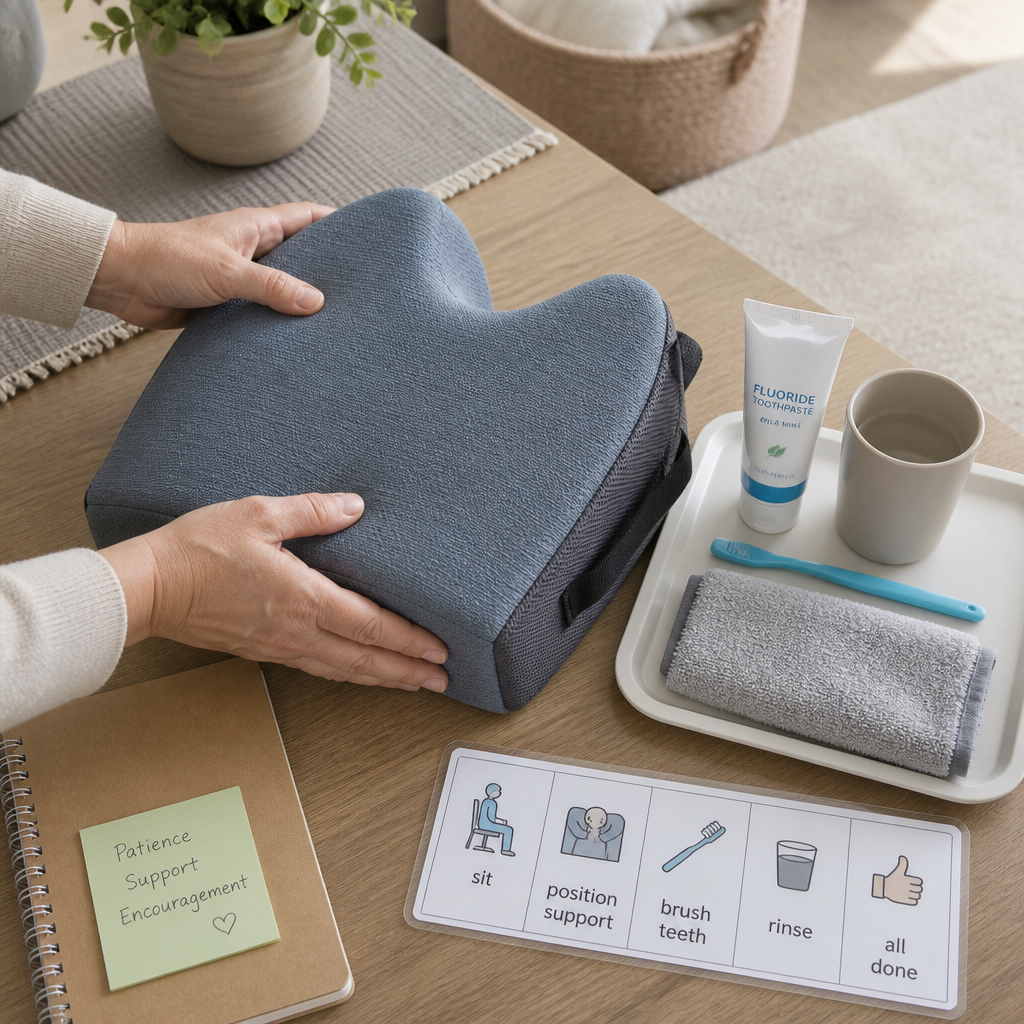
Standing behind the individual and supporting their head against your body gives you better visual access to the mouth and allows the person to relax their neck rather than holding their head up against the intrusion of a brush. For individuals who are seated in a wheelchair, a side approach with the chair reclined slightly, if possible, can open the mouth more naturally. For individuals with significant physical support needs, a two-person approach, one supporting the head and body, one brushing, may be necessary.
Sequencing and Tracking with a Sextant Chart
If full mouth brushing is not achievable in a single session due to resistance or fatigue, divide the mouth into six sections: upper right, upper front, upper left, lower right, lower front, lower left. Keep a simple laminated chart in the bathroom that all carers can mark after each session. This ensures that no area of the mouth is chronically missed, even when brushing time is limited. This approach is used by specialist oral health practitioners working with this population, and it is directly transferable to any care setting.
Pro tip: Always start brushing at the front of the mouth rather than the back. For individuals prone to gagging, starting at the back instantly triggers the reflex and ends the session. Starting at the front builds tolerance before working further back over time.
Do Not Instruct Rinsing
Standard toothbrushing advice includes spitting and rinsing. For many individuals with learning disabilities, rinsing is either not possible or results in swallowing rinse water, which dilutes the fluoride before it has acted on enamel. The correct approach is to spit without rinsing, or for individuals who cannot spit, to use a non-foaming toothpaste with a very small amount and allow natural saliva to clear it. This is especially relevant for unflavoured non-foaming formulations, which are designed to be used in exactly this way.
Building Routine and Trust With Reluctant Individuals
Routine is not rigidity. For individuals with learning disabilities, particularly those with autism spectrum conditions, a consistent oral hygiene routine is itself a therapeutic intervention, not just a hygiene task. When the same carer uses the same products in the same sequence at the same time each day, the individual’s nervous system stops treating the routine as an unpredictable event. That shift, from unpredictable to expected, is what makes sustained oral care possible.
Changing One Variable at a Time
If brushing is not going well, do not change the toothpaste, the brush, and the timing simultaneously. Identify which specific trigger is causing the most distress. Observe carefully and test one change at a time. If you change everything at once, you have no way of knowing what worked. The four most commonly problematic triggers are flavour, foam, brush texture, and smell. Start with flavour and foam by switching to an unflavoured non-foaming paste. If that improves acceptance, you have your answer. Then, if needed, address brush texture by moving to a super-soft or silicone option.
Keeping Supplies Consistent
A common and costly mistake is changing the toothpaste when a supply runs low. For individuals who have adapted to a specific unflavoured product, introducing a different brand, even another unflavoured one, can reset weeks of progress. Keep a reliable stock of the same formulation. This is straightforward for care settings with NHS supply chain access, where oraNurse products can be ordered consistently and reliably as part of standard supplies.
Incremental Tolerance Building
If an individual currently tolerates zero seconds of brushing, the goal is not two minutes. The goal is five seconds without distress, then ten, then fifteen. Each session that ends before the distress peak builds a more positive association than any session that pushes through resistance. This approach takes patience, and it requires every carer involved with an individual to understand and commit to the same incremental strategy rather than reverting to force when time is short.
Fluoride Dosing: Getting It Right for Vulnerable Adults
Fluoride concentration is one of the most frequently mishandled aspects of oral care in learning disability settings. The pattern is predictable: a carer discovers unflavoured toothpaste, which is a genuinely good decision, but then selects the lowest available fluoride concentration on the assumption that lower concentration means safer. For most adults, this assumption is wrong.
According to NHS Delivering Better Oral Health guidance, adults who brush twice daily should use a toothpaste containing at least 1,350ppm fluoride. oraNurse is available in formulations covering this range, including strengths suitable for younger children where a lower concentration is clinically indicated.
The practical implication for carers is this: when you are choosing an unflavoured toothpaste for an adult in your care, check the fluoride concentration on the label and confirm it meets the threshold for the individual’s age and risk profile. Do not choose by label design or by default. If you are unsure, ask the individual’s dentist or community dental service to specify the correct strength in the individual’s oral health care plan. That plan should also document the brushing routine, product choices, and any adaptations used, so that every carer has the same information.
Pro tip: In care home and supported living settings, keep a copy of each individual’s oral health care plan visible in their bathroom alongside their toothbrush and toothpaste. A plan that sits in a folder is not accessible to a night-shift carer who has never met the resident before. Make it a physical, visible part of the routine.
Working With Dental Teams and NHS Services
The NHS Long Term Plan includes a commitment to provide oral health checks for autistic children and young people and those with a learning disability as part of general screening, recognising that access to dental care for this population must be a deliberate priority, not an afterthought. Around 440,000 autistic children and young people and those with a learning disability are in England alone. Provision has not kept pace with that scale of need.
For carers, the practical reality is that specialist dental services have long waiting times and complex referral routes. This makes the daily care that carers provide genuinely critical, not supplementary. At the same time, carers should not work in isolation from dental teams. At minimum, each individual in your care should have a documented oral health care plan, ideally developed in consultation with a community dental service, that specifies appropriate products, techniques, and frequency of professional review.
What to Request From a Dental Assessment
When an individual you support does access dental services, be specific about what you need from that appointment. Ask for written guidance on the correct fluoride concentration for the individual. Ask for a recommendation on brush type and any specific technique adaptations. Ask whether a recall interval more frequent than standard is appropriate given the individual’s caries risk. And document what the dental team recommends so that it is available to every carer, not just the one who attended the appointment.
Recognising Dental Pain in Non-Verbal Individuals
Carers working with non-verbal or minimally verbal individuals carry a particular responsibility to recognise the signs of dental pain. These include changes in eating habits, particularly avoidance of one side of the mouth, increased dribbling, facial swelling, holding or touching the face, disturbed sleep, and escalation of self-injurious or agitated behaviour without another clear cause. Any of these signs warrants an urgent dental assessment. An undetected abscess is not a minor dental problem. It is a serious health event that carries risks beyond the mouth if left untreated.
Frequently Asked Questions
What toothpaste is best for someone with a learning disability who refuses to brush?
Start by removing the most common sensory triggers: mint flavour and foam. Switch to an unflavoured, non-foaming toothpaste such as oraNurse. This alone often produces an immediate improvement in acceptance. If the individual refuses toothpaste entirely, start with a dry silicone fingertip brush to build tolerance of the sensation of brushing before reintroducing toothpaste in very small amounts.
Is it safe for an individual with dysphagia to use toothpaste if they cannot spit?
Yes, with the right product and approach. Use a non-foaming toothpaste in a very small amount, around a grain-of-rice size, and do not instruct rinsing. Non-foaming formulations are designed for exactly this situation. For higher-risk cases, consult the individual’s speech and language therapist and dentist to confirm the approach is safe given their specific swallowing profile.
How do I get other carers in my team to follow the same oral health routine?
Document the routine in the individual’s care plan and make the written guidance physically present in the bathroom alongside the products. Use the same products consistently and keep a spare supply so that no carer is forced to improvise when stocks run low. A sextant chart on the bathroom wall, showing which areas of the mouth were cleaned in the last session, gives any carer picking up the routine a clear starting point.
How often should someone with a learning disability see a dentist?
This depends on the individual’s caries risk and oral health history, and should be determined by a dentist who knows the person. Many people with learning disabilities are at higher caries risk due to medication-induced dry mouth, limited ability to brush consistently, and diet factors. For high-risk individuals, more frequent review than the standard interval is usually appropriate. Ask the dental team to specify a recall interval in the individual’s oral health care plan.
Can unflavoured toothpaste still protect against tooth decay?
Absolutely. Flavour has nothing to do with cavity protection. What matters is fluoride concentration. oraNurse unflavoured toothpaste contains the same levels of fluoride as standard toothpaste, available in concentrations appropriate for children and adults. The key is to confirm you are using the correct concentration for the individual’s age and risk level, as described in NHS Delivering Better Oral Health guidance.
What should I do if someone in my care shows signs of dental pain but cannot express it verbally?
Take it seriously and act quickly. Signs to watch for include facial swelling, avoiding food on one side of the mouth, disturbed sleep, touching or rubbing the face, and unexplained escalation in distressed behaviour. Do not wait for a routine dental appointment if you suspect acute pain or infection. Contact the individual’s dentist or community dental service directly and describe the symptoms. Facial swelling in particular warrants same-day contact, as it may indicate an abscess requiring urgent treatment.
References
- Learning Disability Today: oral health barriers, clinical approaches, and the link between dental pain and behaviour change
- Cochrane systematic review on oral hygiene interventions for people with intellectual disabilities, including dysphagia prevalence and carer-identified barriers
- Public Health England report on oral health inequalities, including barriers for people with learning disabilities and the role of carer support
- NHS England clinical standard for oral healthcare for autistic children and young people and those with a learning disability in special educational settings
- Scottish Learning Disabilities Observatory research on the prevalence of tooth loss in adults with learning disabilities and the impact of personalised oral care