

Most people pick a toothbrush based on how it looks on the shelf. They grab what is familiar, a medium-sized head, medium bristles, a colour they like, and assume the job is done. For a large portion of the population, including children, older adults, post-surgical patients, and anyone with oral sensitivity, that assumption leads to years of inadequate brushing, avoidable gum trauma, and mounting dental problems. A small headed toothbrush is not a niche product or a novelty. It is a clinically sensible tool that fits more mouths more effectively than the oversized brushes that dominate supermarket shelves, and understanding why requires a closer look at what brush head size actually does inside the mouth.
Table of Contents
- Why Toothbrush Head Size Matters More Than You Think
- The Core Benefits of a Small Headed Toothbrush
- Super Soft Bristles and Head Size: Why They Work Together
- Oral Care for Vulnerable Patients: Where Head Size Becomes Critical
- Comparing Toothbrush Types for Special Oral Care Needs
- How to Choose the Right Brush Head for Your Needs or Your Patient’s
- Frequently Asked Questions
- References
Why Toothbrush Head Size Matters More Than You Think
The back molars are consistently the worst-cleaned teeth in the mouth. Research on plaque distribution has shown repeatedly that plaque and gingival inflammation scores are highest at the rearmost molars compared to anterior teeth, and the primary reason is access. A large brush head physically cannot pivot and angle into the distal surfaces of second and third molars without the handle pressing awkwardly against the cheek or jaw.
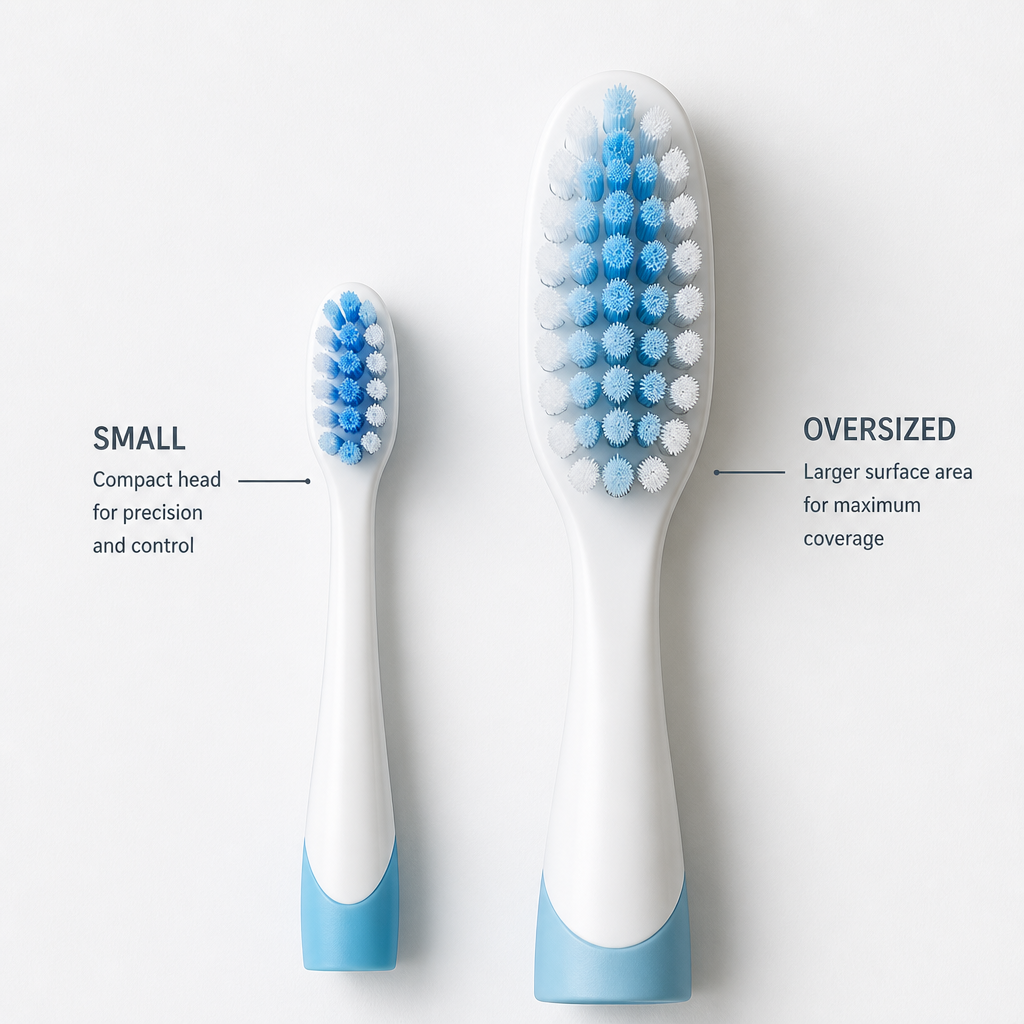
A published in vitro study testing eight manual toothbrushes using a validated robot test on replicated human teeth found that plaque removal was significantly better with a smaller head size (compact versus full-size), confirming what many dental hygienists already observe in practice: smaller heads reach more of the tooth surface, not less. The logic is counterintuitive to consumers who assume bigger equals more thorough, but the reality is that maneuverability determines coverage, not surface area.
Toothbrush head size also affects how a brush feels for users with small mouths, restricted mouth opening, or oral sensitivity. A large head triggers a gag reflex in a significant number of patients, making brushing a genuinely unpleasant experience. When brushing is unpleasant, compliance drops, and compliance is the only metric that actually matters for long-term oral health outcomes.
The Core Benefits of a Small Headed Toothbrush
Better Access to Posterior Teeth
The distal surfaces of second molars are notoriously difficult to reach with a standard-sized brush. A compact head can be angled to address these surfaces without the user contorting their mouth unnaturally. In practice, patients who switch to a small-headed brush often report feeling plaque being removed from areas that previously felt untouched.
This is especially relevant for patients with crowded dentition, dental implants, orthodontic appliances, or bridgework. Each of these creates irregular surfaces that demand a brush head precise enough to navigate around them. A full-sized head overshoots these areas and leaves debris behind.
Reduced Gag Reflex and Sensory Discomfort
A small head reduces both the physical bulk in the mouth and the sensory input at the posterior pharynx. This is not a minor comfort issue. For patients with autism spectrum conditions, dementia, significant anxiety, or previous trauma associated with dental procedures, gag reflex and sensory overload are genuine barriers to daily brushing. Reducing the physical stimulus of the brush head is a measurable, practical intervention.
For patients with extreme oral sensitivity or intolerance, a silicone fingertip toothbrush offers an even smaller contact surface with no rigid handle extending into the oral cavity, making it a useful transitional tool before progressing to a bristled brush.
Precision Around Healing and Sensitive Tissue
After periodontal surgery, tooth extraction, or other oral procedures, specific areas require careful cleaning without disturbing adjacent healing tissue. A small headed toothbrush allows the user or caregiver to brush adjacent areas precisely without accidentally traumatising the healing tissue. A large head makes this kind of targeted brushing nearly impossible.
Toothbrush abrasion is a significant contributor to non-carious cervical lesions, and bristle stiffness combined with brushing force are the primary modifiable factors. Choosing a brush whose design minimises unintended force application is therefore a clinical priority, not just a comfort preference.
Super Soft Bristles and Head Size: Why They Work Together
Head size and bristle stiffness are two separate variables, but for patients with sensitive or compromised gums, they must be addressed together. A small head with medium or hard bristles still delivers concentrated mechanical force to vulnerable tissue. The combination of a compact head and super soft bristles is what produces genuinely gentle, effective cleaning for sensitive patients.
What Super Soft Bristles Actually Do
Ultra-soft or super soft bristles apply significantly less mechanical force per stroke, reducing the risk of further abrasion to inflamed, receding, or post-surgical gum tissue. This is specifically the design intent for patients recovering from periodontal treatment or living with diagnosed gum sensitivity. The clinical literature consistently recommends softer bristles for these populations, with harder bristles associated with higher rates of gingival recession and abrasion.
The concern that softer bristles remove less plaque is worth addressing directly. Peer-reviewed research comparing toothbrush parameters found that brushes with softer filaments and longer cutting height showed greater simulated plaque removal compared to shorter, harder bristles in a larger head. The data does not support the assumption that firmness improves cleaning. What firmness does is increase the risk of tissue damage without a proportional benefit in plaque removal.
Bristle Diameter Matters Too
Beyond the broad categories of soft, medium, and hard, filament diameter is a more precise indicator of how a brush interacts with tissue. Finer filament diameters allow the bristle tips to flex into the gingival sulcus and interproximal spaces without applying damaging lateral force to the gum margin. This is the engineering principle behind super soft toothbrush designs built for genuinely sensitive patients, not just rebranded standard brushes with a “gentle” label.
Pro tip: If a patient describes brushing as painful or regularly notices bleeding gums, switching to a genuinely super soft bristle grade combined with a compact head is the first adjustment to make before exploring any other cause. Most so-called “soft” brushes from major supermarket brands still sit at a firmness level that can cause trauma in sensitive patients.
Oral Care for Vulnerable Patients: Where Head Size Becomes Critical
The term “vulnerable patients” in oral care covers a broad group: older adults in care settings, individuals with physical or cognitive disabilities, patients undergoing cancer treatment, people with autism or sensory processing conditions, and those with dementia who may have lost the ability to brush independently. For all of these groups, the toothbrush is not just an oral hygiene tool. It is the primary line of defence against preventable disease.
NICE guidance on oral health in care homes specifically addresses the need for appropriate oral hygiene equipment supply, including the obligation to accommodate residents who refuse oral health care and to implement policies aligned with NHS oral health frameworks. In this context, the choice of toothbrush is a care decision, not a consumer preference, and a brush that triggers distress or is too large to use safely can directly undermine a resident’s oral health outcomes.
Caregiver-Assisted Brushing
When a carer rather than the patient holds the brush, control and precision matter even more. A small head gives the caregiver more visibility of where the brush is positioned and reduces the risk of accidentally pressing against soft tissue, the cheek, the tongue, or the alveolar ridge in edentulous areas. For patients with limited mouth opening, a compact head may be the only option that physically fits.
NHS Supply Chain Considerations
In NHS special care dental contexts, recommending a product only works if that product can actually be ordered through the channels available to the facility. This is a structural barrier that generic dental advice consistently overlooks. Working with a supplier who is accessible through NHS procurement channels removes a practical obstacle to implementing better oral care at scale. Healthcare professionals who share product recommendations via social media should also recognise that their audience may be purchasing independently. Naming the specific head size and bristle grade is more useful than vague guidance to “use a soft toothbrush.”
Pro tip: For carers assisting with oral hygiene for patients with dementia or significant cognitive impairment, using a small-headed toothbrush with super soft bristles alongside an unflavoured, non-foaming toothpaste reduces the number of sensory triggers simultaneously. Reducing the sensory load of brushing increases the likelihood of completing a full clean without distress.
Comparing Toothbrush Types for Special Oral Care Needs
Not every brush marketed as suitable for sensitive patients delivers what the label implies. The table below compares the three main brush types relevant to patients with oral sensitivity or complex care needs, based on practical design characteristics rather than brand positioning.
| Toothbrush Type | Best Use Case | Key Limitation |
|---|---|---|
| Small headed manual brush with super soft bristles (e.g., oraNurse super soft) | Daily oral hygiene for sensitive gums, post-surgical care, vulnerable adults, children, and anyone with restricted mouth opening. Provides the best combination of precision and plaque removal for these populations. | Requires correct brushing technique. Compliance depends on the patient or carer applying consistent, gentle pressure rather than scrubbing. |
| Standard adult manual brush (medium head, soft-medium bristles) | Healthy adults with no gum sensitivity, full dentition, and adequate dexterity. Widely available and sufficient for low-risk patients. | Head too large to access distal molars effectively in many mouths. Bristle firmness inadequate for post-surgical or sensitivity-driven oral care needs. |
| Silicone fingertip toothbrush (e.g., oraNurse fingertip brush) | Very young children, patients who completely resist a standard bristled brush, or as an introduction to oral care for highly sensitive individuals. Useful as a transitional tool. | Does not deliver the same level of plaque removal as a bristled nylon brush. Should not be used as a permanent replacement for patients capable of tolerating a bristled brush. |
How to Choose the Right Brush Head for Your Needs or Your Patient’s
The decision framework is more straightforward than it might appear. Start with the patient’s specific barriers to effective brushing and work backwards to the product specification that removes those barriers. The most common barriers are: physical access to posterior teeth, oral sensitivity or gag reflex, post-surgical tenderness, and carer-assisted brushing with limited visibility.
For Patients with Sensitive Gums or Recession
Choose a small-headed brush with verifiably super soft bristle grade, not a brush simply labelled “gentle.” The bristle tips should be end-rounded to prevent abrasion at the gum margin. Use it alongside a toothpaste that does not compound the sensory issue: strong mint flavours, high-foam formulations, and certain flavouring agents are as much of a barrier to brushing compliance as the brush design itself.
An unflavoured, non-foaming toothpaste formulated at an appropriate fluoride strength pairs most effectively with a sensitivity-focused brush, removing the flavour and texture triggers that many sensitive patients associate with discomfort. This is not a minor detail. When the entire brushing experience is calibrated for tolerance, compliance increases and oral health outcomes follow.
For Children
A child’s mouth is smaller, their manual dexterity is developing, and their tolerance for brushing is limited. A small-headed toothbrush is the appropriate standard for children, not a special-needs product. The head should comfortably fit within the child’s arch without the parent needing to force the jaw open wider than is comfortable. Bristles should be soft. The handle should be easy for a child or parent to hold securely.
For Older Adults in Residential Settings
Gum recession, reduced manual dexterity, dry mouth, and the presence of bridges, implants, or partial dentures make this group particularly reliant on a brush that is both small enough to navigate complex dentition and gentle enough to avoid trauma to fragile tissue. Caregiver training on correct technique is as important as product selection, and the two should be communicated together.
Pro tip: When recommending a small headed toothbrush to a patient or carer via social media or patient education materials, specify the fluoride strength of the toothpaste alongside the brush recommendation. Fluoride dosage guidance varies by age and clinical risk, and a complete recommendation reduces the likelihood of the patient making an error at the point of purchase.
Frequently Asked Questions
Is a small headed toothbrush better for everyone, or only for certain patients?
A smaller head is a better default choice for the majority of adults and children. The main exception is someone with an unusually large oral cavity who finds a compact head requires excessive strokes to cover all surfaces. For the general population and for anyone with sensitivity, restricted mouth opening, complex dentition, or care needs, a small headed toothbrush outperforms a standard-sized one on access and comfort. The assumption that a larger head cleans more is not supported by the clinical evidence on plaque removal.
What is the difference between soft and super soft bristles, and does it matter?
It matters considerably for sensitive and vulnerable patients. Standard “soft” bristles from most commercial brands still sit at a firmness level that can cause gingival trauma in patients with recession, post-surgical tissue, or inflammatory gum conditions. Super soft or ultra-soft bristles are specifically engineered to apply less mechanical force per stroke. They are not simply a rebrand of standard soft, and for the patient populations who need them, the distinction is clinically significant.
Can a small headed toothbrush still remove plaque effectively?
Yes. In vitro research comparing compact and full-sized brush heads found that smaller heads produced significantly better plaque removal across buccal, lingual, and proximal tooth sites. The improved access to posterior and interproximal areas outweighs any theoretical disadvantage in surface coverage per stroke. Plaque removal is a function of how well the bristles contact every surface, not how large a single sweep covers.
What toothpaste should be used with a small headed super soft toothbrush for a sensitive patient?
For patients choosing a small-headed brush because of oral sensitivity, toothpaste selection matters as much as brush selection. Strong mint flavours, high-foam formulations, and certain flavouring agents can be significant barriers to brushing compliance. An unflavoured, non-foaming toothpaste formulated at an appropriate fluoride strength removes the sensory triggers associated with standard toothpaste. The fluoride strength should reflect the patient’s age and clinical risk, which a dental professional can advise on directly.
How should a caregiver use a small headed toothbrush to assist a patient?
Stand to the side or slightly behind the patient rather than directly in front. Use a small headed brush with super soft bristles, and hold the handle between the thumb and forefinger rather than in a full fist grip. Apply light, circular or bass-technique strokes. The small head gives the caregiver better visibility of each surface being cleaned and reduces the risk of pressing accidentally against soft tissue. For patients with very limited mouth opening or resistance to brushing, a silicone fingertip brush may be a more practical starting point.
Are small headed toothbrushes available through NHS supply channels?
Yes, and this is an important practical consideration for healthcare settings. oraNurse works with NHS supply chain partners specifically to ensure that small headed and super soft toothbrush options are accessible to care homes, special care dental teams, and other NHS facilities. If you are in a care setting and unsure how to order, contacting the supplier directly to confirm procurement options saves time and removes a common barrier to better oral care provision.
References
- Peer-reviewed in vitro study on toothbrush head size, filament characteristics, and plaque removal efficacy across multiple tooth surfaces
- Crossover randomised clinical trial examining ultra-soft toothbrush bristles, gingival recession risk, and plaque and bleeding indices
- NICE guideline NG48: Oral health for adults in care homes, covering toothbrush provision, daily mouth care, and duty of care obligations
- oraNurse guide to small headed toothbrush benefits and which patients benefit most from compact brush head design
- oraNurse clinical guide on why a smaller toothbrush head is the better choice for patients with special oral care needs