

When a patient leaves your chair with bleeding gums, receding tissue, or toothbrush abrasion, the instrument in their bathroom is often part of the problem. The debate around super soft toothbrush bristles versus standard soft or medium options is not academic – it directly affects patient compliance, tissue health, and long-term outcomes. And yet far too many healthcare professionals still hand out medium-bristle brushes without a second thought, or leave patients to choose whatever is cheapest on the supermarket shelf. This guide cuts through the noise and tells you what the evidence supports, what patients actually need, and where super soft bristles make a genuine clinical difference.
Table of Contents
- Quick Takeaways
- Understanding Bristle Classifications
- The Case for Super Soft Bristles
- Who Genuinely Needs a Super Soft Toothbrush?
- Soft vs Medium Toothbrush: What the Evidence Actually Says
- Comparison Table: Super Soft vs Soft vs Medium Bristles
- Design Details That Matter Beyond Bristle Softness
- Frequently Asked Questions
- References
Quick Takeaways
| Key Insight | Explanation |
|---|---|
| Hard and medium bristles increase gum recession risk | Studies show that harder bristles cause more gingival lesions and accelerate recession compared to soft and super soft options. |
| Super soft bristles are specifically indicated post-surgery | Patients who have undergone periodontal surgery, or who present with active recession and dentinal hypersensitivity, are primary candidates for ultra-soft bristles. |
| Plaque removal is still achievable with super soft bristles | Softer bristles flex more against the tooth surface, allowing effective cleaning when correct technique is used – the brush does not need to be firm to be effective. |
| Bristle softness alone does not prevent abrasion | Brushing pressure, technique, and toothpaste abrasivity all contribute to tooth and gum damage. Bristle type is one part of the picture, not the whole solution. |
| Most dental professionals recommend soft over medium for daily use | Standard soft bristles suit the majority of patients; super soft bristles are the right step up for vulnerable groups, not just a marketing category. |
| Small-head brush design improves access in fragile mouths | A small brush head combined with super soft bristles allows better access around compromised tissue, orthodontic appliances, and posterior teeth. |
| End-rounded bristles reduce microtrauma to the gingival margin | Bristles with rounded tips cause less tissue trauma than cut or frayed ends, making them the preferred finish for sensitive and vulnerable patients. |
Understanding Bristle Classifications
Toothbrush bristles are categorised by the thickness and flexibility of the individual fibres used to make them. There are three broad types you will encounter: soft, medium, and hard. Super soft or ultra-soft sits at the gentler end of the soft spectrum, with finer fibres that flex readily against the gingival tissue and tooth surface. Medium bristles are noticeably thicker and stiffer. Hard bristles are the stiffest option and are rarely recommended by any dental professional in modern practice.
The distinction between standard soft and super soft matters because the variance in fibre diameter directly affects how much lateral force is transferred to the gum margin during brushing. Thinner fibres deflect more easily, which means less abrasive contact per stroke – a meaningful difference for patients who already have compromised tissue.
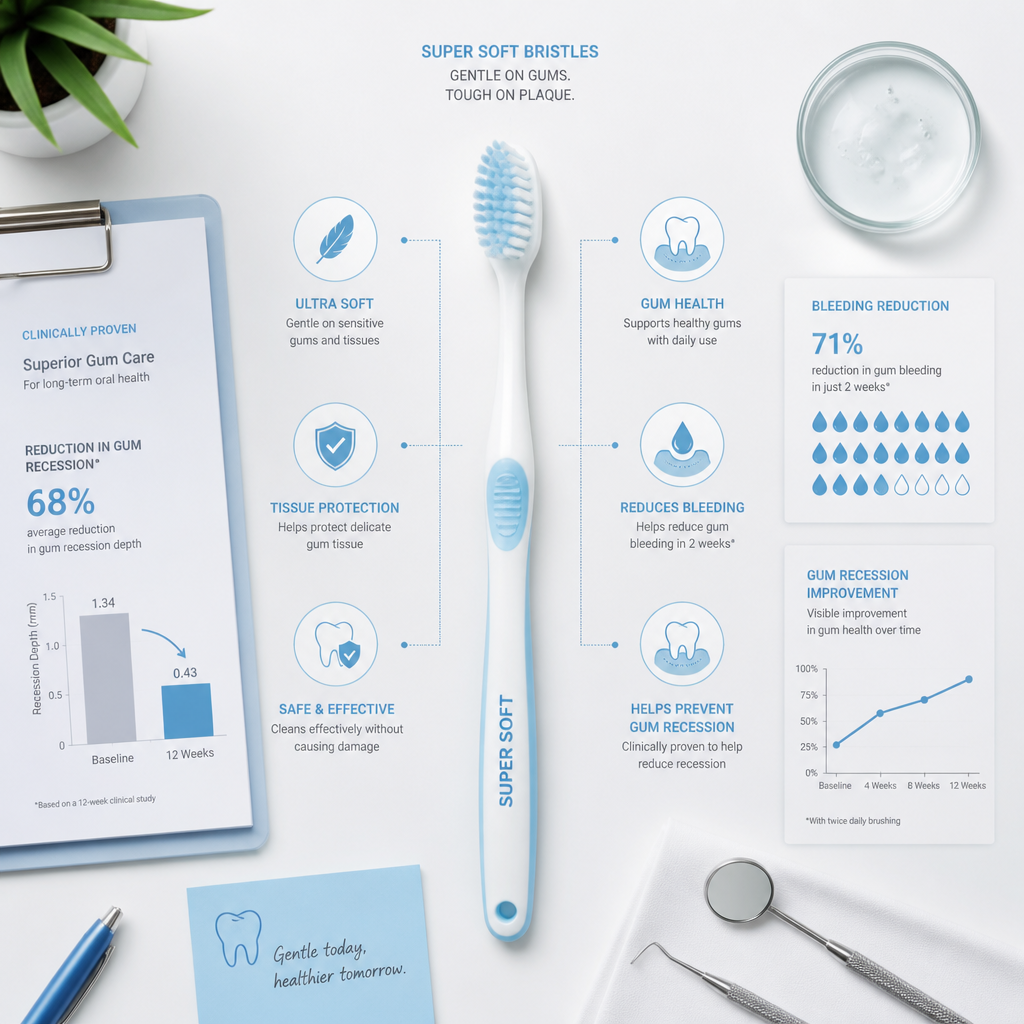
A common mistake in clinical settings is treating all soft toothbrushes as equivalent. They are not. The density of the bristle tufts, the length of the fibres, and whether the tips are end-rounded all vary between products sold as “soft.” This is why recommending a specific brush by name – rather than just saying “use a soft toothbrush” – tends to produce better patient outcomes.
Pro tip: When counselling patients on brush selection, ask them to bring their current toothbrush to their next appointment. Most people are surprised to discover they have been using a medium-bristle brush, or that their brush is overdue for replacement and the frayed bristles are causing micro-abrasion they had attributed to sensitivity.
The Case for Super Soft Bristles
The clinical rationale for super soft toothbrush bristles rests on a clear body of evidence linking bristle stiffness to tissue damage. Toothbrushes with hard bristles cause more gum recession compared to those with soft bristles, and harder bristle toothbrushes produce more gingival lesions than soft and medium options. If that is true of standard soft versus hard, the logic extends further: for patients at the vulnerable end of the spectrum, moving from standard soft to super soft provides an additional margin of safety without sacrificing cleaning function.
Ultra-soft bristles are specifically recommended for individuals with gingival recession, dentinal hypersensitivity, and patients who have undergone periodontal surgeries. These are not fringe cases in a typical practice – they represent a significant proportion of adult patients. Anyone with active recession, anyone mid-recovery from a gum procedure, and any patient who reports that brushing is painful all have a legitimate clinical reason to be using a super soft brush.
The toothbrush that causes no discomfort is the toothbrush the patient will actually use consistently. Compliance is a clinical outcome in its own right.
There is a persistent assumption in dentistry that softer bristles mean less effective plaque removal. The evidence does not straightforwardly support this. Softer bristles flex against the tooth surface and into the gingival margin, and when correct technique is applied, they can disrupt biofilm effectively. The variable that matters most is whether the patient is actually brushing – and patients with sore or fragile gums are far more likely to avoid or rush brushing if their brush is causing pain.
Who Genuinely Needs a Super Soft Toothbrush?
Not every patient needs a super soft toothbrush, but the groups who do are specific and identifiable in any practice. Matching the right tool to the right patient is the professional’s job, and knowing who qualifies matters.
Patients with Active Gingival Recession or Periodontal Disease
For anyone with exposed root surfaces or active gingival recession, a standard soft brush can still create enough frictional force to worsen an already compromised margin. Super soft bristles reduce that mechanical load. These patients also frequently have dentinal hypersensitivity, which means discomfort during brushing compounds the problem and drives avoidance behaviour.
Post-Surgical and Post-Treatment Patients
Patients recovering from periodontal surgery, implant placement, or any procedure involving gingival tissue need a brush that cleans without disturbing sutured or healing areas. A super soft brush with a small head is the practical choice here. The small head allows targeted cleaning around specific sites without inadvertently contacting adjacent healing tissue.
Patients with Oral Mucositis or Dry Mouth
In oncology settings, care homes, and hospital wards, patients on chemotherapy or radiotherapy frequently develop oral mucositis – painful inflammation of the oral mucosa that makes any brushing contact deeply uncomfortable. These are also some of the patients most at risk of oral infection, which means maintaining oral hygiene is critical even while the tissue is vulnerable. A super soft toothbrush is not a luxury in this context; it is the only instrument that allows brushing to continue safely.
Paediatric and Elderly Patients
Children have thinner, more permeable gingival tissue than adults. Elderly patients frequently present with generalised recession and reduced salivary flow, which means tissue that is already compromised and less buffered against abrasion. In both groups, super soft bristles reduce the risk of causing damage that standard brushing would produce in a healthier adult mouth.
Patients Who Brush Too Hard
Many patients report using significant pressure during brushing because they associate the scrubbing sensation with cleanliness. In practice, brushing pressure is one of the primary drivers of gum recession and tooth abrasion alongside bristle stiffness. Switching these patients to super soft bristles reduces the damage they do during the transitional period while you work on correcting their technique.
Soft vs Medium Toothbrush: What the Evidence Actually Says
The soft vs medium toothbrush comparison resolves fairly clearly in the clinical literature. Dental professionals and major dental associations recommend soft-bristled toothbrushes for most people. The reasons are straightforward: soft bristles are gentle enough to avoid damaging tooth enamel and gum tissue while still removing plaque effectively. Medium bristles offer a stronger brushing sensation, but that sensation is not a sign of superior cleaning – it is often a sign of more force being applied to tissue that does not benefit from it.
Abrasion is multi-factorial. Improper brushing technique, frequent brushing with too much pressure, bristle design or stiffness, and the abrasiveness of the toothpaste all contribute. This matters because recommending a softer toothbrush should be paired with advice on technique and product pairing. A patient using a super soft toothbrush with a highly abrasive whitening toothpaste is not getting the full protection the brush offers.
Pro tip: For patients with sensitive gums who are also concerned about whitening, pair the oraNurse super soft toothbrush with the oraNurse unflavoured toothpaste – which is formulated without harsh abrasives or strong flavour additives. This combination removes the two most common sources of brushing discomfort simultaneously and is particularly useful for patients who have previously avoided brushing because it caused them pain.
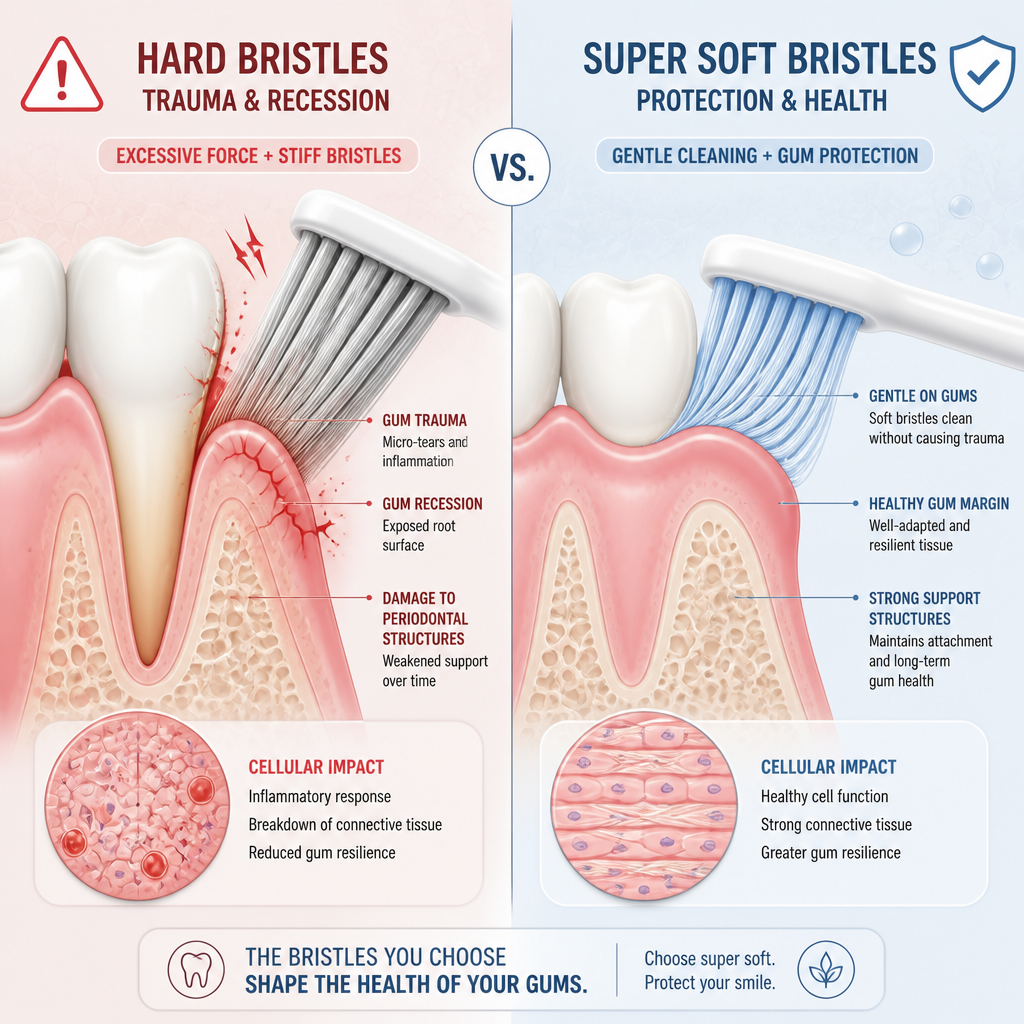
Medium-bristle toothbrushes remain on shelves primarily because they satisfy the instinct that brushing should feel vigorous. They are not appropriate for patients with gum sensitivity, any existing recession, or vulnerable oral tissue. For a healthy adult with no existing gum problems and good technique, a standard soft brush is adequate. For anyone else, the safer direction is toward softer, not firmer.
Comparison Table: Super Soft vs Soft vs Medium Bristles
The table below compares three bristle types across the dimensions that matter most when recommending a toothbrush to patients with varying needs and risk profiles.
| Feature | Super Soft Bristles (e.g. oraNurse Super Soft) | Standard Soft Bristles | Medium Bristles |
|---|---|---|---|
| Gum recession risk | Lowest – minimal lateral force on gingival margin | Low – suitable for most healthy adults | Moderate – can accelerate recession with heavy brushers |
| Gingival lesion risk | Very low – fibres deflect before causing trauma | Low in correct use | Higher – studies show more gingival lesions versus soft options |
| Plaque removal | Effective with correct technique | Effective – the benchmark for most patients | Effective, but at a tissue cost not justified by the benefit |
| Suitability for sensitive or vulnerable patients | Ideal – specifically recommended for recession, hypersensitivity, post-surgery | Suitable for healthy adults and mild sensitivity | Not recommended for sensitive gums or recession |
| Patient compliance in painful mouths | High – reduces the brushing discomfort that drives avoidance | Moderate – may still cause discomfort in inflamed tissue | Low – patients with sore gums frequently stop brushing |
| NHS and care setting use | Appropriate – available via NHS supply chain partners | Common standard issue | Not recommended for care settings with vulnerable residents |
Design Details That Matter Beyond Bristle Softness
Bristle softness is the headline feature, but the full design of the brush determines how well it performs in practice. Several design elements compound or reduce the benefit of soft bristles, and these are worth understanding when recommending a specific product to patients.
End-Rounded Bristle Tips
Cut bristle ends – the default when fibres are simply trimmed – have sharp edges that create microtrauma at the gingival margin. End-rounded bristles are polished at the tip to remove that sharp edge. This is not a minor detail. For patients brushing twice daily, the cumulative difference in tissue trauma between cut and rounded bristle tips is significant over weeks and months. The oraNurse Super Soft Toothbrush uses end-rounded bristles specifically to address this, making it genuinely different from a brush that simply carries a “soft” label with standard cut tips.
Small Brush Head and Slim Neck
A small head allows the brush to reach posterior teeth, navigate around orthodontic brackets, and target individual sites around implants or healing surgical areas without the bulk of a standard head dragging across adjacent tissue. The slim neck improves the angle of access, particularly for patients who struggle with motor control or who are being brushed by a carer rather than brushing themselves.
Full-Size Handle
This point is overlooked frequently. A full-size handle on a small-head brush means the patient does not sacrifice grip and control for access. For elderly patients, patients with limited dexterity, or carers brushing a patient’s teeth, a comfortable grip directly affects the quality of brushing. A small novelty-style handle designed for children creates control problems for an adult user.
The combination of a super soft bristle profile, small head, slim neck, and full-size handle – as found in the oraNurse Super Soft Toothbrush – represents a coherent design solution to a real clinical problem, not a collection of marketing features. Each element has a functional justification.
Frequently Asked Questions
Are super soft toothbrush bristles too gentle to clean teeth properly?
No. The premise that firmness equals cleaning power is one of the most persistent misconceptions in oral hygiene. Plaque is a biofilm, not a calcified deposit – it does not require mechanical force to disrupt. Super soft bristles flex against the tooth surface and into the gingival sulcus, disrupting biofilm effectively when the correct technique is used. The clinically meaningful variable is whether the patient is actually brushing and whether they are reaching all surfaces, not whether their brush bristles are firm.
Which patients should a clinician never give a medium-bristle toothbrush?
Patients with active gingival recession, dentinal hypersensitivity, periodontal disease, post-surgical healing oral tissue, oral mucositis, dry mouth, or a known habit of heavy-pressure brushing should not be using medium-bristle toothbrushes. For these groups, the tissue damage caused by medium bristles outweighs any cleaning benefit. A soft or super soft brush is the clinical choice without exception for these presentations.
Does switching to a super soft toothbrush stop gum recession from progressing?
Switching to a super soft brush removes one of the contributing mechanical factors, which can slow recession caused by toothbrush abrasion. However, recession has multiple causes including brushing technique, brushing frequency, existing periodontal disease, and anatomical factors. A softer brush is part of the management plan, not a standalone cure. Patients should also be assessed for their brushing pressure and technique, and the toothpaste abrasivity should be reviewed at the same time.
Is a super soft toothbrush appropriate for daily use by a healthy adult with no gum problems?
Yes. There is no clinical downside to a healthy adult using a super soft brush. The argument against it – that it will not clean adequately – is not supported by evidence when the patient uses correct technique. If anything, giving a healthy adult a super soft brush removes the risk of future abrasion damage that they might not notice accumulating over years of medium-bristle use.
How does the oraNurse Super Soft Toothbrush differ from standard pharmacy soft toothbrushes?
The oraNurse Super Soft Toothbrush is specifically designed by oral health professionals for patients with sore or fragile mouths, combining super soft bristles with end-rounded tips, a small convex brush head, and a slim neck for improved access. Most standard pharmacy “soft” brushes are designed for the general adult market and may have cut bristle tips, larger heads, and a firmness level that sits at the harder end of the soft spectrum. The clinical specification of the oraNurse brush makes it genuinely appropriate for vulnerable patients, not just comfortable for average users.
Can carers in residential settings use a super soft toothbrush to brush residents’ teeth safely?
Yes – and they should. In care home and hospital settings, residents frequently have compromised gum tissue, reduced saliva, medication-induced dry mouth, and limited ability to tolerate discomfort. A super soft toothbrush with a small head allows a carer to brush thoroughly without risking trauma to already vulnerable tissue. The full-size handle on the oraNurse Super Soft Toothbrush also makes it easier for carers to maintain control during assisted brushing, which directly affects the quality of cleaning achieved.
References
- Peer-reviewed clinical trial examining ultra-soft toothbrush effectiveness on plaque and gingival bleeding indices (Journal of Dentistry, Shiraz)
- Overview of soft bristle toothbrush recommendations and gum sensitivity guidance from Sensodyne
- Dental continuing education resource on tooth abrasion, gingival recession causes and risk factors
- Comparison guide to soft, medium, and hard toothbrush bristle types and professional recommendations
- Detailed breakdown of soft vs medium toothbrush differences, enamel impact, and patient suitability