
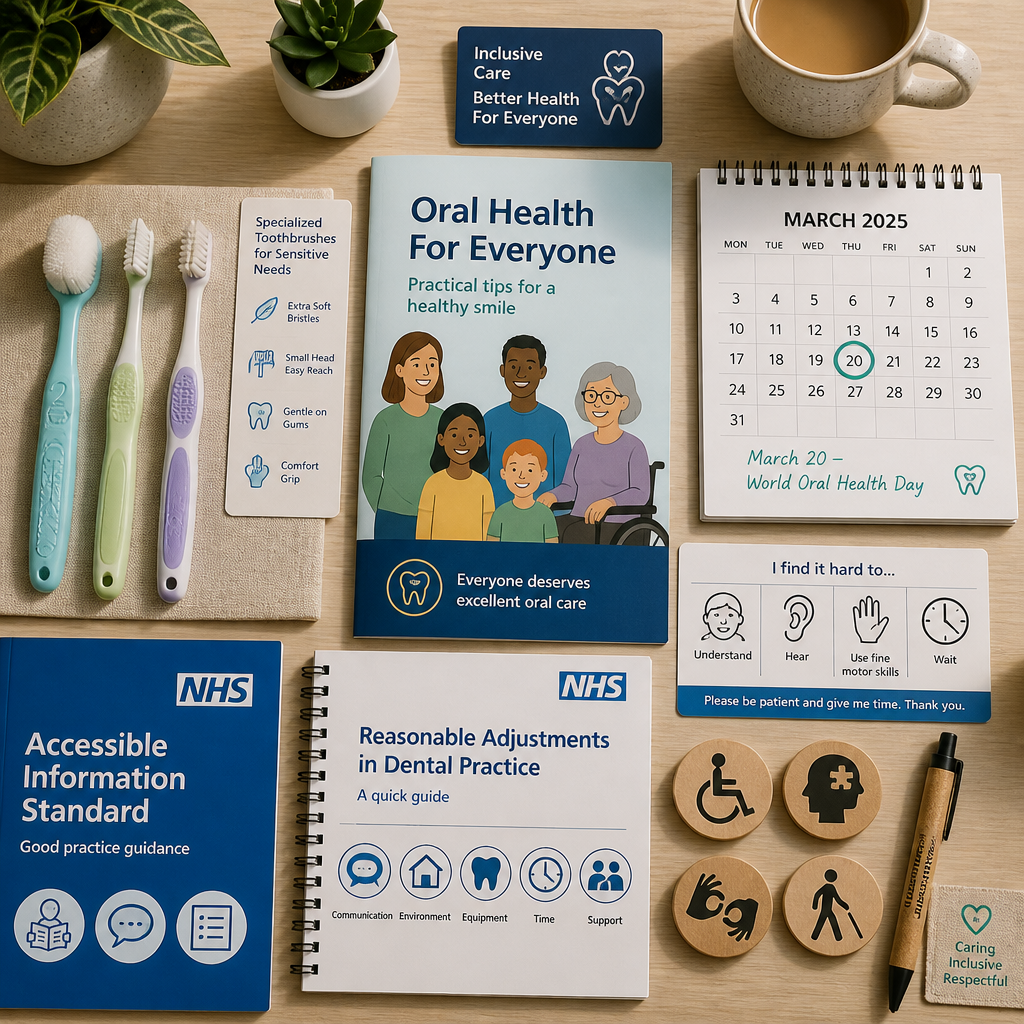
World Oral Health Day falls on 20 March each year, and most dental practices treat it as a social media moment rather than what it actually is: a structured opportunity to reshape how your practice communicates with patients who have been underserved by standard oral care. For teams working with patients who have sensory sensitivities, learning disabilities, autism, tender gums, or swallowing difficulties, this date is one of the most useful hooks in the calendar. The challenge is not awareness. It is knowing how to translate that awareness into concrete, patient-centred action your whole team can carry out, consistently, before and on the day itself.
Table of Contents
- What Is World Oral Health Day and Why It Matters for Inclusive Practice
- The Inclusive Oral Care Gap Most Practices Still Miss
- Planning Your World Oral Health Day Campaign: A Practice-Ready Framework
- Choosing the Right Products to Back Your Inclusive Message
- Comparing Campaign Approaches for Dental Practices
- Social Media and Patient Communication That Actually Works
- NHS and Specialist Settings: Raising the Bar on Inclusive Supply
- Frequently Asked Questions
- References
What Is World Oral Health Day and Why It Matters for Inclusive Practice
World Oral Health Day (WOHD) is organised by the FDI World Dental Federation and is observed every year on 20 March. The date itself is intentional: it encodes the number 20-0-32, representing 20 baby teeth, zero cavities, and 32 adult teeth. The FDI first established the observance in 2007, originally on 12 September to mark the birthday of FDI founder Dr. Charles Godon, before moving it to 20 March in 2013 to encourage wider global participation.
The 2025 campaign ran under the theme “A Happy Mouth is a Happy Mind,” the second year of the FDI’s 2024-2026 campaign arc “A Happy Mouth Is…”. This theme placed the spotlight on the relationship between oral health and mental well-being, noting that poor oral health can limit socialising, reduce food choices, and contribute to anxiety and low self-esteem. For inclusive dental care practitioners, that framing is not just aspirational language. It describes the lived experience of a significant portion of your patient list.
The global picture reinforces why this matters at practice level. Oral diseases affect over 3.5 billion people worldwide, making them among the most prevalent health conditions on the planet. For dental practices in the UK that serve patients with complex needs, neurodivergent patients, or those receiving NHS special care dentistry, WOHD provides external validation for conversations your clinical team should already be having internally.
Inclusive oral care is not a niche add-on to your clinical toolkit. For patients who cannot tolerate standard products and are never offered alternatives, it is a fundamental access issue.
The Inclusive Oral Care Gap Most Practices Still Miss
The honest truth about inclusive oral care awareness in UK dental practice is this: most practices are not failing their patients through bad intentions. They are failing them through omission. A patient with sensory processing differences, autism, or a condition causing tender or inflamed gums may never be told that alternatives to standard mint-flavoured, foaming toothpaste exist. They leave every appointment with the same generic recommendation, go home, fail to use it, and the decay or gum disease progresses unchecked.
Sensory processing differences affect how the brain interprets stimulation from the mouth, including taste, texture, smell, and the physical sensation of foam expanding. For individuals on the autism spectrum, those with ADHD, people recovering from cancer treatment-related oral mucositis, or patients with dementia who resist toothbrushing, standard products are a genuine barrier. This is not preference. It is a clinical consideration that deserves the same attention as instrument choice or pain management.
A common mistake is conflating “inclusive oral care” with installing a ramp at the front door. Physical accessibility matters, but product-level inclusivity is where daily oral health outcomes are actually determined. World Oral Health Day is the right moment to audit whether your recommendation pathways reflect the full range of patients you see.
Many autistic adults in the UK have never been told by a dentist or hygienist that unflavoured, non-foaming toothpaste exists, let alone that it is available in clinically recommended fluoride concentrations. That is not an anecdote. It reflects a systemic gap between what is known in specialist circles and what reaches patients in general practice.
Pro tip: Before WOHD, ask your whole clinical team this single question: “If a patient tells you they cannot tolerate mint or foam, what do you currently recommend?” The variation in answers will tell you exactly where your practice’s inclusive care gap sits.
Planning Your World Oral Health Day Campaign: A Practice-Ready Framework
Running a meaningful WOHD campaign does not require a marketing budget. It requires lead time, clear messaging, and team alignment. Start planning at least four weeks before 20 March. What follows is a practical sequence that works for practices of any size.
Four Weeks Out: Define Your Angle
Generic WOHD posts (“Brush twice a day!”) produce no meaningful engagement and do nothing to differentiate your practice. Choose a specific angle that connects to your actual patient population. If you serve a high proportion of patients with learning disabilities, frame your campaign around accessible oral care. If you work closely with NHS care homes or special care dentistry referrals, lead with what inclusive product choice looks like in practice. Specificity builds trust. Vague cheerleading does not.
Two to Three Weeks Out: Create Patient-Facing Content
Prepare content in plain English. Avoid jargon. A carer managing oral hygiene for a family member with dementia does not need clinical language. They need clear, direct guidance on what product to switch to and why it will make the routine easier to complete. Write for the decision-maker in the room, not for the clinical peer reviewing your website. Create at least three pieces of content: a social media post for the day itself, a short FAQ for your waiting room or website, and a script for reception or nursing staff to use if patients ask questions following the campaign.
One Week Out: Prepare Product Recommendations
Your campaign has no credibility if your product recommendations are not stocked and ready to discuss. If you are recommending unflavoured toothpaste as part of an inclusive care message, make sure your team can explain what concentration of fluoride is appropriate for different patient groups, why non-foaming formulas are clinically relevant, and how a super-soft brush with a small head supports patients with tender gums, restricted opening, or gag sensitivity. Recommending a product your reception team has never seen before does not land well.
Pro tip: Use WOHD as the prompt to update your patient intake forms. Adding a single question such as “Do you have any sensitivities to taste, texture, or dental products?” takes seconds to answer and can transform the clinical guidance you provide from that appointment forward.
Choosing the Right Products to Back Your Inclusive Message
A WOHD awareness campaign is only as strong as the clinical recommendations it leads patients toward. Telling a sensory-sensitive patient that oral health matters and then handing them a standard minty toothpaste defeats the purpose entirely. If your practice is serious about inclusive oral care, the products you recommend must be selected for that population specifically.
For patients with flavour sensitivities, foam intolerance, or conditions affecting oral comfort, unflavoured non-foaming toothpaste is not a specialist niche product. It is a clinically appropriate alternative that removes a primary barrier to daily brushing compliance. oraNurse’s unflavoured toothpaste is available in multiple fluoride strengths making it suitable across a wide range of patient profiles without requiring prescriptions or specialist sourcing.
Brush selection is the other area where general practice routinely under-advises. A patient with tender gums following periodontal treatment, a child with a strong gag reflex, or an adult with restricted jaw opening all benefit from a super-soft brush with a small head. These are not luxury options. They are the tools that make brushing physically achievable for people who would otherwise simply stop. Silicone fingertip brushes are a further option for patients who resist conventional brushes altogether, including non-verbal patients in care settings where a carer performs all oral hygiene.
Comparing Campaign Approaches for Dental Practices
Not every dental practice has the same capacity to run a WOHD campaign. The table below compares three realistic approaches based on practice size and available resource.
| Campaign Approach | Best Suited For | Key Actions and Expected Outcomes |
|---|---|---|
| Awareness-Only (Minimal Resource) | Solo practitioners or small practices with limited admin capacity | Post one WOHD message on social media with a clear inclusive care angle. Update patient leaflets to mention unflavoured toothpaste. Brief clinical staff verbally before the day. Outcome: low effort, measurable if you track patient queries on the day. |
| Education-Led Campaign (Mid Resource) | Group practices, hygienist-led clinics, or practices serving complex-needs patients | Publish a short plain-language guide on the practice website or social channels in the week before WOHD. Prepare a short in-practice display or waiting room leaflet. Offer one free “inclusive oral care check-in” appointment slot. Outcome: higher patient engagement, measurable via appointment uptake. |
| Integrated Awareness Campaign (Full Resource) | NHS special care dental services, large group practices, or practices with NHS supply chain relationships | Coordinate with care homes, schools, or community health teams ahead of 20 March. Distribute product samples or information packs via existing NHS supply channels. Use FDI’s Action Toolkit resources adapted to your patient demographic. Outcome: broadest community reach, strongest alignment with WOHD’s global intent. |
Social Media and Patient Communication That Actually Works
Since most readers arriving here are coming via social media, it is worth being direct about what performs and what does not on WOHD specifically. The posts that generate engagement are not the ones that recite brushing statistics. They are the ones that say something unexpected, specific, or immediately useful to the person reading them.
What to Post and When
Post on 20 March, but also one to two days before. The pre-WOHD posts can frame the topic (“Did you know that some patients physically cannot use standard toothpaste? Here’s what that means for oral health…”), while the day-of post delivers the clearest call to action or recommendation. On social channels driven by algorithmic reach, posts with a direct question or a “share this with someone who might need it” prompt tend to outperform broadcast-only messages.
Language That Resonates With Carers and Patients
Your inclusive oral care content will reach two distinct audiences: patients managing their own sensitivities, and carers managing oral hygiene for someone else. Both groups are looking for practical, non-condescending guidance. Avoid clinical vocabulary unless you are writing specifically for dental professionals. Replace “sensory processing disorder” with “if brushing feels overwhelming or uncomfortable” in consumer-facing posts. Replace “fluoride concentration” with “the right strength for your patient’s risk level” in professional-facing ones.
The FDI WOHD 2025 campaign generated activities in 218 countries and over 400,000 page views. The reach is there. What dental practices can contribute is local specificity, the thing a global campaign cannot provide: the name of a product your team actually recommends, the reassurance that your practice will not judge a patient for struggling with a mint toothbrush, and a clear pathway to a better experience.
NHS and Specialist Settings: Raising the Bar on Inclusive Supply
For dental practices operating within the NHS supply chain, or those providing care to residential settings, the WOHD moment has a specific operational use: it is a prompt to review what products are currently being supplied to patients who cannot give informed feedback on whether they are working.
Patients in care homes, those with advanced dementia, or those with profound learning disabilities are receiving oral hygiene products chosen by someone other than themselves. That procurement decision has direct consequences for compliance, comfort, and long-term oral health outcomes. If the toothpaste being distributed causes distress during brushing, it will either be avoided or applied so reluctantly that it provides minimal protection. Neither outcome is acceptable from a clinical standpoint.
oraNurse supplies directly to NHS facilities and has NHS supply chain partnerships in place, meaning that switching to an unflavoured, non-foaming formula for appropriate patient groups does not require navigating a complex new procurement process. For Special Care Dentistry teams, community dental services, and care home healthcare leads, this is worth investigating well ahead of WOHD so that any product changes are in place before the awareness push, not during it.
The British Society of Disability and Oral Health provides guidance on adapting clinical practice for patients with complex needs, and WOHD is a natural peg on which to hang an internal CPD session, a team briefing, or a referral pathway review. Do not let the date pass as a social media opportunity only. Use it to change something that will still be in effect in November.
Frequently Asked Questions
When is World Oral Health Day?
World Oral Health Day is observed on 20 March every year. It is organised by the FDI World Dental Federation and has been held on this date since 2013, chosen partly because the numbers 20-0-32 represent 20 baby teeth, zero cavities, and 32 adult teeth.
What is the theme for World Oral Health Day 2025?
The 2025 theme is “A Happy Mouth is a Happy Mind,” the second year of the FDI’s three-year 2024-2026 campaign “A Happy Mouth Is…” The theme focuses on the relationship between oral health and mental well-being, highlighting how poor oral health can affect confidence, social life, and emotional resilience.
How can a dental practice raise awareness of inclusive oral care on WOHD?
Start four weeks before 20 March by defining a specific angle that reflects your actual patient population. Create plain-language content for patients and carers, update your product recommendation pathways to include unflavoured and non-foaming options, and brief your whole team on the talking points. A campaign with a clear clinical recommendation outperforms a generic awareness post every time.
What products should practices recommend for patients with sensory sensitivities?
For patients who cannot tolerate standard mint-flavoured or foaming toothpastes, unflavoured non-foaming toothpaste in an appropriate fluoride strength is the most clinically direct alternative. Paired with a super-soft toothbrush with a small head, or a silicone fingertip brush for patients who resist conventional brushes, this combination removes the most common sensory barriers to daily oral hygiene compliance. oraNurse produces all three product types specifically for this patient group.
Is unflavoured toothpaste suitable for NHS patients and care settings?
Yes. Unflavoured non-foaming toothpaste in clinically recommended fluoride concentrations is appropriate for use across NHS settings, including special care dentistry and care home environments. oraNurse has NHS supply chain partnerships and can supply directly to NHS facilities, making it a straightforward choice for care settings that need a consistent, inclusive product for patients who cannot tolerate standard formulas.
How do we differentiate our WOHD campaign from a generic oral health post?
Specificity is the differentiator. Name the patient groups you serve. Name the products you recommend. Give carers and patients a concrete action, not just an affirmation. A post that says “If you or a patient in your care struggles with standard toothpaste, here is what we recommend and why” will outperform a generic “brush twice a day” post in both reach and trust, particularly among the audiences most likely to need the guidance.
Can we use FDI’s World Oral Health Day resources in our practice campaign?
Yes. The FDI provides a free Action Toolkit through wohd.org that includes key messages, social media templates, and guidance on how to adapt the campaign for different settings including healthcare providers. The toolkit is designed specifically to help practitioners and organisations run their own local WOHD activities within the global campaign framework.
If you have run a WOHD campaign in your practice or have found a particular approach that works well for patients with sensory sensitivities or complex needs, share your experience in the comments or tag us on social media.
References
- FDI World Dental Federation: Official launch of the 2025 World Oral Health Day campaign and its mental well-being theme
- FDI World Dental Federation: WOHD 2025 resources, Action Toolkit, and guidance for healthcare professionals
- Dental Tribune: Overview of the three-year FDI WOHD 2024-2026 campaign arc and global reach statistics
- ScienceDirect: Global Burden of Disease Study 2021 analysis of oral disorders across 204 countries
- oraNurse: Unflavoured toothpaste for sensory-sensitive oral care, clinical background and product guidance