

September arrives, the school bags are packed, and routines snap back into place overnight. But one routine that often gets rushed, skipped, or quietly abandoned over the summer holidays is twice-daily toothbrushing. Children’s oral health back to school season is genuinely one of the best windows of the year to reset brushing habits, because children respond to structure. The problem is that most parents focus on stationery and uniforms, not fluoride levels and brushing technique. Tooth decay remains the leading reason for hospital admissions among young children in the UK, and it is almost entirely preventable. This guide is written specifically for parents, carers, and the healthcare professionals who advise them.
Table of Contents
- Quick Takeaways
- Why Back to School Is the Right Moment to Reset Brushing Habits
- What the NHS Actually Recommends by Age
- The Flavour Problem: Why Some Children Refuse to Brush
- Choosing the Right Toothbrush for a Child’s Mouth
- Comparison: Brushing Approaches for Different Needs
- Building the Habit: What Actually Works
- Frequently Asked Questions
- References
Quick Takeaways
| Key Insight | Explanation |
|---|---|
| Fluoride level matters by age | Children under 3 need at least 1,000ppm fluoride toothpaste. Children aged 7 and over should use 1,350ppm to 1,500ppm. Check the box, not just the branding. |
| Spit, do not rinse | Rinsing with water after brushing washes away the fluoride before it can protect enamel. Spitting out excess toothpaste is all that is needed. |
| Unflavoured toothpaste is a legitimate clinical solution | Many children refuse to brush because standard mint toothpaste burns or overwhelms them. Unflavoured, non-foaming toothpaste removes that barrier entirely. |
| Two minutes, twice a day is non-negotiable | Morning and last thing at night. The bedtime brush is the most important one because saliva production drops during sleep, reducing the mouth’s natural protection. |
| Small, soft toothbrush heads reach more effectively | A toothbrush head that is too large for a child’s mouth skips the back molars and the gum line, which is exactly where decay begins. |
| Supervision matters longer than most parents think | Children aged 3 to 6 should be encouraged to brush but supervised closely. Even children aged 7 and over benefit from occasional checks on technique and duration. |
| Back-to-school is a natural habit anchor | New routines form more easily when they attach to an existing behavioural cue. Morning school prep and bedtime reading are ready-made anchors for brushing. |
Why Back to School Is the Right Moment to Reset Brushing Habits
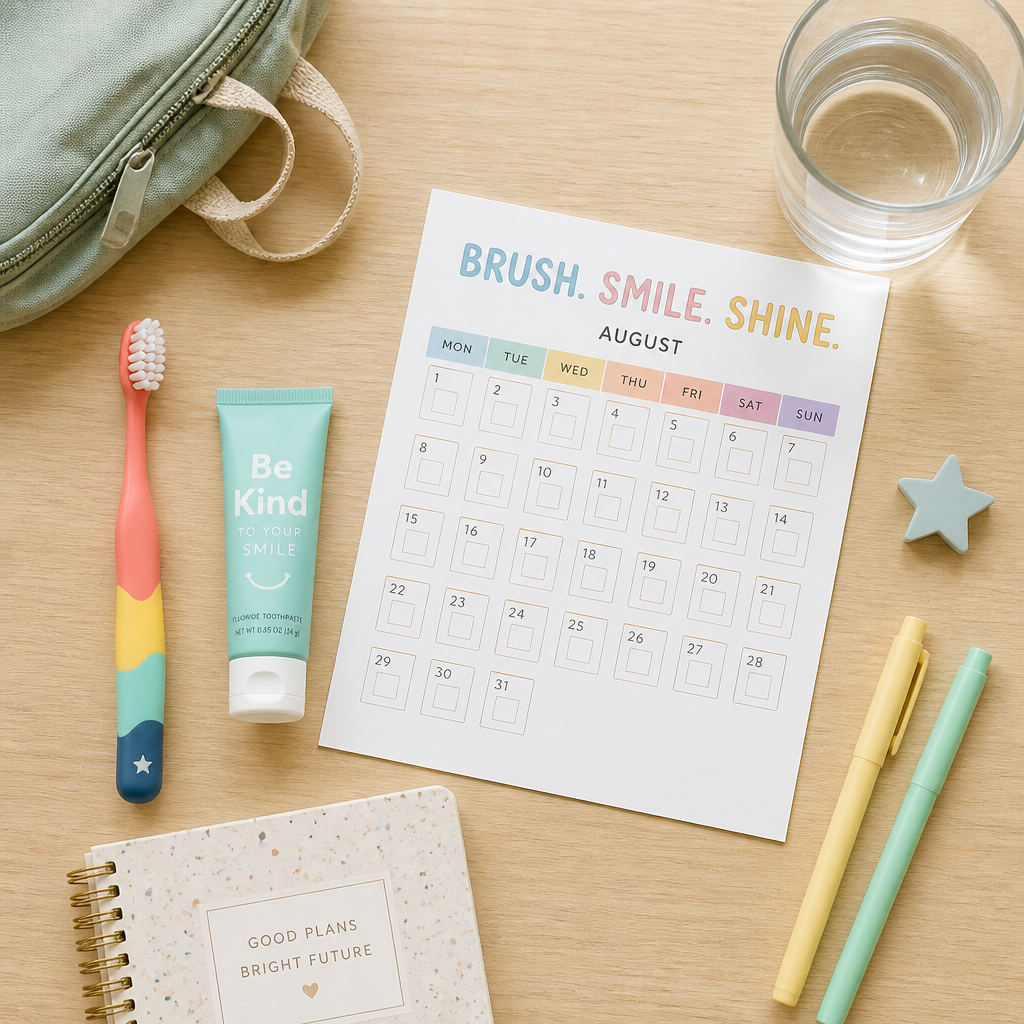
Habit research consistently shows that existing transitions, such as a new term, a new class, or a new daily schedule, make new behaviours easier to install than attempts made in the middle of an unchanged routine. The back-to-school period in the UK gives parents and carers a genuine, low-effort anchor point: the morning routine already has structure, and children are often more receptive to “new rules” when everything else is changing too.
This is not about being clever with parenting psychology. It is about being practical. If you tried to introduce a proper two-minute brushing routine in July and it failed, September gives you a natural reset with no explanation needed. “We are doing things properly this term” lands much better than repeating the same argument from three weeks ago.
Pro tip: Pair the morning toothbrush with a non-negotiable school-day anchor, such as putting on shoes or packing the school bag. Children who brush before a fixed physical cue build the habit faster than those who brush “when they remember.”
What the NHS Actually Recommends by Age
The NHS guidelines on children’s teeth are specific, and most parents are not following them precisely. The common errors are using too little fluoride (choosing “gentle” children’s toothpaste that is under-strength), rinsing after brushing, and under-supervising older children who are not actually brushing correctly.
Under 3 Years Old
Start brushing as soon as the first milk tooth appears, which is typically around six months. Use only a smear of fluoride toothpaste containing no less than 1,000ppm of fluoride. Parents or carers should do the brushing, not the child. Brush twice daily for approximately two minutes, with the last brush of the day always happening at bedtime before sleep.
Ages 3 to 6
Switch to a pea-sized amount of toothpaste. The NHS recommends toothpaste containing 1,000ppm to 1,500ppm fluoride for this age group. Encourage children to brush their own teeth, but supervise every session. The child’s technique at this age is rarely adequate without guidance. Spit out after brushing and do not rinse.
Ages 7 and Over
Children aged 7 and over should use fluoride toothpaste containing between 1,350ppm and 1,500ppm of fluoride, the same strength as standard adult toothpaste. They should be capable of brushing independently, but the NHS is clear that it is still a good idea to observe them periodically to confirm they are brushing for the full two minutes and covering all surfaces correctly.
A consistent brushing routine, with the right fluoride toothpaste at the right strength and no rinsing afterwards, is one of the most effective preventive health measures a family can adopt. The evidence base for it is unambiguous.
The Flavour Problem: Why Some Children Refuse to Brush
The most common reason children resist toothbrushing is not laziness. It is sensory discomfort. Standard children’s toothpastes are flavoured with mint, bubblegum, or strawberry, and while these are designed to be appealing, they frequently backfire with children who have heightened taste sensitivity, sensory processing differences, or conditions such as autism. For these children, the taste and foam sensation of a conventional toothpaste can make brushing a genuinely distressing experience.
This is where unflavoured, non-foaming toothpaste changes the entire picture. When there is no strong taste and no foaming sensation, many children who previously fought every brush session become cooperative within days. It is not a compromise. It is the clinically appropriate solution for a significant minority of children, and it works.
oraNurse’s unflavoured toothpaste is available in the fluoride strengths that align with NHS guidelines, making it straightforward for parents and healthcare professionals to choose the right option by age. Unlike “sensitive” or “gentle” mainstream products that still contain flavour compounds and foaming agents, oraNurse removes those variables entirely.
Pro tip: If you are a dental professional advising the parents of a child with sensory sensitivities, recommend unflavoured toothpaste before recommending behavioural strategies. Removing the aversive stimulus is almost always more effective than trying to condition a child around it.
Choosing the Right Toothbrush for a Child’s Mouth
Toothbrush choice is underrated. A brush head that is too large cannot clean the back molars or the inner surfaces of lower front teeth properly, and those are the surfaces where plaque accumulates fastest in children. The NHS recommends a small, soft toothbrush appropriate for the child’s age, and that guidance is worth taking literally.
Super Soft Bristles for Tender Gums
Children’s gums, particularly during the period when adult teeth are erupting alongside remaining milk teeth, can be tender and inflamed. A standard “soft” toothbrush from a supermarket is often firmer than it should be for a child experiencing gum sensitivity. Super soft bristles with a small head, such as those in the oraNurse toothbrush range, allow thorough cleaning without causing the discomfort that leads children to press too lightly or avoid certain areas entirely.
Silicone Fingertip Toothbrushes for Younger Children and Those with Sensory Needs
For very young children or for children who resist a standard toothbrush, a silicone fingertip toothbrush gives the parent far more control and produces far less resistance. The sensation is gentler, the parent can feel what they are doing, and the transition to a conventional brush later is easier. It is also a practical tool for carers in healthcare and special educational settings where cooperative toothbrushing is a daily challenge.
Comparison: Brushing Approaches for Different Needs
Not every child fits the standard approach. The table below compares three common scenarios, so parents and healthcare professionals can match the right combination of tools and technique to the child in front of them.
| Child Profile | Recommended Approach | Key Product Consideration |
|---|---|---|
| Neurotypical child aged 3 to 6, no sensory issues | Pea-sized standard children’s toothpaste, age-appropriate soft brush, parent supervises and guides technique | 1,000ppm to 1,500ppm fluoride toothpaste; small-head toothbrush appropriate for age |
| Child with sensory sensitivities or autism, any age | Unflavoured, non-foaming toothpaste; introduce silicone fingertip brush first if standard brush causes distress; build up gradually | oraNurse unflavoured toothpaste at age-appropriate fluoride level; silicone fingertip brush as a stepping stone |
| Child aged 7 and over brushing independently but poorly | Use a mirror so the child can see what they are cleaning; guide hand movements; time two minutes using a visible timer; re-supervise temporarily | 1,350ppm to 1,500ppm fluoride toothpaste; super soft small-head brush to encourage fuller coverage without gum soreness |
Building the Habit: What Actually Works
There is a difference between toothbrushing compliance, which is what you get when you stand over a child and insist, and toothbrushing habit, which is what happens automatically when the right conditions are in place. The goal is the latter, because compliance disappears the moment the adult is not present.
Timing and Anchoring
Brush last thing at night before bed, every single night without exception. This is the most important brush of the day because saliva production drops significantly during sleep, removing the mouth’s natural defence against acid. Morning brushing anchors to the school routine and reinforces the twice-daily pattern. Do not allow one of these to become optional.
Removing Barriers Rather Than Adding Motivation
Most habit-building advice focuses on rewards and sticker charts, and while these can help with younger children in the short term, they treat the symptom rather than the cause. If a child hates brushing, the first question should be: what specifically do they hate? Is it the taste? The foam? The brush scratching their gums? Fix the physical barrier first. An unflavoured toothpaste, a softer brush, or a different brushing position can resolve most resistance without any behaviour management strategy at all.
Technique Over Duration
Two minutes of ineffective brushing is still ineffective. Use small circular movements. Cover the outer surfaces, the inner surfaces, and the chewing surfaces of every tooth. Gently brush the gum line and the gums themselves. A common mistake parents make is brushing only the surfaces that are visible when the child smiles, which misses the inner lower teeth and the back molars entirely. Those are exactly the areas where decay starts.
The DHSC’s Best Start in Life campaign summarises the core messages for children aged 3 and over clearly: brush twice a day, encourage spitting not rinsing, reduce sugar especially at night, and protect the smile with regular dentist visits. These are not aspirational guidelines. They are the minimum standard for preventing entirely avoidable harm.
Frequently Asked Questions
At what age should children start using adult-strength toothpaste?
Children aged 7 and over should use toothpaste containing between 1,350ppm and 1,500ppm of fluoride, which is the same strength as standard adult toothpaste. There is no need to keep older children on under-strength “children’s” formulations. Check the fluoride level on the box rather than relying on the product’s branding or age labelling.
My child refuses to brush because of the taste. What can I try?
Switch to an unflavoured, non-foaming toothpaste. For many children with sensory sensitivities, taste and foam are the primary barriers to cooperative brushing, not the act of brushing itself. oraNurse unflavoured toothpaste is available at the fluoride strengths recommended for children across different age groups, so you do not have to sacrifice protection to remove the sensory trigger.
Is it really necessary to supervise a 7-year-old brushing their teeth?
Yes, periodically. The NHS guidance states that while children aged 7 and over should be able to brush independently, it is still advisable to watch them occasionally to confirm they are brushing for the full two minutes and covering all tooth surfaces correctly. Most children who brush unsupervised are brushing for under a minute and missing the inner surfaces of their teeth.
Why should children spit rather than rinse after brushing?
Rinsing with water after brushing dilutes and removes the fluoride film left on the teeth by the toothpaste. That residual fluoride continues to protect enamel after brushing ends. Spitting out the excess toothpaste without rinsing preserves that protective layer. This is NHS-recommended guidance and applies to children and adults alike.
How soft should a child’s toothbrush be?
Softer than most parents assume. Standard “soft” toothbrushes from supermarkets are often firm enough to cause discomfort against tender or erupting gums. A super soft toothbrush with a small head is the more appropriate choice, particularly for children who are teething, have sensitive gums, or are experiencing tooth eruption alongside existing milk teeth. Discomfort during brushing is a common and underreported reason why children resist the routine.
Can the same brushing routine work for a child with autism or sensory processing differences?
The same goals apply, but the route to achieving them often needs adapting. Unflavoured, non-foaming toothpaste removes the most common sensory triggers. A silicone fingertip toothbrush can be a more tolerable starting point than a conventional brush. Keeping the approach predictable and consistent, including the sequence of steps and the time of day, also reduces resistance significantly. Healthcare professionals advising families in this situation should recommend the least aversive combination of tools first, before introducing any behaviour management strategies.