
Stroke leaves behind consequences that most people never see coming. One of the most overlooked is the collapse of oral health. Research published in a peer-reviewed journal found that untreated tooth decay was present in 48% of patients admitted to a stroke unit in North West England, and 61% had marked gum disease, rates far above those of the general adult population. For carers managing someone at home or in a care setting, oral care for stroke survivors is not a minor daily task. It is a direct line of defence against aspiration pneumonia, malnutrition, and serious infection. This guide covers the tools, techniques, and products that genuinely work, with specific attention to the challenges of hemiplegia, dysphagia, and sensory sensitivity.
Table of Contents
- Quick Takeaways
- Why Stroke Survivors Are at Higher Oral Health Risk
- Understanding the Physical Barriers to Toothbrushing After Stroke
- Adapted Oral Hygiene Tools That Actually Help
- Choosing the Right Toothpaste for Stroke Survivors
- Tool Comparison: Manual, Electric, and Fingertip Brushes
- Carer Technique: How to Brush a Stroke Survivor’s Teeth Safely
- Frequently Asked Questions
- References
Quick Takeaways
| Key Insight | Explanation |
|---|---|
| Dental disease rates are significantly higher in stroke survivors | Studies show nearly half of stroke patients admitted to specialist units have untreated decay, making prevention a clinical priority, not just comfort care. |
| Aspiration pneumonia is the primary risk driving oral care urgency | Poor oral hygiene allows pathogenic bacteria to accumulate in the mouth. If aspirated, these cause pneumonia, a leading cause of post-stroke mortality. |
| Super soft, small-headed toothbrushes are the correct choice for tender or paralysed gums | Standard medium-bristle brushes traumatise already sensitive tissue. A small head allows access to posterior teeth without triggering a gag reflex. |
| Unflavoured, non-foaming toothpaste removes a major sensory barrier | Strong mint flavour and foaming agents cause distress in survivors with sensory changes or dysphagia. Unflavoured formulations allow brushing without foam aspiration risk. |
| Silicone fingertip toothbrushes work when standard brushes fail | For survivors who cannot open their mouth wide, clench involuntarily, or have very tender gums, a silicone fingertip brush gives the carer maximum control with minimal trauma. |
| Positioning is as important as the tool chosen | Carers must ensure the survivor is upright or tilted to the unaffected side during brushing to prevent fluid and toothpaste running into the airway. |
| Foam swabs alone are not adequate for plaque removal | Clinical evidence is clear that foam swabs do not remove plaque effectively. They have a role in moisture management and comfort, but should not replace toothbrushing where that is possible. |
Why Stroke Survivors Are at Higher Oral Health Risk
A stroke does not just affect movement. It disrupts the full system that supports oral health, including saliva production, swallowing coordination, facial muscle control, and a person’s ability to carry out their own self-care. The result is an oral environment that deteriorates rapidly without active intervention from carers.
Dry mouth is almost universal after stroke. Many post-stroke medications, including antihypertensives and antidepressants, reduce saliva flow. Saliva is the mouth’s natural defence mechanism. Without it, bacteria multiply faster, acid is not neutralised, and the risk of decay and gum infection increases significantly.
Dysphagia, the difficulty swallowing, affects a substantial proportion of stroke survivors in the acute phase. This creates a twofold problem. First, survivors may not be able to spit out toothpaste, making foaming formulations a genuine aspiration hazard. Second, pooled saliva and food debris cannot be cleared normally, creating a reservoir of bacteria in the mouth.
Poor oral hygiene after stroke is not a cosmetic concern. It is a documented pathway to aspiration pneumonia, extended hospital stays, and poorer rehabilitation outcomes. Carers who understand this treat oral care as a clinical intervention, not a routine.
The social impact is also real. Stroke survivors who develop visible tooth decay, halitosis, or painful gums are more likely to withdraw from social contact, which compounds the isolation that already accompanies post-stroke recovery. Getting oral care right early protects far more than teeth.
Understanding the Physical Barriers to Toothbrushing After Stroke
Before choosing any product, carers need to understand exactly which physical barriers they are working around. Not all stroke survivors present identically. The barriers differ depending on whether the stroke caused hemiplegia, cognitive impairment, or swallowing difficulties, and the carer’s approach must reflect that.
Hemiplegia and One-Sided Weakness
Hemiplegia (paralysis on one side of the body) is one of the most common stroke outcomes. A survivor who was right-handed may now have no functional use of their right hand. Tooth brushing with hemiplegia requires either relearning the task with the non-dominant hand, which takes significant time and practice, or relying on a carer to do it for them.
Where a survivor has partial function in the affected hand, weighted or widened toothbrush handles can help maintain grip. Universal cuff adaptations, which strap a toothbrush to the palm, allow survivors with very limited grip to attempt self-brushing. Electric toothbrushes remove the need for the scrubbing motion entirely, which matters greatly when only one hand is available. The brush does the work; the user simply moves it from tooth to tooth.
Involuntary Clenching and Reduced Mouth Opening
Hypertonicity in the jaw muscles after stroke can make it very difficult for carers to access the mouth safely. Forcing a standard toothbrush between clenched teeth risks injury to both the survivor and the carer. This is precisely where a silicone fingertip toothbrush becomes the correct clinical choice. The soft silicone nubs clean tooth surfaces with gentle pressure, and the carer’s finger provides far more tactile sensitivity than a handled brush, reducing the risk of causing pain or triggering further clenching.
Cognitive and Behavioural Changes
Stroke frequently causes cognitive changes including confusion, memory loss, reduced attention, and altered perception. A survivor may not understand what toothbrushing is for, may resist the process, or may respond strongly to sensory stimulation such as strong mint flavour or foaming toothpaste in the mouth. A calm, consistent routine, combined with products that minimise sensory load, significantly improves compliance.
Adapted Oral Hygiene Tools That Actually Help
The market for adapted oral care tools is wide, but the quality is uneven. Here is a practical breakdown of what genuinely helps for post-stroke oral care, starting with the most fundamental choice: the toothbrush.
Super Soft Toothbrushes With Small Heads
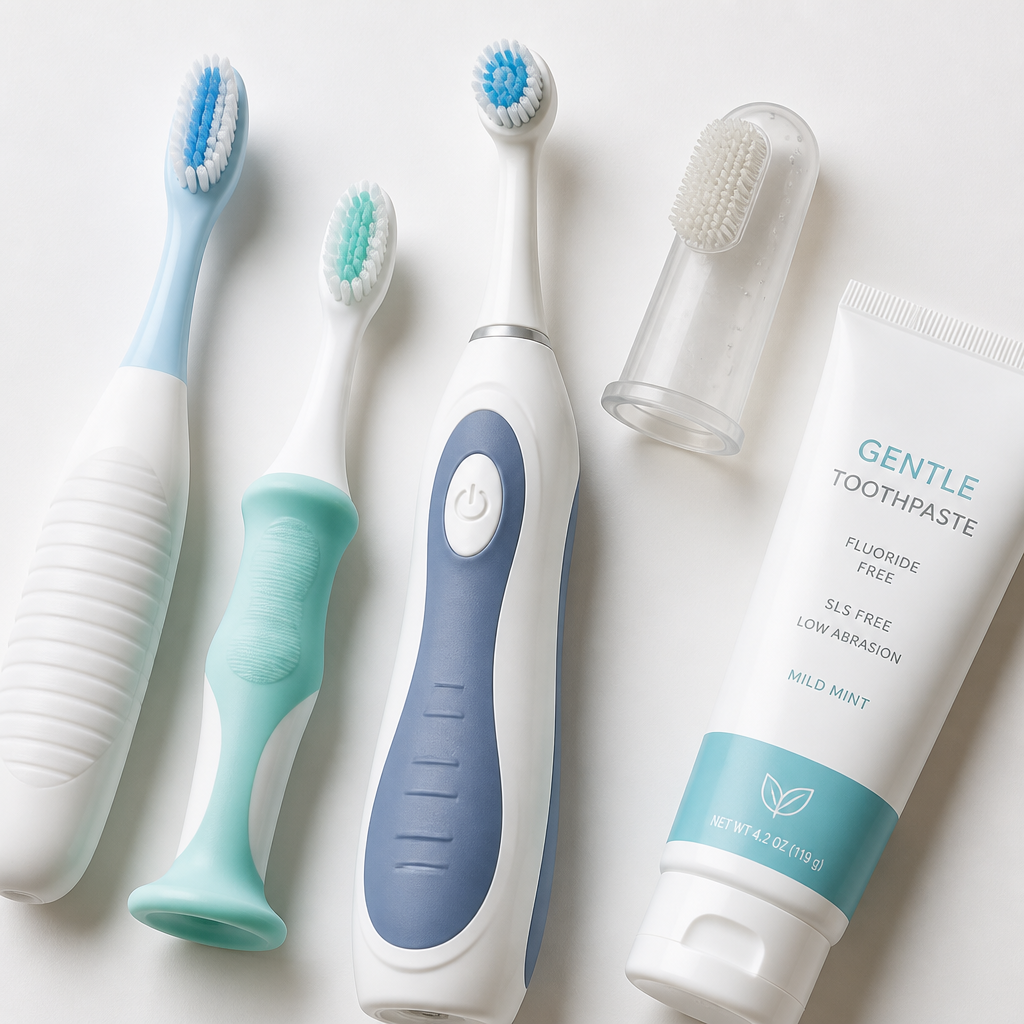
This is the single most important product choice for carers. Stroke survivors frequently have inflamed, tender, or neglected gums at the point when carer-led oral care begins. Introducing a medium or firm brush at this stage causes pain, bleeding, and resistance. A super soft toothbrush with a small head, such as those produced by oraNurse, allows the carer to reach posterior teeth, clean around the gum line, and manoeuvre in a mouth that may have reduced opening, all without causing tissue trauma.
The small head is not a minor design feature. In a person with limited mouth opening, or one who is at risk of clenching, a large brush head creates unnecessary pressure and may trigger the gag reflex. A small head means precision and control.
Silicone Fingertip Toothbrushes
Where a standard toothbrush cannot be safely used, the silicone fingertip brush is the correct step-down option. It fits over the carer’s index finger and uses gentle silicone bristles to clean tooth surfaces and massage the gums. It gives the carer maximum tactile feedback, which is critical when working in a mouth that may clench unpredictably.
The fingertip brush is also the right choice for initial oral care after a period of neglect, where gums are extremely tender and any firm pressure causes bleeding. It is a bridge product: use it until the mouth tolerates a soft toothbrush comfortably.
Pro tip: When first introducing oral care to a resistant stroke survivor, begin with the fingertip brush using no toothpaste for the first few sessions. The goal is simply to establish tolerance of the sensation before introducing a product. Compliance improves dramatically with this approach.
Electric Toothbrushes for Survivors With Partial Hand Function
For stroke survivors who retain enough grip and arm function to hold a handle, an electric toothbrush removes the need for the manual scrubbing motion that is difficult to replicate with one hand. The rotating or oscillating head does the mechanical work. The user guides the brush from tooth to tooth. This is particularly relevant for survivors working toward greater independence and who are undergoing occupational therapy to rebuild hand function.

Choosing the Right Toothpaste for Stroke Survivors
This is where carers most often make the wrong choice, usually by default. Standard supermarket toothpastes contain two elements that create real problems for stroke survivors: strong mint or menthol flavouring, and sodium lauryl sulphate (SLS), the foaming agent.
Strong flavour is a sensory assault for a person with altered oral sensation after stroke. It causes gagging, distress, and active resistance to the brushing process. Once a survivor associates toothbrushing with an unpleasant sensation, getting them to accept it becomes exponentially harder. Eliminating the flavour removes this barrier entirely.
Foaming is a more serious clinical concern. SLS creates foam in the mouth that a survivor with dysphagia cannot reliably spit out. That foam, carrying bacteria from the mouth, can pool in the throat and be aspirated. A non-foaming toothpaste removes this risk while still delivering fluoride protection to the teeth.
oraNurse’s unflavoured, non-foaming toothpaste is available in multiple fluoride concentrations, which matters because post-stroke survivors, particularly those on medications that cause dry mouth, are at elevated caries risk. A higher-fluoride formulation may be appropriate depending on clinical advice, while the standard 1450ppm option is suitable for general use. The point is that fluoride protection does not have to come with the sensory barriers that make compliance impossible.
Pro tip: Store the toothpaste where the survivor can see it and, if possible, reach it. Familiar visual cues help survivors with cognitive changes engage more willingly with the routine, even when they cannot initiate it independently.
Tool Comparison: Manual, Electric, and Fingertip Brushes
Choosing the right tool depends on the survivor’s level of function, their tolerance of oral care, and the carer’s level of access to the mouth. The table below compares the three main options across the criteria that matter most in a post-stroke context.
| Tool Type | Best Suited For | Key Limitations |
|---|---|---|
| Super soft manual toothbrush (small head) | Carer-led brushing for survivors with moderate mouth opening, tender gums, and no severe clenching. Also suitable for survivors working toward independence with non-dominant hand. | Requires controlled manual technique from the carer. Ineffective if mouth cannot be safely opened wide enough to insert the brush. |
| Electric toothbrush | Survivors with partial grip who are working toward independence. Removes the scrubbing motion, reducing the demand on the affected hand. Good for those with hemiplegia on the non-dominant side. | Handle weight and vibration may not be tolerated by all survivors. Less suitable where carer has limited access or survivor resists the sensation. Requires charging management. |
| Silicone fingertip toothbrush | Survivors with significant jaw clenching, very tender or inflamed gums, or who are very resistant to standard brushing. Ideal first-step tool when introducing oral care to a neglected mouth. | Lower plaque removal efficacy than a bristled toothbrush. Should be a bridge tool, not a permanent replacement, wherever possible. Carer must have good hand hygiene. |
Carer Technique: How to Brush a Stroke Survivor’s Teeth Safely
The right products fail if the technique is wrong. Carers often receive little training in oral care delivery, and the default approach, standing in front of the person and brushing as you would your own teeth, is one of the least effective positions for accessing the mouth and the most likely to cause gagging or aspiration.
Positioning Before You Start
The survivor must be sitting upright, or at minimum at a 45-degree angle, before oral care begins. Never attempt toothbrushing with a stroke survivor lying flat on their back. If they have one-sided weakness, tilt their head slightly toward the unaffected side so that any fluid or foam runs toward the cheek, where it can be wiped away, rather than pooling at the back of the throat.
The carer standing behind or to the side of the survivor, rather than directly in front, gives far better access to all surfaces of the teeth and allows the head to be gently supported. This is particularly important when working with a survivor who has limited head control.
The Brushing Sequence
Work in a consistent sequence every time: outer surfaces of upper teeth, inner surfaces of upper teeth, chewing surfaces, then the same for lower teeth, finishing with the tongue. Consistency matters because it builds a predictable routine the survivor can recognise, even with cognitive impairment, and because it ensures no surfaces are missed.
Use only a pea-sized amount of toothpaste on the brush. For survivors who cannot spit reliably, use even less. The goal is fluoride contact with the tooth surface, not a full rinse routine. With a non-foaming toothpaste, the residue can be gently wiped away with gauze if rinsing and spitting is not safely possible.
After Brushing: Managing Residue Safely
Do not assume the survivor has swallowed or spat all toothpaste. Use a small amount of water on a foam swab or gauze to wipe residue from the cheeks and gum line after brushing. Check for buccal pocketing, food or fluid lodged between the cheek and lower teeth. This is common in stroke survivors and is a source of silent aspiration after meals.
Foam swabs have a legitimate role here, as cleaning-up tools after brushing, and for moisture management in the mouth. They are not effective as standalone plaque removal tools and should not replace brushing where brushing is achievable.
Denture Care for Stroke Survivors
If the survivor wears dentures, remove them for cleaning separately at least once daily. Brush them with a denture brush and mild soap or a designated denture cleaner. Do not use standard toothpaste, which is abrasive enough to scratch denture surfaces, creating sites for bacterial accumulation. Clean the gums and palate with a soft toothbrush or damp gauze while the dentures are out.
Ill-fitting dentures are more common after stroke because facial muscle tone changes and weight loss alter the shape of the mouth. If dentures have become loose, they significantly increase the risk of choking and should be reviewed by a dentist promptly.
When building a carer-led oral care kit for a stroke survivor, the essentials are straightforward: a super soft small-headed toothbrush for daily use, a silicone fingertip brush for difficult sessions, unflavoured non-foaming fluoride toothpaste to eliminate sensory barriers and aspiration risk, and gauze for post-brushing cleanup. Everything else is secondary to getting these four elements right and using them consistently, twice daily.
Frequently Asked Questions
What is the safest toothpaste for a stroke survivor who cannot spit reliably?
An unflavoured, non-foaming fluoride toothpaste is the safest option. Standard toothpastes contain foaming agents that create foam a dysphagic survivor cannot clear safely. A non-foaming formulation, such as oraNurse’s range, delivers fluoride protection without generating foam that can pool in the throat and be aspirated. Use a small amount and wipe away residue with gauze if spitting is not possible.
How do I brush the teeth of a stroke survivor who clenches their jaw?
Do not try to force a standard toothbrush between clenched teeth. Switch to a silicone fingertip toothbrush instead. The soft silicone can be worked gently between the lips with far less risk of injury, and the tactile feedback through your finger allows you to feel tension and respond before it escalates. Approach slowly, maintain a calm verbal tone, and work with short cleaning bursts rather than a continuous session. Over time, consistent exposure to a low-pressure routine typically reduces clenching episodes. Use a Mouth Rest if required.
Can a stroke survivor with hemiplegia brush their own teeth?
Many can, with the right adaptations. Tooth brushing with hemiplegia is supported by a range of tools including universal cuff straps that hold a toothbrush to the palm, suction denture brushes that fix to a basin surface, and electric toothbrushes that eliminate the need for a scrubbing motion. Occupational therapists are the right professionals to assess a specific survivor’s capability and recommend adaptations. Independence in oral care is a realistic goal for many survivors with one-sided weakness.
How often should a carer perform oral care for a stroke survivor?
Twice daily is the minimum, ideally after breakfast and before sleep. Where a survivor has dysphagia and is eating by mouth, the mouth should also be cleaned after meals to remove food debris from the teeth and cheeks before it becomes a source of bacterial growth or aspiration. Consistent twice-daily brushing, combined with post-meal cleaning, reflects the current evidence base for reducing aspiration pneumonia risk in post-stroke care.
Are foam swabs sufficient for oral care if the survivor cannot tolerate a toothbrush?
No. Foam swabs do not remove plaque effectively. They are appropriate for moisturising a dry mouth, wiping residue after brushing, and for survivors who cannot tolerate any form of brushing at all. Clinical evidence consistently shows that they should not replace toothbrushing where brushing is achievable. If a survivor is currently managed with swabs alone, introduce a silicone fingertip toothbrush as a stepping stone toward more effective plaque removal. There are also documented safety concerns about the sponge head detaching, so use only quality swabs and inspect them before use.
What type of toothbrush head is best for a carer to use on a stroke survivor?
Small and super soft. A small head gives access to the back of the mouth without triggering the gag reflex and fits into a mouth with limited opening. Super soft bristles prevent trauma to already-compromised gum tissue. Medium or firm bristles are not appropriate. They are abrasive enough to cause bleeding in healthy gums and significantly more so in the inflamed gum tissue common in stroke survivors who have had inconsistent oral care.
References
- Research on dental disease prevalence and patient experiences in stroke survivors
- Randomised controlled trial on intensified oral hygiene care and aspiration pneumonia in hospitalised stroke patients
- Systematic review of nurse-led oral care for post-stroke dysphagia patients
- Clinical guidance on brushing technique and carer-led mouth care for dependent patients
- PubMed study on technology for maintaining oral care after stroke and implications for rehabilitation