
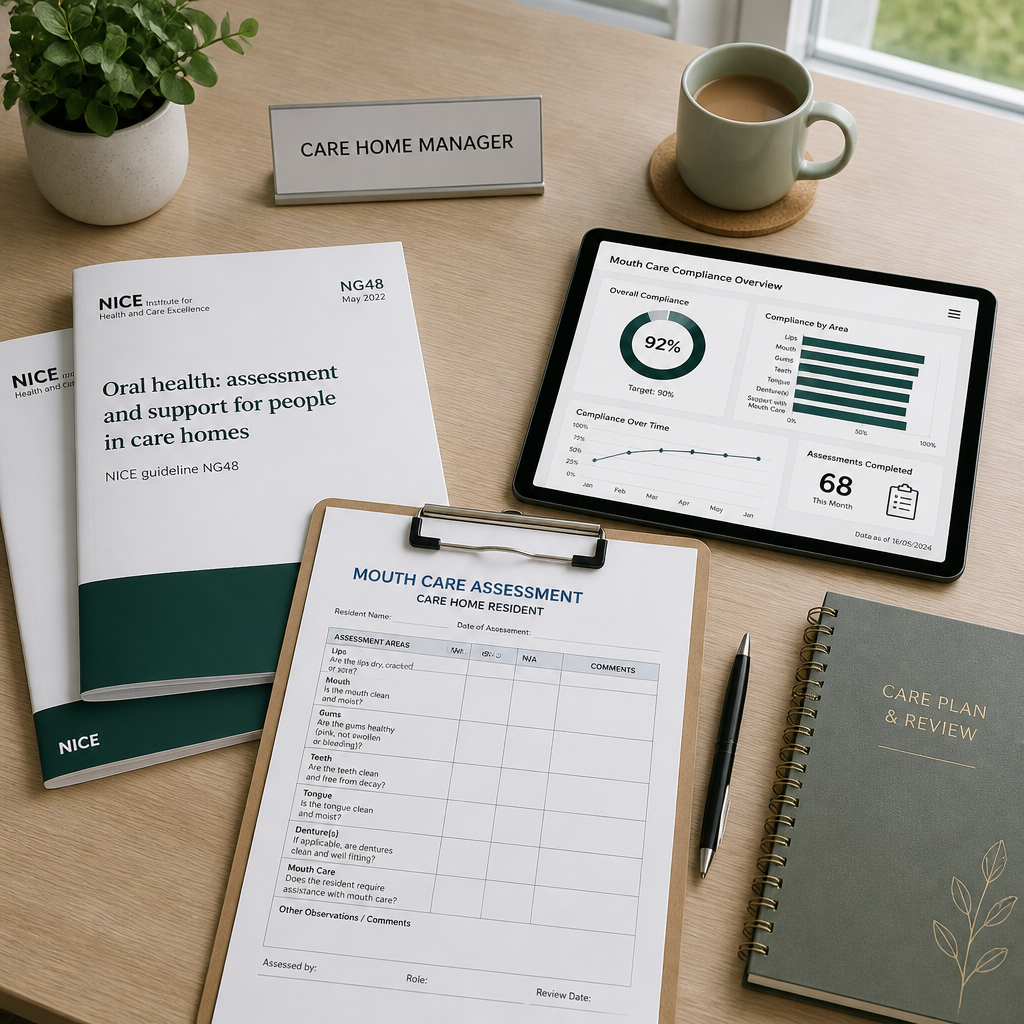
Poor oral health in care homes is not a minor comfort issue. It is a documented clinical risk that affects nutrition, medication absorption, pain levels, and overall quality of life for residents. Yet the Care Quality Commission’s own Smiling Matters review found that in 2019, 39% of care home managers were not aware of NICE guideline NG48 at all. The framework for delivering better oral health in residential settings exists. The evidence-based toolkit is freely available. What care home managers need is a clear, practical understanding of what compliance actually looks like on a ward round, during a CQC inspection, and in the hands of a carer at 8am. This guide gives you that.
Table of Contents
- Quick Takeaways
- Why Oral Health Fails in Care Settings
- What NICE NG48 Requires of Care Home Managers
- Building a Compliant Care Home Oral Health Policy
- Oral Health Assessment and Mouth Care Plans
- Oral Care Training for Care Staff
- Choosing the Right Products for Your Residents
- Comparing Approaches to Care Home Oral Health Delivery
- Frequently Asked Questions
- References
Quick Takeaways
| Key Insight | Explanation |
|---|---|
| NICE NG48 is the legal and clinical benchmark | Every care home policy on oral health must align with NG48. CQC inspectors use it as a reference point during inspections. Non-compliance is a documented risk. |
| 40% of care staff may still receive no oral health training | Despite improvement since 2019, the CQC’s 2022 progress report found that 4 in 10 care staff may not receive specific oral health training. This is the single biggest delivery gap. |
| Every resident needs an oral health assessment on admission | NG48 requires assessment regardless of length of stay. The Oral Health Assessment Tool (OHAT) is the recommended instrument. |
| Toothpaste strength matters for adults | The Delivering Better Oral Health toolkit recommends fluoride toothpaste for twice-daily brushing. Research-based NG48 interventions have used 1500ppm fluoride toothpaste for adults in care settings. |
| Refusal of care must be recorded | NG48 requires that daily mouth care records include instances where a resident refuses care and the action taken, in line with the Mental Capacity Act. |
| Unflavoured, non-foaming toothpaste removes a major barrier | Many residents with dementia, sensory sensitivities, or dysphagia cannot tolerate standard mint toothpaste. Unflavoured options like those from oraNurse directly address this barrier to compliance. |
| Denture care is part of the daily routine, not optional | NG48 specifies that daily oral care for full or partial dentures, including brushing and removing food debris, is a mandatory component of the care plan. |
Why Oral Health Fails in Care Settings
The problem is rarely a lack of concern. Most care home managers understand that mouth health matters. The failure is almost always structural: oral care is treated as an add-on to personal care rather than a clinical task with defined protocols, documentation, and accountability.
In practice, the most common failures look like this. Toothbrushes are stored in communal cups. Residents who resist brushing are marked as “refused” without any follow-up or adapted technique. Dentures are cleaned inconsistently, or not at all overnight. And the toothpaste available on the unit is a standard supermarket mint formulation that a resident with dementia, dysphagia, or a sensory sensitivity will spit out, gag on, or simply refuse to open their mouth for.
The Delivering Better Oral Health toolkit exists precisely because these failures are predictable. The question for a care home manager is not whether you believe oral health matters. It is whether your systems, policies, products, and staff training actually make it happen, daily, for every resident.

What NICE NG48 Requires of Care Home Managers
NICE guideline NG48, Oral Health for Adults in Care Homes, is the definitive framework. It is not guidance that you can treat as aspirational. CQC inspectors reference it directly, and compliance with it forms part of the evidence base for a home’s overall rating on care quality.
The Seven Core Requirements
NG48 sets out structured obligations for managers. Care homes must have a written oral health policy that covers daily mouth care, use of products, what happens if a resident refuses care, and how oral hygiene equipment is supplied. The policy must align explicitly with the Delivering Better Oral Health toolkit from what was then Public Health England (now the Office for Health Improvement and Disparities).
The guideline also requires that managers set out the home’s duty of care in relation to residents’ oral health needs and access to dental treatments. This is not a soft commitment. It means having a pathway for dental referral, knowing which residents are dentate and which wear dentures, and having documented evidence that care is being delivered.
What NG48 Requires Care Staff to Do Daily
At the operational level, NG48 specifies that care staff must provide daily support for residents to brush natural teeth at least twice a day with fluoride toothpaste, and must also provide daily oral care for full or partial dentures. Daily records must be kept, including when a resident refuses and what action was taken. This documentation requirement is a concrete audit trail that CQC inspectors will look for.
The evidence is clear: consistent daily mouth care, supported by the right products and trained staff, is the foundation of oral health in care settings. Without it, assessment tools and care plans are just paperwork.
Building a Compliant Care Home Oral Health Policy
A care home oral health policy that satisfies NG48 is not a single-page statement of intent. It is an operational document that staff at every level can follow without interpretation.
What the Policy Must Cover
At minimum, your oral health policy needs to address: daily mouth care procedures for both natural teeth and dentures; how oral hygiene equipment is supplied and replaced; the process for oral health assessment on admission; how mouth care plans are created, updated, and reviewed; what happens when a resident refuses care, in line with the Mental Capacity Act; and how oral health concerns are escalated and dental referrals made.
The policy must also reflect current product guidance. Recommending a generic mint toothpaste as your sole option is not sufficient if a significant proportion of your residents have dementia, sensory sensitivities, or conditions that make standard flavoured, foaming toothpaste intolerable. The policy should name the products available on the unit and explain the clinical rationale for each choice.
Aligning Your Policy with the Delivering Better Oral Health Toolkit
NG48 explicitly requires that your policy aligns with the Delivering Better Oral Health toolkit. This means the toolkit is not background reading. It is a document that should inform your product procurement, your staff training content, and your assessment tools. If your policy was written before the most recent edition of the toolkit, review it. If it does not reference fluoride toothpaste use, twice-daily brushing, and denture care procedures, it is incomplete.
Pro tip: Include a version number and annual review date on your oral health policy. When a CQC inspector asks when it was last updated, a dated document signals that it is a live, managed policy rather than a legacy document no one has touched in three years.
Oral Health Assessment and Mouth Care Plans
Assessment is where individual care begins. NG48 is unambiguous: all residents must have an oral health assessment carried out as soon as they start living in a care home, regardless of the length or purpose of their stay. This includes short-term respite residents.
Using the Oral Health Assessment Tool (OHAT)
The Oral Health Assessment Tool (OHAT) is the instrument recommended under NG48. It covers eight categories including lips, tongue, gum and tissues, saliva, natural teeth, dentures, oral cleanliness, and dental pain. Each category is scored, and the total identifies whether a resident needs routine monitoring, a dental referral, or urgent dental care.
In practice, the OHAT is most useful when it is completed by a staff member who has received specific training in how to use it. A care assistant filling it in for the first time without training will produce inconsistent scores, which then produces unreliable care plans. Training and the assessment tool go together, not separately.
Writing Mouth Care Plans That Care Staff Will Actually Use
A mouth care plan fails when it is written in clinical language that a non-clinically trained care assistant cannot act on. The most effective plans are specific and task-based. They name the products to be used, the frequency, whether the resident needs assistance or prompting, how the resident prefers to be approached, and what sensory or behavioural factors affect compliance.
For a resident who resists standard mint toothpaste because of flavour sensitivity or a strong gag reflex, the plan should specify an unflavoured, non-foaming alternative and document why it was selected. That specificity protects the resident, protects the staff member, and creates an auditable record.
Pro tip: When a family member is involved in a resident’s ongoing care, NG48 recommends involving them in the initial oral health assessment (with the resident’s permission). This conversation often surfaces critical information about a resident’s oral care history, preferences, previous dental phobia, or prior use of specific products that care staff would not otherwise know.
Oral Care Training for Care Staff
Training is where the gap between policy and practice lives. The CQC’s 2022 progress report found that while the proportion of care home providers saying staff receive specific oral health training had doubled from 30% in 2019 to 60% in 2022, this still means that approximately 40% of care staff may not receive this training at all. That is not a marginal compliance gap. That is a majority of residents in those homes receiving oral care from staff who have not been trained to deliver it.
What Oral Care Training for Care Staff Should Cover
Effective training is not a 15-minute induction slide. It needs to cover the purpose and requirements of NG48, how to conduct and record an oral health assessment using OHAT, the correct technique for assisting with toothbrushing, how to clean and store dentures, how to handle refusal of care in line with dignity principles and the Mental Capacity Act, and how to identify and report signs of oral pain, infection, or deterioration.
Training should also address product knowledge. Staff who do not understand why an unflavoured, non-foaming toothpaste is clinically appropriate for some residents will default to whatever is easiest to find. The result is inconsistent care and frustrated residents.
Refresher Training and Competency Checks
Initial training is not enough. High staff turnover in care settings means that oral health knowledge deteriorates at the team level even when individual training records look complete. Building refresher training and competency observation into your induction and annual review cycle is the only way to maintain a consistent standard across shifts and staff groups.
Choosing the Right Products for Your Residents
Product choice is an underestimated variable in care home oral health delivery. The Delivering Better Oral Health toolkit recommends fluoride toothpaste for twice-daily brushing, but the formulation matters as much as the fluoride content when your residents include people with dementia, swallowing difficulties, strong gag reflexes, or sensory sensitivities to flavour and texture.
Why Standard Mint Toothpaste Is Often the Wrong Choice
Most commercially available toothpastes are strongly flavoured, foaming, and designed for a general adult population that can rinse and spit effectively. In a care home, a significant number of residents cannot or will not tolerate these formulations. Strong mint flavour can trigger refusal in residents with dementia or sensory sensitivities. Foaming agents make rinsing and expectoration harder for residents with dysphagia. The result is oral care that simply does not happen, documented as refusal, when in reality the product was the barrier.
Unflavoured, non-foaming toothpastes such as those produced by oraNurse remove this barrier directly. Available in multiple fluoride strengths, they allow care homes to provide clinically appropriate oral care to residents who would otherwise resist standard products. For residents who are tube-fed, cognitively impaired, or receiving palliative care, the absence of flavour and foam is not a preference. It is a clinical requirement.
Toothbrush Selection for Assisted Care
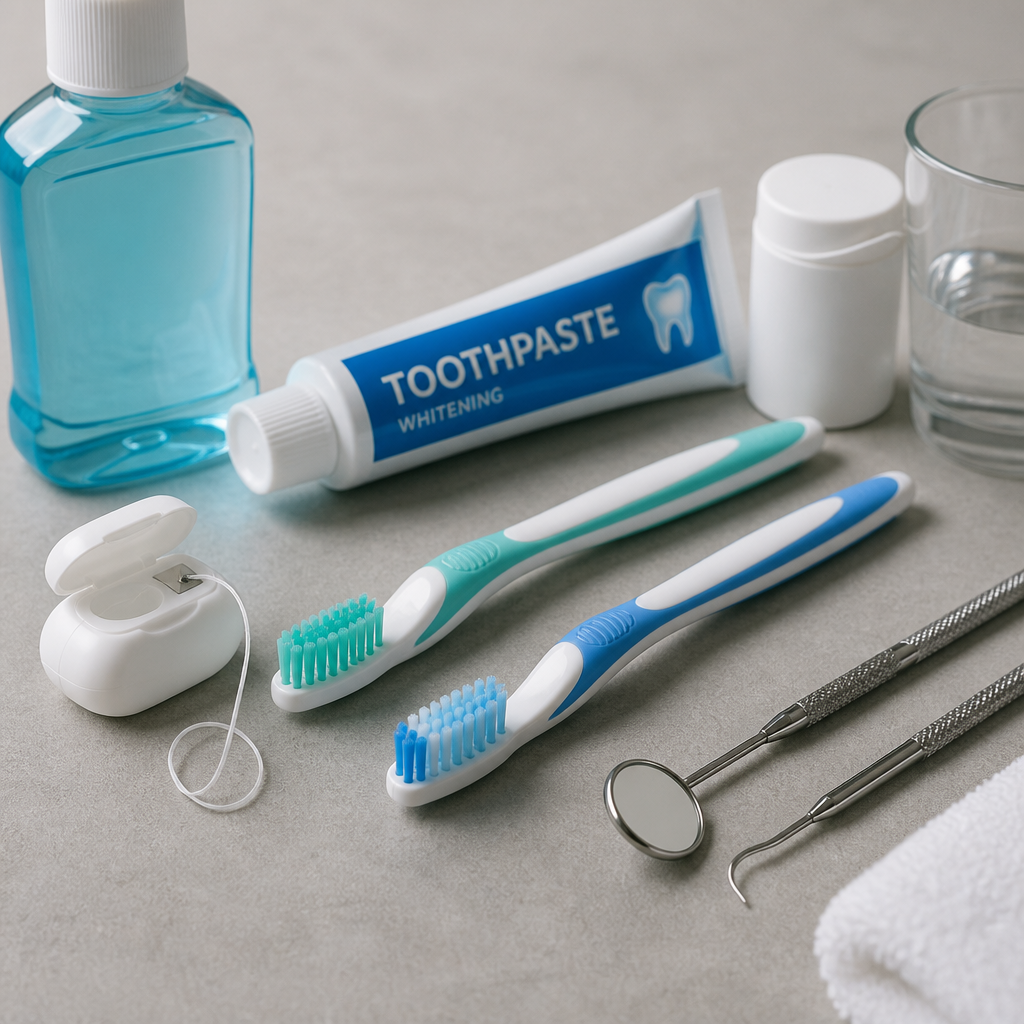
Standard adult toothbrushes are difficult to manoeuvre in the mouth of a resident who cannot cooperate fully with assisted brushing. Super soft brushes with small heads allow staff to reach all surfaces without causing discomfort to residents with tender gums, inflamed tissues, or reduced mouth opening. For residents who resist toothbrushes entirely, a silicone fingertip brush gives a care worker more control and a less invasive contact point, which can make the difference between a completed oral care task and a distressed refusal.
Comparing Approaches to Care Home Oral Health Delivery
Not all approaches to oral health delivery in care homes are equal. Below is a comparison of three approaches that care home managers commonly encounter, assessed against NG48 compliance, practicality for residents with sensitivities, and staff delivery burden.
| Approach | NG48 Compliance | Suitability for Residents with Sensitivities |
|---|---|---|
| Standard commercial toothpaste with a regular brush (e.g., mainstream retail brands with mint flavour and SLS foaming agents) | Partial. Provides fluoride but does not accommodate residents who cannot tolerate standard formulations. Refusal rates increase, reducing actual care delivery. | Poor. Strong flavours and foaming agents create barriers for residents with dementia, dysphagia, sensory sensitivities, or reduced swallowing function. |
| Specialist unflavoured, non-foaming toothpaste with a super soft small-head brush (e.g., oraNurse range with oraNurse Super Soft Toothbrush) | Strong. Aligns with Delivering Better Oral Health toolkit guidance on fluoride toothpaste. Reduces product-driven refusals, supporting consistent twice-daily compliance. | Excellent. Designed specifically for residents who cannot tolerate standard products. Available in multiple fluoride strengths to match clinical need. Available through NHS Supply Chain. |
| Oral hygiene wipes and foam swabs as a primary care tool (a common improvised approach where toothbrushing is deemed “too difficult”) | Non-compliant. NG48 requires toothbrushing with fluoride toothpaste. Foam swabs do not deliver fluoride and do not remove plaque adequately. Treating them as equivalent to toothbrushing is a documented clinical gap. | Inappropriate as a primary approach. May be used for mouth moistening in palliative contexts but should never replace fluoride toothbrushing where a resident can tolerate it. |
Frequently Asked Questions
What does NICE NG48 actually require care home managers to do?
NG48 requires care home managers to have a written oral health policy that aligns with the Delivering Better Oral Health toolkit, ensure all residents receive an oral health assessment on admission using a recognised tool such as OHAT, ensure daily mouth care is provided and documented, ensure care staff have received specific oral health training, and have clear pathways for dental referral. CQC inspectors use NG48 as a benchmark during inspections.
Is an oral health assessment required for short-stay and respite residents?
Yes. NG48 is explicit that the oral health assessment must be carried out for all residents as soon as they start living in the care home, regardless of the length or purpose of their stay. A resident staying for two weeks of respite care has the same entitlement to an assessment and a care plan as a long-term resident.
What should a care home oral health policy include to be NG48-compliant?
A compliant policy must cover the home’s duty of care in relation to oral health, daily mouth care procedures for both natural teeth and dentures, how oral hygiene products are supplied, the process for oral health assessment and care planning, what happens when a resident refuses care (including documentation requirements in line with the Mental Capacity Act), and how oral health concerns are escalated and dental referrals made. The policy must reference and align with the Delivering Better Oral Health toolkit.
What toothpaste is appropriate for residents who resist standard products?
For residents who resist standard mint-flavoured or foaming toothpastes due to dementia, sensory sensitivities, dysphagia, or a strong gag reflex, an unflavoured, non-foaming fluoride toothpaste is the clinically appropriate alternative. oraNurse produces unflavoured, non-foaming toothpaste in multiple fluoride strengths, available through NHS Supply Chain. This approach reduces product-driven refusal and supports compliance with the twice-daily brushing requirement in the Delivering Better Oral Health toolkit.
How should care staff document refusal of oral care?
NG48 requires that daily records of mouth care include instances where a resident refuses and the action taken in response. Documentation should record the date, which care element was refused, any reason given or observed, what adapted approach was attempted, and whether the refusal was escalated. This record protects the resident’s rights, demonstrates duty of care, and provides an audit trail for CQC inspection. Refusal records should be reviewed regularly to identify whether a different approach, a different product, or a dental referral is warranted.
How often should care staff receive oral health training?
NG48 requires that care staff have the knowledge and skills to deliver mouth care, but does not prescribe a specific training interval. In practice, initial training at induction is the minimum. Given high staff turnover in care settings, building oral health into annual mandatory refresher training and including competency observations is the standard recommended by sector bodies. If a home’s training records show that 40% or more of staff have not received specific oral health training, this is a documented CQC concern.
References
- NICE Guideline NG48: Oral Health for Adults in Care Homes, full guidance document
- CQC Smiling Matters Progress Report 2022: findings on oral health delivery in care homes
- CQC press release on improvements to oral health in care homes since the 2019 Smiling Matters review
- Oral Health Foundation guidance on NG48 and oral health promotion in care homes