
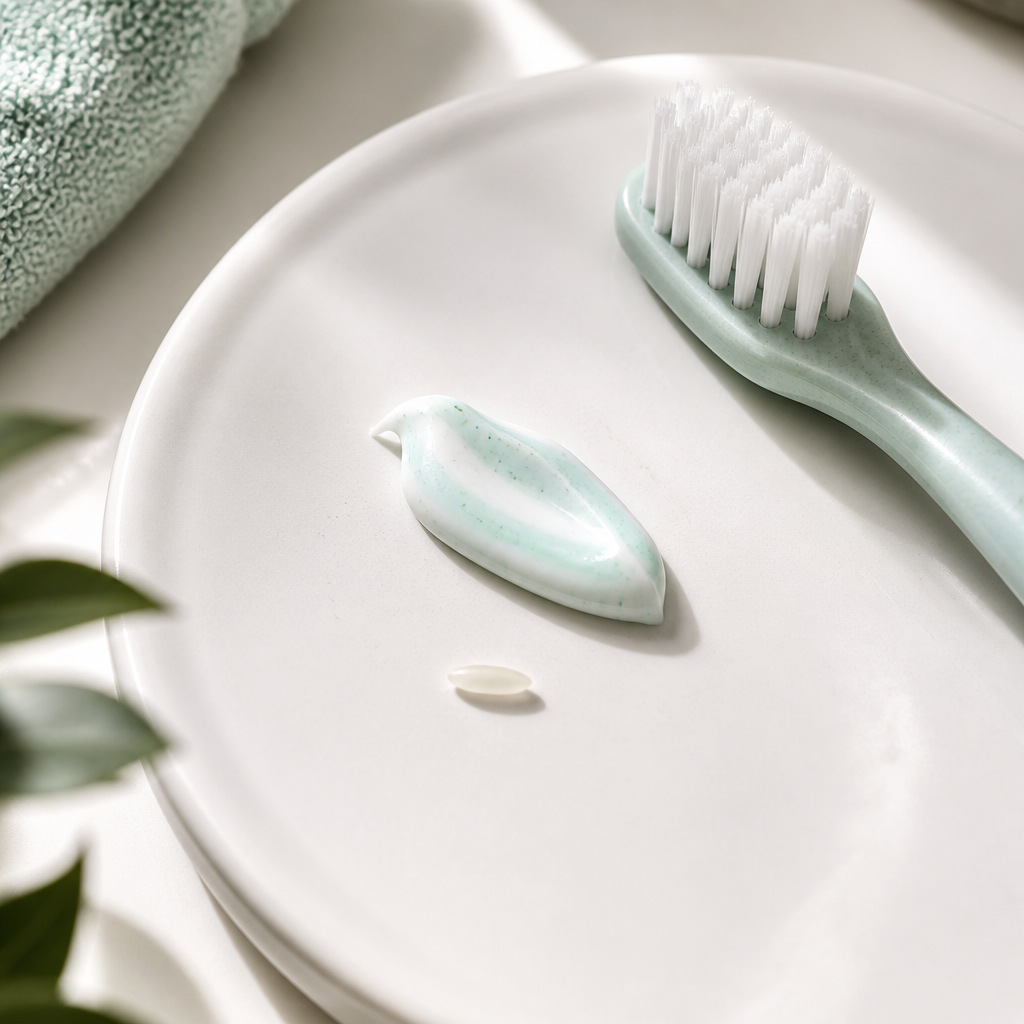
Parents are often surprised to learn that fluoride toothpaste choice is not one-size-fits-all. The amount of fluoride that protects a three-year-old’s teeth is different from what a seven-year-old needs, and the risks of getting it wrong, whether by using too little or too much, are real. This guide cuts through the confusion, gives you the current recommended guidelines on fluoride toothpaste for children by age, explains what dental fluorosis actually is and when to worry about it, and shows you why the formulation of the toothpaste matters just as much as the fluoride level itself.
Table of Contents
- Quick Takeaways
- Why Fluoride Matters for Children’s Teeth
- Fluoride Toothpaste Age Guide: The Right Level at Every Stage
- How Much Fluoride Is Too Much? Understanding Dental Fluorosis
- Why Flavour and Formulation Matter as Much as Fluoride Level
- Comparing Fluoride Toothpaste Options for Children
- Getting Brushing Technique Right From the Start
- Frequently Asked Questions
- References
Quick Takeaways
| Key Insight | Explanation |
|---|---|
| Children under 3 need at least 1000ppm fluoride | Use a smear of toothpaste (no larger than a grain of rice) from the moment the first tooth appears. Less fluoride is not safer; it is less effective. |
| Children aged 3 and over can move to 1450ppm | A pea-sized amount of 1450ppm fluoride toothpaste is recommended from age 3 and above for stronger cavity protection as more permanent teeth emerge. |
| Amount matters as much as concentration | Dental fluorosis risk comes mainly from swallowing excess toothpaste, not from using an age-appropriate amount at the correct strength. Supervise brushing. |
| Unflavoured toothpaste removes a major compliance barrier | Many children, particularly those with sensory sensitivities or autism, refuse to brush because of strong mint flavour. An unflavoured formula solves this without compromising fluoride protection. |
| SLS-free formulas are kinder to tender mouth tissue | Sodium lauryl sulphate (SLS) is the foaming agent that can irritate sensitive gums and oral mucosa. Non-foaming toothpastes are a practical alternative for children with mouth ulcers or tenderness. |
| Spitting does not have to mean rinsing | Encourage spitting out after brushing but avoid rinsing with water. Residual fluoride left on the teeth continues to protect enamel throughout the night. |
| High-risk children may need a higher prescription strength | In cases of significantly elevated decay risk, dental professionals can recommend 2800ppm fluoride toothpaste for children aged 10 and above. This is not an over-the-counter decision. |
Why Fluoride Matters for Children’s Teeth
Tooth decay remains one of the most common reasons children are admitted to hospital in the UK. That is not a background statistic to gloss over. It is a preventable condition, and fluoride toothpaste is one of the most reliably effective tools available for preventing it.
Fluoride works by strengthening tooth enamel, making it more resistant to the acid attacks produced by bacteria in dental plaque. It can also slow or even reverse early stages of decay through a process called remineralisation, where it helps rebuild weakened enamel before a cavity has fully formed. This is why the advice is not to wait until a child has a mouthful of teeth before starting to use fluoride toothpaste. Brushing begins the moment the first tooth emerges.
Fluoride in toothpaste works on the tooth surface where decay starts. Consistency of use matters far more than perfection of technique, especially in the early years when enamel is still maturing.
It is also worth understanding what fluoride is doing at a structural level. Enamel is made largely of hydroxyapatite crystals. When fluoride is present, it replaces the hydroxyl group and forms fluorapatite, a harder, less acid-soluble mineral. Children’s developing enamel is particularly responsive to this effect, which is precisely why getting the right fluoride toothpaste in place early pays dividends for long-term dental health.
Fluoride Toothpaste Age Guide: The Right Level at Every Stage
The most important practical decision for most parents is choosing the correct fluoride strength for their child’s age. The guidance below reflects the recommendations used by NHS dental professionals across the UK.
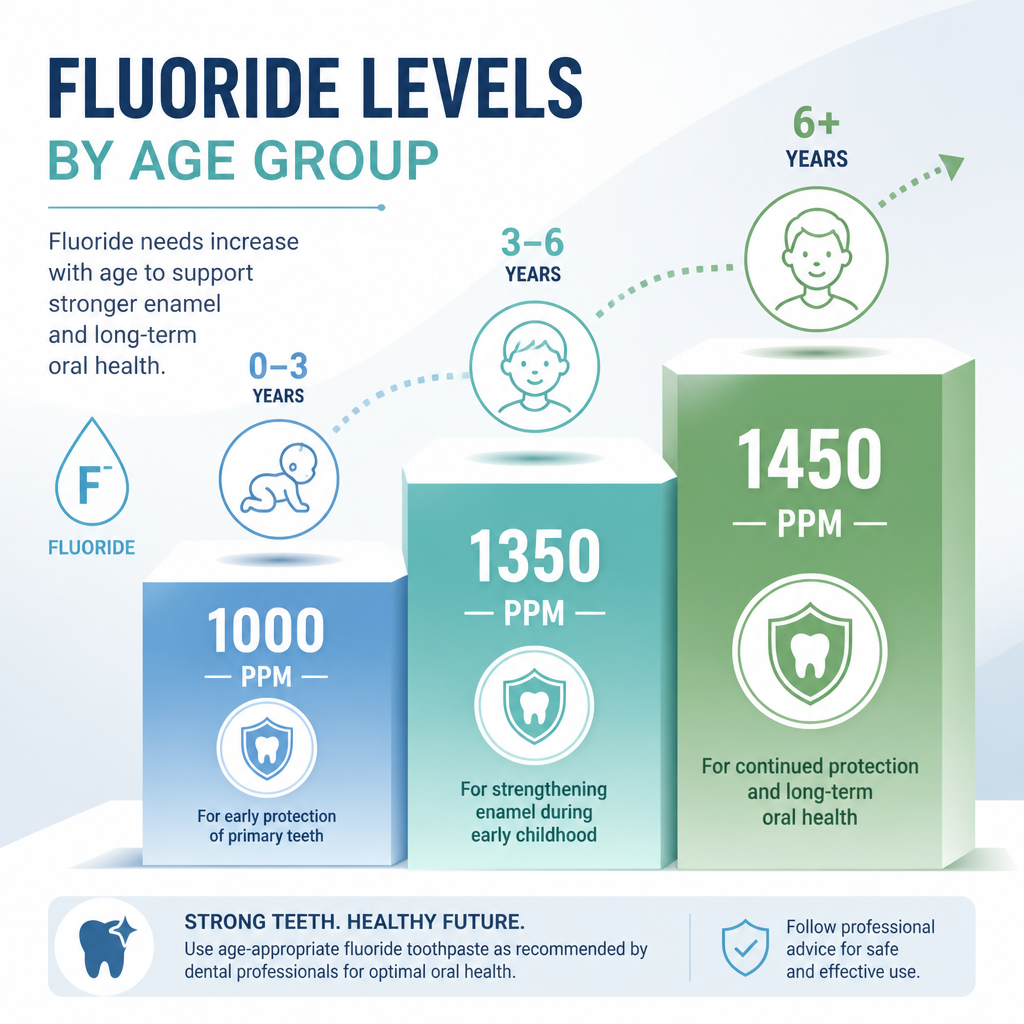
Under 3 Years: 1000ppm Fluoride, Smear Amount
As soon as the first baby tooth appears, start brushing twice daily with a smear of toothpaste containing at least 1000ppm fluoride. The smear should be no larger than a grain of rice. This tiny amount delivers protective fluoride to the tooth surface without presenting a meaningful swallowing risk, since infants and toddlers will inevitably swallow some paste rather than spitting it out.
The key word in the guideline is “at least” 1000ppm. Some toothpastes marketed for babies contain lower concentrations on the assumption that less fluoride is safer. This assumption is incorrect. A toothpaste with fewer than 1000ppm fluoride provides inadequate protection and is not recommended for preventing decay. For this age group, oraNurse offers a 1000ppm unflavoured, non-foaming formula specifically suited to infants and toddlers who need protection without the sensory challenge of flavour.
Ages 3 to 6: 1450ppm Fluoride, Pea-Sized Amount
From age 3, children can move to a pea-sized amount of 1450ppm fluoride toothpaste, brushing at least twice daily. This is the standard adult fluoride concentration, and it is appropriate because by this age, children are better at spitting out, reducing the swallowing risk. The higher concentration gives stronger protection against decay as the first permanent molars begin to emerge and dietary sugar exposure typically increases.
Many parents are nervous about moving their young child onto what looks like “adult strength” toothpaste. The pea-sized amount restriction is exactly the safeguard that makes this appropriate. A small, supervised amount of 1450ppm toothpaste is the right choice for this age group, not a junior toothpaste with lower fluoride that may leave teeth under-protected.
Ages 7 and Above: 1450ppm Fluoride, Continuing Daily Use
From age 7, children continue using 1450ppm fluoride toothpaste, gradually taking on more responsibility for their own brushing under adult supervision. This is when the emphasis shifts slightly toward technique as well as consistency, since the permanent teeth emerging now will need to last a lifetime.
For children in this age range who have a significantly elevated risk of decay, a dental professional may recommend a prescription-strength 2800ppm toothpaste. This is not an over-the-counter decision. If a dentist suggests it, the recommendation is based on a clinical assessment of that specific child’s decay risk.
Pro tip: Write the fluoride concentration on a sticky note and put it inside the bathroom cabinet. When grandparents, childminders, or older siblings are doing the brushing, it removes any guesswork about which tube to use and how much to apply.
How Much Fluoride Is Too Much? Understanding Dental Fluorosis
Dental fluorosis is a cosmetic condition caused by excessive fluoride intake during the years when permanent teeth are forming, typically from birth to around age 8. In its mildest form, it appears as faint white lines or spots on the enamel. More severe forms can cause brown discolouration and pitting, though these are rare in the UK where water fluoridation levels are carefully controlled.
The practical risk for most families is not water or food, but toothpaste swallowing. Research indicates that higher levels of fluoride in toothpaste used in very young children are associated with an increased risk of fluorosis in permanent teeth when excess paste is swallowed regularly. This is not an argument against using fluoride toothpaste. It is an argument for using the correct amount.
How to Reduce Fluorosis Risk Without Reducing Protection
The smear-for-under-3, pea-sized-for-3-plus approach is the primary safeguard. Supervise brushing until children are reliably spitting, and actively discourage rinsing and swallowing. Do not put toothpaste on the brush and leave the room. In practice, fluorosis risk is almost entirely a product of excess toothpaste being swallowed over many months, not of using the clinically recommended amount with supervision.
One underappreciated factor is toothpaste palatability. If a child finds the taste of their toothpaste appealing, they are more likely to swallow it. Strong mint flavours can paradoxically backfire in the opposite direction too; children who dislike the taste may refuse to brush at all. An unflavoured formula removes the incentive to swallow while also removing the barrier to brushing in the first place.
Why Flavour and Formulation Matter as Much as Fluoride Level
Most conversations about children’s toothpaste focus solely on fluoride concentration. That is the right starting point, but it is not the whole picture. A toothpaste with the correct fluoride level is useless if the child refuses to use it, and formulation choices have a direct bearing on compliance.
The Sensory Barrier to Brushing
Children with autism, sensory processing differences, or strong taste aversions frequently find conventional mint toothpastes intolerable. The combination of menthol flavour, foaming action, and the sensation of brushing can make tooth brushing a daily battle. oraNurse Unflavoured Toothpaste was originally developed specifically in response to this need, providing full fluoride protection without any flavouring agents or sodium lauryl sulphate.
This is not a niche product for a niche problem. Sensory sensitivities around oral care affect a significant proportion of children, including many who have not been formally diagnosed with any condition. If brushing is a daily struggle in your household, the toothpaste formulation deserves to be the first thing you review.
SLS and Why It Matters for Young Mouths
Sodium lauryl sulphate is the detergent that creates foam in most conventional toothpastes. For children with tender gums, mouth ulcers, or inflamed oral tissue, SLS can cause irritation that makes brushing uncomfortable. An SLS-free, non-foaming toothpaste eliminates this source of discomfort entirely. oraNurse’s non-foaming formula is particularly suited to children who are already reluctant brushers, as it reduces the sensory load associated with brushing.
There is also a practical point: foaming toothpaste makes it harder for children (and parents) to see what they are doing inside the mouth. Less foam means cleaner visibility during brushing, which is useful when you are trying to reach second molars in a wriggling seven-year-old.
Pro tip: If your child tolerates unflavoured food and drinks but rejects standard toothpaste, start with the oraNurse 1000ppm unflavoured formula and introduce brushing as a neutral, non-threatening sensory experience. Many families report that brushing compliance improves within days of switching away from strong-flavoured products.
Comparing Fluoride Toothpaste Options for Children
The table below compares three distinct approaches to children’s toothpaste, based on formulation type and the population each is primarily designed to serve.
| Approach | Best Suited For | Key Limitations |
|---|---|---|
| Standard flavoured children’s toothpaste (1000ppm) (e.g. most supermarket own-brand or named children’s ranges) | Children without strong taste sensitivities who tolerate fruity or mild mint flavours; those who spit reliably by age 3 | Flavour agents and SLS can deter reluctant brushers; some products use lower-than-recommended fluoride concentrations; children may swallow appealing-tasting paste |
| Unflavoured SLS-free toothpaste (1000ppm or 1450ppm) (e.g. oraNurse Unflavoured Toothpaste, available in both strengths) | Children with sensory sensitivities, autism, taste aversions, tender gums, or those who have previously refused brushing due to flavour; also suitable for any child where reducing sensory load during brushing is a priority | May need a short adjustment period if child is used to flavoured paste; less widely available in supermarkets (primarily through dental professionals and specialist oral care retailers) |
| Prescription high-fluoride toothpaste (2800ppm+) | Children aged 10 and above with a clinically assessed high decay risk; used under dental supervision only | Not appropriate for routine use or younger children; requires professional assessment; not available over the counter |
Getting Brushing Technique Right From the Start
Choosing the right toothpaste is step one. Step two is making sure it reaches all tooth surfaces. A common mistake in early childhood brushing is that parents focus on the front teeth because those are the easiest to see and reach. The back teeth, including the first permanent molars that typically appear around age 6 to 7, are the surfaces most vulnerable to decay and the hardest to clean.
A toothbrush with a small head and extra-soft bristles makes a meaningful difference here. A large-headed brush physically cannot access the surfaces behind young molars, and medium or firm bristles can cause the child to resist brushing because of the sensation. oraNurse’s super soft toothbrush range with small heads is designed precisely for this reason: to access hard-to-reach surfaces without discomfort.
The Spit, Don’t Rinse Rule
One simple habit change has a measurable impact on fluoride efficacy: after brushing, encourage children to spit out excess toothpaste but not to rinse their mouth with water. Rinsing washes away the fluoride that remains on the tooth surface, reducing the protective effect significantly. This takes a few weeks of consistent reminding to become a habit, but it is one of the most practical, zero-cost improvements to any child’s brushing routine.
When to Start Using a Fingertip Brush
For infants with one or two erupting teeth, a silicone fingertip toothbrush allows a parent to control exactly how much pressure is applied, and to gently introduce the sensation of brushing before a child is ready for a conventional toothbrush. It is also helpful for children who are hypersensitive to the sensation of a bristled brush. oraNurse offers a fingertip toothbrush that fits most adult fingers and pairs naturally with their unflavoured toothpaste for a fully low-stimulus brushing routine.
Frequently Asked Questions
What is the correct fluoride level for a child’s toothpaste?
Children under 3 should use a toothpaste with at least 1000ppm fluoride, applied as a smear no larger than a grain of rice. From age 3 onwards, a pea-sized amount of 1450ppm fluoride toothpaste is recommended. These levels align with NHS guidance and are the concentrations at which fluoride has a proven protective effect on developing teeth.
Is 1000ppm fluoride toothpaste safe for babies and toddlers?
Yes. A smear-sized amount of 1000ppm fluoride toothpaste is specifically recommended for children from the appearance of their first tooth until age 3. The key safeguard is the quantity used, not the concentration itself. Using less fluoride than 1000ppm is not safer; it simply provides weaker decay protection. Supervise brushing to minimise swallowing.
My child refuses to brush because of the taste of toothpaste. What can I do?
Start with an unflavoured, non-foaming toothpaste. Many children, particularly those with sensory sensitivities, find mint or fruit-flavoured toothpastes genuinely intolerable rather than simply fussy. oraNurse Unflavoured Toothpaste contains no flavouring agents and no SLS, which removes the two most common sensory triggers for brushing refusal, while maintaining full fluoride protection at either 1000ppm (under 3) or 1450ppm (age 3 and above).
Can my child get too much fluoride from toothpaste?
The primary risk of excessive fluoride from toothpaste is dental fluorosis, a cosmetic change in enamel appearance. This risk is almost entirely a function of swallowing large amounts of toothpaste repeatedly over time, not of using the clinically recommended amount under supervision. Use the correct quantity for your child’s age, supervise brushing, and encourage spitting rather than swallowing. Fluoride in food, water, and supplementary sources all contribute to total intake, so using toothpaste correctly and to NHS-recommended amounts is the right approach for the vast majority of children.
At what age should my child brush their own teeth without supervision?
Most dental professionals recommend supervising brushing until a child is at least 7 years old, and many suggest continuing to check brushing quality until age 10 or so. Unsupervised brushing in younger children almost always means inadequate coverage of back teeth and back surfaces, plus a higher likelihood of swallowing excess paste. You do not have to do the brushing yourself, but standing nearby and checking the result makes a significant difference to the standard achieved.
What makes oraNurse toothpaste different from standard children’s toothpaste?
oraNurse is unflavoured and contains no sodium lauryl sulphate, the foaming agent used in most conventional toothpastes. It was originally developed for children with autism and sensory processing differences who could not tolerate flavoured, foaming products. It provides the same fluoride protection (1000ppm for under 3s, 1450ppm for age 3 and above) as standard-strength toothpaste without the sensory barriers that cause many children to refuse brushing. It is also used in healthcare settings including NHS supply chain, which reflects the level of professional confidence in its formulation.
Should I use a child-specific toothbrush alongside fluoride toothpaste?
Yes. The toothbrush matters almost as much as the toothpaste. A brush with a small head reaches the back teeth and tight spaces between molars that a larger brush misses. Super-soft bristles reduce the sensation of brushing on tender gum tissue, making children more willing to allow thorough cleaning. For infants, a silicone fingertip toothbrush gives the parent precise control over pressure and reach, and pairs well with a smear of unflavoured 1000ppm toothpaste as a complete first brushing routine.
References
- NHS Inform Scotland: Fluoride guidance for children and adults, including recommended fluoride levels and brushing amounts by age
- Scottish Dental Clinical Effectiveness Programme: Evidence-based toothbrushing and fluoride recommendations for children at varying caries risk
- Cochrane Review: Evidence on topical fluoride and dental fluorosis risk in children, including analysis of toothpaste concentration and brushing age
- PubMed Central: Fluoride intake and fluorosis risk in young children, including analysis of toothpaste ingestion as a key contributing factor