
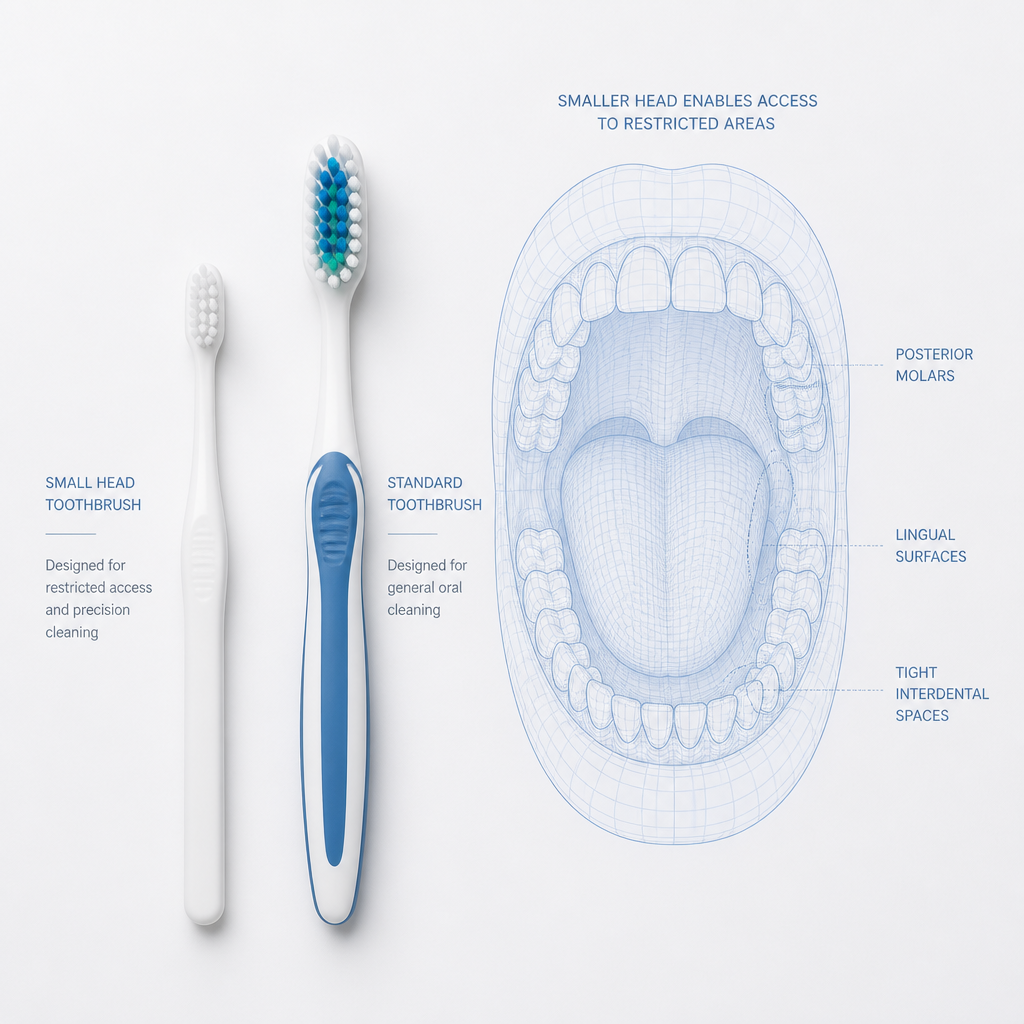
Most toothbrush decisions are made on autopilot: grab whatever is stocked, brush for two minutes, done. But for a substantial group of patients, a standard toothbrush head is not just inconvenient. It is a genuine barrier to oral hygiene. Anyone living with trismus, recovering from oral or head and neck surgery, managing a temporomandibular joint disorder, or coping with restricted mouth opening due to fibrosis faces a daily practical problem: how do you clean your teeth properly when your mouth will not open fully? The answer starts with the extra small toothbrush head, and this article explains precisely why size matters, who needs it, and what clinical and consumer decisions flow from that choice.
Table of Contents
- Quick Takeaways
- Why Toothbrush Head Size Is a Clinical Decision, Not a Preference
- Who Needs an Extra Small Toothbrush Head
- Oral Care and Trismus: The Overlooked Hygiene Crisis
- Gentle Toothbrush After Surgery: What the Healing Mouth Needs
- Choosing a Toothbrush for Limited Mouth Opening
- Comparing Brush Options for Restricted Access
- The Toothpaste Problem You Also Need to Solve
- Frequently Asked Questions
- References
Quick Takeaways
| Key Insight | Explanation |
|---|---|
| Head size directly affects access | A standard adult toothbrush head forced through a partially opened mouth causes pressure on the commissure and surrounding soft tissue, making brushing painful or impossible for patients with restricted opening. |
| Trismus dramatically compromises oral hygiene | Trismus (restricted jaw opening) is a recognised complication of head and neck cancer treatment, jaw surgery, and TMJ disorders. It makes standard toothbrushes impractical and often unusable. |
| An extra small head is approximately 20-25mm in length | This allows the brush to angle into the posterior arch without making contact with adjacent soft tissue or the opposing arch, even when mouth opening is severely limited. |
| Super soft bristles are non-negotiable post-surgery | Healing gingival tissue, exposed root surfaces, and post-surgical mucosa are all significantly more vulnerable to abrasion. Firm bristles that would be fine on healthy enamel can cause real damage here. |
| Compliance depends on the full sensory experience | A correctly sized brush used with a strongly flavoured, foaming toothpaste still produces compliance failure in many patients with oral sensitivities. Brush and paste must be matched. |
| Healthcare professionals should specify head size in care plans | Recommending “a soft toothbrush” without specifying head size leaves the patient to make a choice that many lack the clinical context to make correctly. |
| Silicone fingertip brushes offer an even smaller footprint | For patients with extreme oral aversion or very limited opening, a silicone fingertip brush removes the rigid handle from the equation entirely and reduces the contact area to its minimum. |
Why Toothbrush Head Size Is a Clinical Decision, Not a Preference
There is a persistent assumption in oral health communication that toothbrush selection is a personal preference issue, something to choose based on what feels comfortable in a healthy mouth. For the majority of the population, that is broadly true. For patients with complex oral care needs, it is not.
When a standard toothbrush head, which can measure 30mm or more in length, is used by someone who can only open their mouth 20-30mm, the geometry simply does not work. The brush cannot be angled correctly, it cannot reach posterior teeth, and the process of inserting it causes direct pressure on already-sensitive tissues. A patient in this situation does not brush less thoroughly. In most cases, they stop brushing at all.
This is why head size is a clinical decision. The consequences of failed oral hygiene in medically complex patients are serious. Poor oral hygiene can result in dental caries, chronic gum disease, dental abscesses, and in patients who have received radiation to the head and neck, radiation-related osteoradionecrosis of the jaws. In older and care-dependent populations, aspiration pneumonia linked to poor oral hygiene is a documented preventable cause of death. The toothbrush head size is the first practical lever in preventing this cascade.
Pro tip: When advising patients with limited mouth opening, always ask them to describe the physical sensation of brushing, not just whether they brush. Pain, pressure, and gagging on the brush handle are all signals that the tool is wrong, not the patient’s technique.
Who Needs an Extra Small Toothbrush Head
The clinical indications for an extra small toothbrush head are broader than most people expect. This is not a niche product for a tiny patient group. It is the correct tool for a range of common and overlapping conditions.
Post-surgical and post-radiotherapy patients
Anyone who has undergone surgery to the jaw, mouth, or head and neck region may experience restricted mouth opening during recovery. For patients who have received radiotherapy to the head and neck, fibrosis (scarring of soft tissue) can develop and worsen over time, progressively reducing the range of motion. This is not a temporary problem: fibrosis can build up years after radiation therapy has ended.
Patients with trismus
Trismus is a condition in which restricted jaw opening makes daily oral hygiene genuinely difficult or impossible to perform adequately. It can result from surgery, radiation, trauma, or temporomandibular joint disorders. Normal mouth opening is broadly considered to be in the range of 35-60mm. When opening falls significantly below this, standard toothbrush heads become physically impractical.
People with sensory or neurological conditions
Autism, cerebral palsy, Parkinson’s disease, and other neurological or sensory conditions can produce oral hypersensitivity, reduced jaw mobility, or a heightened gag reflex. A smaller brush head reduces the physical footprint in the mouth, which lowers the sensory load and reduces the risk of triggering a gag response. For carer-assisted brushing, a small head also gives the carer better visibility and more precise control.
Elderly and care-dependent individuals
Age-related reduction in jaw mobility, dry mouth, and oral fragility all make a smaller, softer brush head clinically appropriate. This group often has the least capacity to communicate that brushing is uncomfortable, which makes the right equipment more important, not less.
Pro tip: Healthcare professionals in NHS community dental teams and care settings should document the specific toothbrush head size and type in oral care plans. A note that says “soft toothbrush” is not actionable. A note that specifies an extra small headed, super soft brush removes the ambiguity entirely and supports consistent care across multiple carers and shifts.
Oral Care and Trismus: The Overlooked Hygiene Crisis
Trismus is one of the most clinically underaddressed oral hygiene problems in complex patient groups. It is well documented as a complication of head and neck cancer treatment, but it also occurs after jaw surgery, as a result of temporomandibular joint disorders, and following trauma. The restriction it creates is not just uncomfortable. It makes standard oral hygiene genuinely difficult.
When someone cannot open their mouth fully, the practical consequences for oral hygiene are immediate. The patient may struggle to brush their teeth effectively. Their dentist may be unable to perform routine dental care due to limited access to the mouth. The standard tools that work for patients with normal opening simply do not work here, and the result is a predictable decline in oral health if the right equipment is not provided.
The mechanical reality is straightforward: you cannot clean what you cannot reach. For a patient with trismus, an extra small toothbrush head is not an upgrade. It is a prerequisite for any brushing to happen at all.
For patients managing trismus caused by radiation-related fibrosis, the problem is also progressive. Fibrosis develops as healing tissue scars after surgery or radiation, and in some cases continues to worsen over time. Oral hygiene equipment recommendations need to keep pace with the changing degree of restriction, not just address the acute post-treatment period.
The wider health implications of poor oral hygiene in this patient group are significant. Dental caries, periodontitis, and dental abscesses are all more likely when brushing is inadequate. For patients who have received head and neck radiotherapy specifically, poor oral hygiene is associated with serious local complications that go well beyond routine tooth decay. Addressing the toothbrush head size is not a cosmetic fix. It is part of managing systemic risk.
Gentle Toothbrush After Surgery: What the Healing Mouth Needs
Post-surgical oral care is a context where the wrong toothbrush choice has direct, tangible consequences. The mouth after surgery is a different environment from the healthy mouth: tissue is healing, surgical sites are tender, and the normal protective mechanisms of the gingiva are temporarily compromised. A brush that would be perfectly appropriate for a healthy patient can cause real harm here.
Why bristle softness matters as much as head size
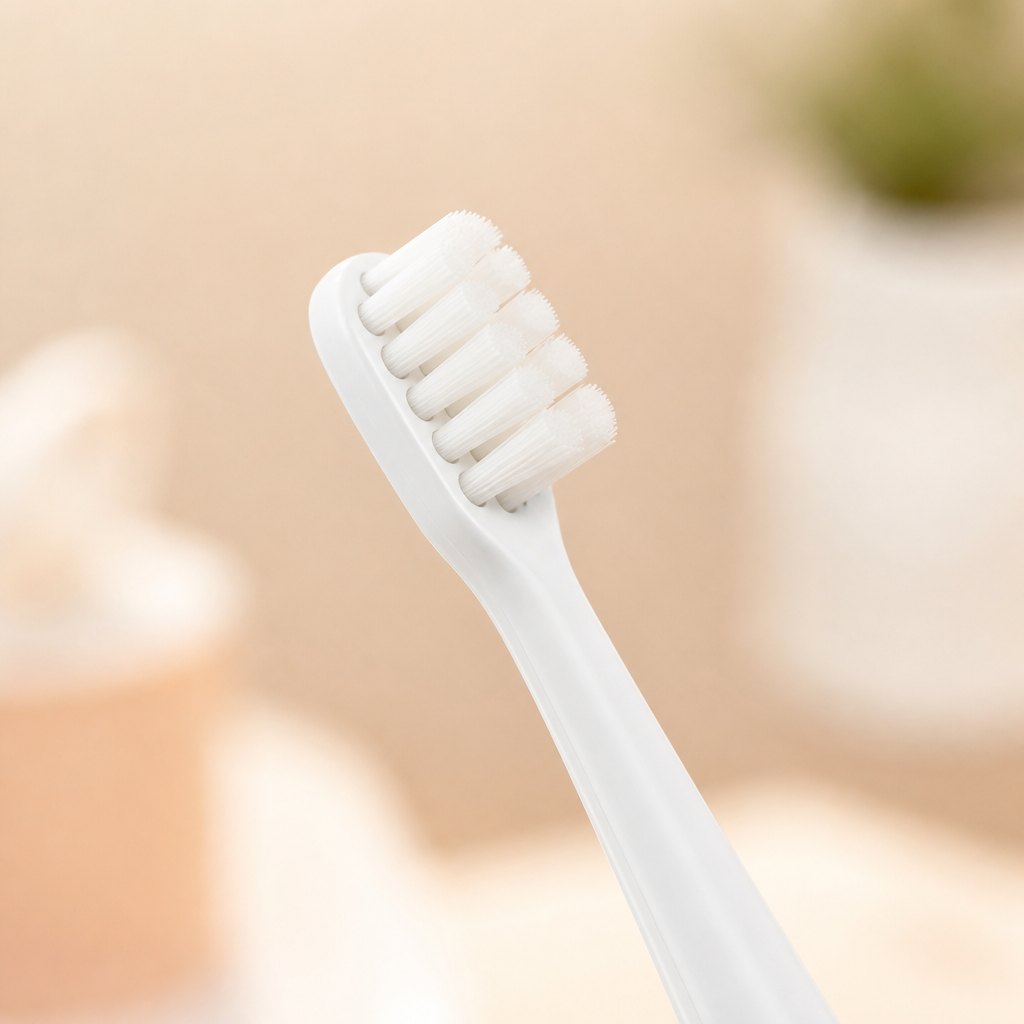
Exposed dentine, cementum, and post-surgical mucosa are all significantly softer than intact enamel. Bristles that would not abrade healthy enamel can damage these tissues. Super soft bristles with the correct filament density are not a comfort preference in this context. They are a clinical requirement. The mechanical removal of plaque depends on bristle contact with the tooth surface and gingival sulcus, and super soft bristles can achieve this contact without the lateral scrubbing force that causes tissue trauma.
The access problem that soft bristles alone cannot solve
Reducing bristle firmness addresses one problem, but if the head is still too large to navigate a post-surgical mouth with limited opening, the patient still cannot brush effectively. The extra small head combined with super soft bristles is the correct pairing, not either element alone. A standard brush head forced through a partially opened mouth creates pressure against the commissure and makes the process genuinely painful. For patients already managing surgical pain, that additional discomfort is enough to stop brushing entirely.
Recovery timescales vary considerably depending on the type of surgery, individual healing, and whether adjuvant therapies such as chemotherapy or radiotherapy are involved. The gentle post-surgical toothbrush should not be seen as a temporary measure for one or two weeks. In patients with ongoing limited opening due to fibrosis or trismus, it may be the correct tool indefinitely.
Choosing a Toothbrush for Limited Mouth Opening
When limited mouth opening is the primary constraint, the practical selection criteria for a toothbrush are specific. Marketing language like “compact head” or “smaller profile” is not sufficient. Actual measurements matter.
What dimensions to look for
For adults, an extra small toothbrush head is generally one that measures around 20-25mm in length and no wider than 10mm. This allows the brush to angle into the posterior arch without contacting adjacent soft tissue or the opposing arch. Some manufacturers describe their adult brushes as having a compact head while still exceeding these dimensions, so checking actual measurements rather than relying on marketing descriptions is the correct approach.
Handle length and rigidity
The handle is often overlooked when selecting a toothbrush for limited mouth opening, but it matters for a different reason. A long rigid handle can catch on the corner of the mouth during insertion when opening is severely restricted, which adds discomfort and reduces control. For patients with very limited opening, a silicone fingertip brush eliminates the handle problem entirely. It sits on the carer’s or patient’s fingertip, requires minimal clearance for insertion, and gives direct tactile feedback during brushing.
Carer-assisted brushing considerations
In care settings, the person doing the brushing is often a carer, not the patient themselves. An extra small head gives the carer better visibility of what they are cleaning and more precise control over where the bristles are placed. This is not a trivial benefit: carer-assisted brushing of a patient with limited mouth opening is a technical task, and the right equipment makes a meaningful practical difference to the quality of the result.
Comparing Brush Options for Restricted Access
| Brush Type | Best Suited For | Key Limitation |
|---|---|---|
| Extra small headed super soft toothbrush (e.g. oraNurse Supersoft Extra Small Headed Toothbrush) | Patients with trismus, post-surgical recovery, limited mouth opening, sensory sensitivities. Full posterior access with correct angling. Suitable for self-brushing and carer-assisted use. | Still requires some degree of mouth opening. Does not eliminate the handle as a physical obstacle for patients with very severe restriction. |
| Silicone fingertip toothbrush (e.g. oraNurse silicone fingertip brush) | Patients with extreme oral aversion, very severe limited opening, or those in early transition from no brushing to active brushing. Minimal oral footprint, no rigid handle. | Relies on carer or patient having manual dexterity to use the finger correctly. May not provide equivalent posterior access to a handled brush in all cases. |
| Standard soft toothbrush with compact adult head (e.g. general pharmacy soft brush) | Patients with mild sensitivity and near-normal mouth opening who want a slightly smaller head than average. | Head often still exceeds 25mm in length. “Soft” bristle grade varies widely between manufacturers. Insufficient for patients with clinically significant restricted opening or post-surgical healing tissue. |
The comparison above reflects a practical hierarchy. For most patients with restricted mouth opening, the extra small headed super soft brush is the right primary tool. The silicone fingertip brush is the right starting point for patients at the more severe end of the restriction spectrum, or as an introduction for patients who are resistant to any brush contact. The standard soft brush is the wrong choice for anyone with clinically significant limited opening, regardless of its marketing description.
The Toothpaste Problem You Also Need to Solve
Addressing the toothbrush without addressing the toothpaste is solving half the problem. This is a common error in oral care planning for complex patients, and it matters more than it might appear.
Patients with trismus, post-surgical recovery, oral sensitivities, or sensory conditions often have barriers to toothpaste compliance that are entirely separate from their brush choice. Strong mint flavours can trigger oral aversion in patients with chemotherapy-related mucositis or sensory hypersensitivity. High-foam formulations can cause gagging or aspiration risk in patients with swallowing difficulties. Both of these barriers are entirely preventable if the right product is specified.
oraNurse’s unflavoured, non-foaming toothpaste is formulated specifically to remove these sensory barriers. It is available in multiple fluoride strengths, which matters because the correct fluoride level needs to match the patient’s clinical risk profile, not just a default choice. For high-risk patients such as those undergoing head and neck cancer treatment, fluoride level is a clinical decision in its own right. Available through NHS supply chain partnerships and from pharmacies via PIP code, it is a practical option for healthcare settings procuring at scale.
The absence of strong flavour is not a marketing quirk. It addresses a real barrier to compliance in patients with sensory sensitivities, flavour aversions, and swallowing difficulties. In practice, the most successful oral hygiene programmes in inpatient and care settings are those that remove every barrier to compliance. A correctly sized brush combined with an unflavoured, non-foaming toothpaste removes two of the most common barriers simultaneously.
Pro tip: For patients newly diagnosed with trismus or referred after head and neck cancer treatment, build the complete oral hygiene kit recommendation into the first clinical interaction: extra small headed super soft brush, unflavoured non-foaming toothpaste at the appropriate fluoride strength, and written instructions for carer-assisted use if relevant. Waiting until oral hygiene has already deteriorated makes the problem significantly harder to reverse.
Frequently Asked Questions
What is considered an extra small toothbrush head for adults?
For adults, an extra small toothbrush head is generally one measuring around 20-25mm in length and no wider than approximately 10mm. These dimensions allow the brush to navigate a restricted oral space and angle into the posterior arch without pressing against adjacent soft tissue or the opposing arch. It is worth checking actual product measurements rather than relying on terms like “compact” or “small,” which are not standardised across manufacturers.
Can an extra small toothbrush head clean as effectively as a standard one?
Yes. Effective plaque removal depends on bristle contact with the tooth surface and gingival sulcus, not on head size. A smaller head that can actually reach and access posterior teeth in a restricted mouth will clean far more effectively than a larger head that cannot be properly positioned. For patients with limited opening, the extra small head is not a compromise. It is the more effective tool for their specific anatomy and clinical situation.
What toothbrush should I use after jaw or oral surgery?
A gentle toothbrush after oral surgery should combine an extra small head with super soft bristles. Post-surgical tissue, including healing gingiva, exposed root surfaces, and surgical sites, is significantly more vulnerable to abrasion than healthy enamel. Super soft bristles at the correct filament density remove plaque without causing trauma to healing tissue. This pairing should be used from the point at which brushing is cleared by the surgical team and maintained for as long as restricted opening or tissue tenderness persists.
What is trismus and how does it affect oral hygiene?
Trismus is a condition in which restricted range of motion of the jaw makes full mouth opening difficult, painful, or in severe cases impossible. It can result from head and neck cancer treatment including surgery and radiotherapy, from temporomandibular joint disorders, from trauma, or from post-surgical scarring and fibrosis. Its impact on oral hygiene is direct: when mouth opening is severely limited, standard toothbrush heads cannot be inserted, angled, or moved effectively. Poor oral hygiene in this patient group increases risk of caries, periodontitis, dental abscesses, and in patients who have received head and neck radiation, more serious local complications.
Is an unflavoured toothpaste really necessary when switching to an extra small toothbrush?
For many patients with complex oral care needs, yes. The patients most likely to benefit from an extra small toothbrush head, including those with post-surgical sensitivity, trismus, oral sensitivities, or sensory conditions, are often the same patients who have difficulty tolerating strongly flavoured or high-foam toothpastes. Using the correct brush with an inappropriate toothpaste leaves a significant compliance barrier in place. Pairing an extra small headed super soft brush with an unflavoured, non-foaming toothpaste addresses the brushing experience as a complete sensory event rather than solving only one element of it.
When is a silicone fingertip toothbrush better than an extra small headed brush?
A silicone fingertip toothbrush is the better starting point when mouth opening is so severely limited that even a small handled brush creates difficulty on insertion, or when a patient has strong oral aversion and refuses brush contact entirely. The fingertip brush removes the rigid handle from the equation, sits directly on the carer’s or patient’s finger, and has the smallest possible oral footprint. For many patients, it serves as a transitional tool, introducing controlled contact and building tolerance before moving to a handled extra small brush for more thorough posterior access.
Where can healthcare professionals in the UK source extra small headed super soft toothbrushes?
oraNurse produces the Supersoft Extra Small Headed Toothbrush, which is designed specifically for this patient group and is available through NHS supply chain partnerships. For NHS facilities or care settings procuring in volume, NHS supply chain access makes it a practical option within existing procurement channels. The unflavoured non-foaming toothpaste is available from pharmacies via PIP code and through online care product distributors.
References
- Oral Cancer Foundation: Trismus complications, causes, and oral health impact
- Head and Neck Cancer Alliance: Managing trismus and its effects on oral hygiene
- NCBI Bookshelf: Radiation-induced trismus in head and neck cancer, current definitions and clinical implications
- THANC Guide: How trismus affects oral hygiene and practical strategies to help
- Facial Palsy UK: Patient guide to trismus, mouth opening measurement, and management