
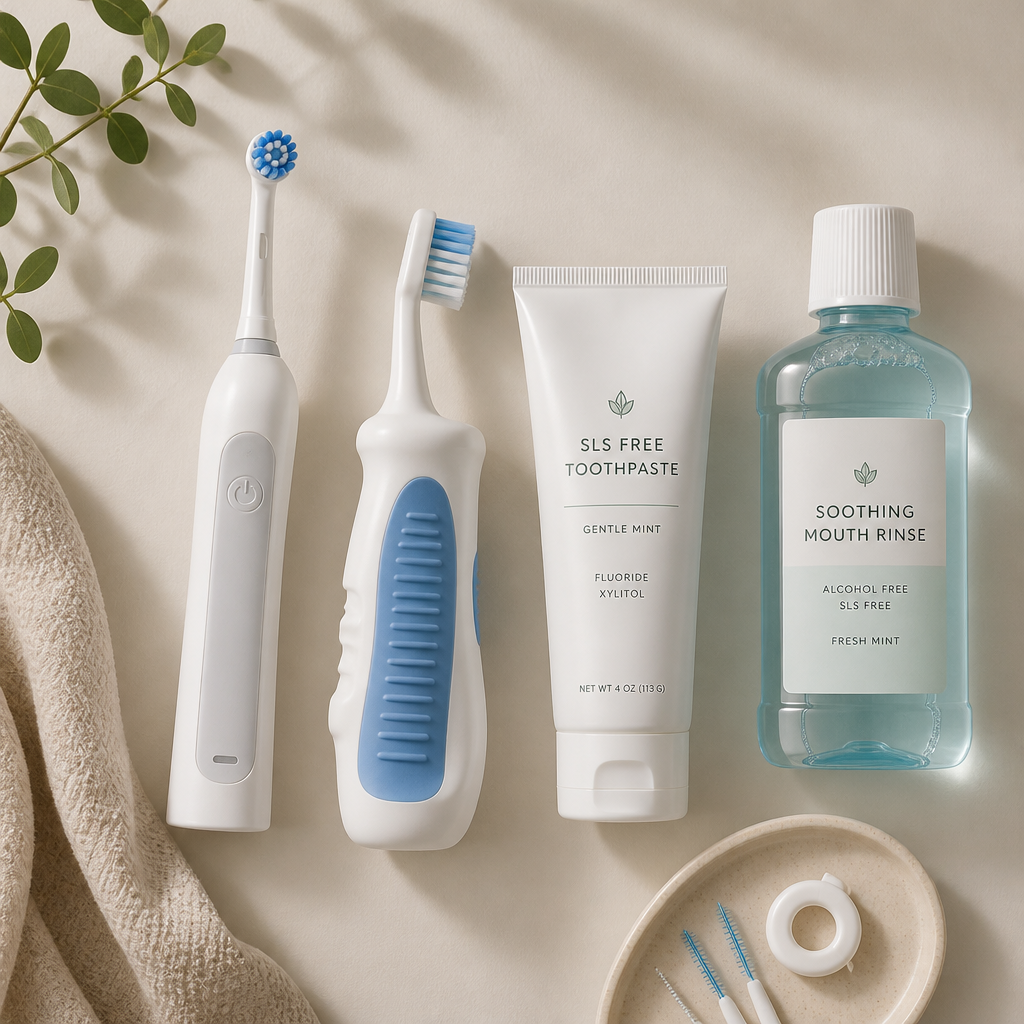
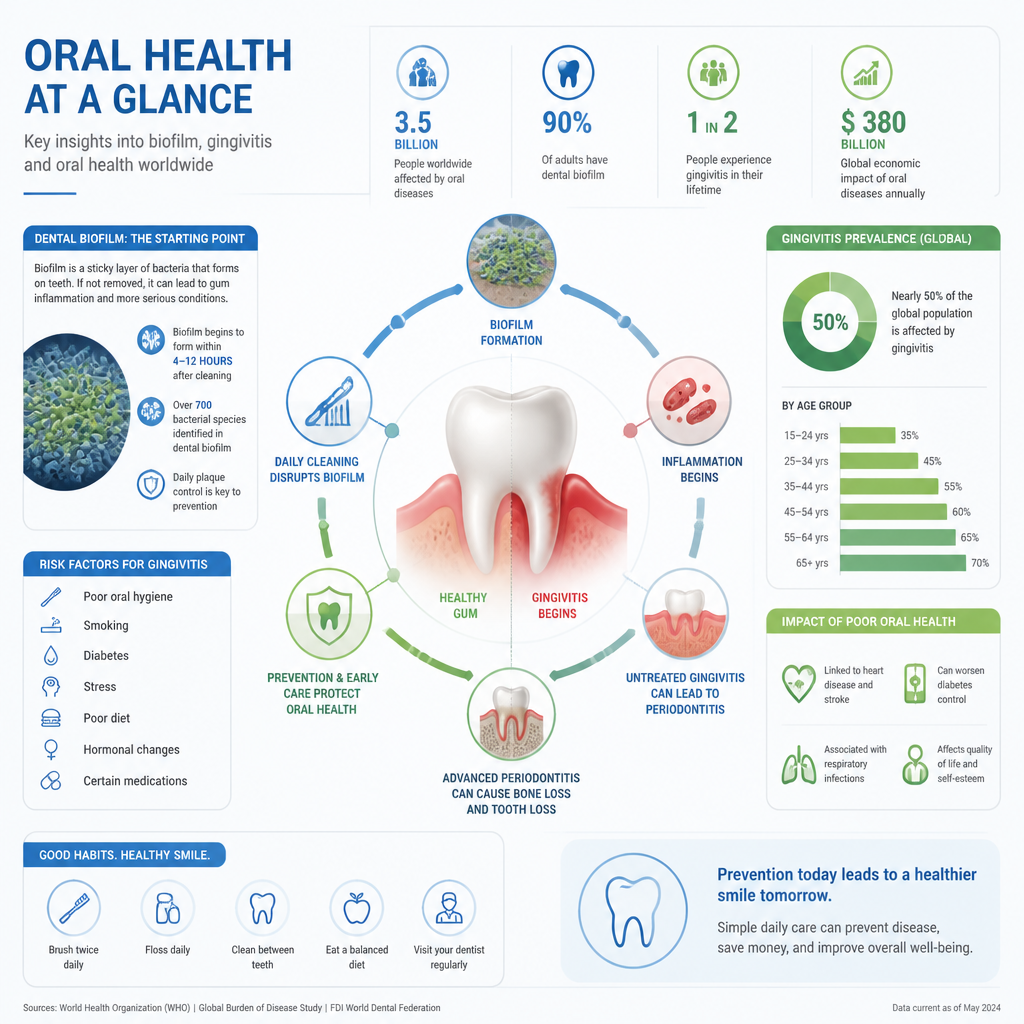
Parkinson’s disease makes a toothbrush feel like an obstacle course. Tremors reduce grip and control, rigidity slows the arc of every brush stroke, and cognitive fatigue makes a twice-daily routine feel like a full workout. The result is a predictable cascade: plaque builds faster than it is removed, gum disease takes hold, and tooth decay accelerates. Research published in npj Parkinson’s Disease found that people with Parkinson’s show a higher prevalence of dental biofilm, gingivitis, and caries than age-matched controls. Oral care for Parkinson’s disease is not a peripheral concern. It sits right at the centre of daily quality of life, and it deserves a practical, evidence-informed approach.
Table of Contents
- Quick Takeaways
- Why Parkinson’s Damages Oral Health
- Motor Symptoms and Brushing Difficulty
- Choosing the Right Tools
- Toothpaste Choices Matter More Than Most People Think
- Adaptive Techniques for Independent Brushing
- Caregiver-Assisted Oral Hygiene
- Comparing Oral Hygiene Tools for Parkinson’s
- Working with Dental Professionals
- Frequently Asked Questions
- References
Quick Takeaways
| Key Insight | Explanation |
|---|---|
| Dry mouth and drooling can coexist | Parkinson’s disrupts normal saliva management. Xerostomia affects between 49% and 77% of people with Parkinson’s, while drooling is caused by reduced swallowing efficiency rather than excess saliva production. Both conditions accelerate tooth decay. |
| A small-headed, super soft toothbrush outperforms a standard brush | A compact brush head reaches posterior teeth and tight gum margins without requiring wide jaw opening. Ultra-soft bristles protect inflamed, tender gums that are common in people with Parkinson’s. |
| Strong-flavoured toothpaste can trigger the gag reflex | Mint and strong flavourings intensify sensory responses. People with Parkinson’s who also have swallowing difficulties are particularly vulnerable. Unflavoured, non-foaming toothpaste removes this barrier entirely. |
| Timing brushing around medication peaks improves outcomes | Motor function is at its best roughly 60 to 90 minutes after a levodopa dose. Scheduling brushing within this window makes independent brushing more achievable and less distressing. |
| A silicone fingertip toothbrush is a practical caregiver tool | For people who can no longer manage a standard handle, a fingertip brush gives the caregiver full control of pressure and angle while remaining gentle on sensitive gum tissue. |
| Alcohol-based mouthwash worsens dry mouth | Many standard mouthwashes contain alcohol, which dries the oral mucosa further. People with Parkinson’s-related xerostomia should avoid these products entirely. |
| Most people with Parkinson’s do not brush for long enough | A retrospective study cited in npj Parkinson’s Disease found that most individuals with Parkinson’s brushed for less than two minutes. Adaptive strategies and tool choices must address this directly. |
Why Parkinson’s Damages Oral Health
Parkinson’s disease affects the oral cavity from multiple directions at once. The neurological changes that cause motor symptoms also alter how the mouth produces and manages saliva, how the tongue moves food during chewing, and how efficiently swallowing occurs. These are not cosmetic inconveniences. They are direct pathways to serious dental disease.
Xerostomia (dry mouth) is among the most clinically significant oral consequences of Parkinson’s. Reduced saliva flow strips the mouth of its natural buffering and remineralising action, leaving enamel exposed to the acids produced by plaque bacteria. The prevalence of dry mouth among people with Parkinson’s has been reported to range from 49% to 77%, making it one of the most common oral complaints in this population. Many Parkinson’s medications, particularly anticholinergics, compound this problem further.
Drooling, which appears to contradict the idea of a dry mouth, actually has a different mechanism entirely. The primary cause is not excess saliva production but reduced swallowing efficiency. The saliva pools at the front of the mouth because it is not being cleared. Both conditions can and do coexist in the same person, creating a complicated picture for oral health management.
Dysphagia (difficulty swallowing) is another factor with direct oral health consequences. People who cannot swallow comfortably often reduce their fluid intake, which worsens xerostomia. They may also avoid certain foods, leading to dietary patterns that are higher in soft, processed, or sugary options, increasing cariogenic exposure. The interaction between swallowing difficulty and oral health is a cycle that worsens without targeted intervention.
Motor Symptoms and Brushing Difficulty
The physical act of brushing teeth requires grip, fine motor control, range of movement in the wrist and shoulder, and sustained concentration. Parkinson’s undermines every one of these requirements simultaneously.
Tremor and Its Effect on Brushing Accuracy
A resting tremor, one of the most recognisable features of Parkinson’s, makes it difficult to position a toothbrush with precision. The brush head moves unpredictably across tooth surfaces and gum margins, causing inconsistent plaque removal and, more immediately, gum trauma from uncontrolled bristle pressure. In practice, people compensate by pressing harder to stabilise the brush, which makes gum damage worse rather than better.
Intentional tremor and dyskinesia, which occur with involuntary movements, add further complexity. Where a resting tremor tends to settle once the person begins moving intentionally, dyskinesia can actually increase with voluntary activity. This means that even focused effort to brush carefully does not guarantee controlled movement.
Rigidity and Reduced Range of Motion
Muscle rigidity limits the rotation of the wrist and the full opening of the jaw. For thorough brushing, particularly of posterior teeth, you need both. When either is restricted, specific areas of the mouth, typically the back molars and the inner surfaces of lower teeth, receive consistently poor cleaning. These are exactly the surfaces where calculus builds up fastest and where the earliest signs of periodontitis appear.
Bradykinesia, the general slowing of movement, means that even when coordination is adequate, brushing takes longer and requires more cognitive effort. Fatigue sets in earlier. The two-minute recommendation becomes genuinely difficult to achieve, and a study referenced in npj Parkinson’s Disease confirmed that most individuals with Parkinson’s brush for less than two minutes and fail to replace their brush heads on schedule. This is not a matter of motivation. It is a direct consequence of disease progression.
Choosing the Right Tools
The right tools reduce the physical demand of oral hygiene without removing the person’s agency. The wrong tools turn a manageable task into an exhausting or painful one.
The Case for a Super Soft, Small-Headed Toothbrush
A super soft toothbrush with a small head is the single most impactful tool change for most people with Parkinson’s. The logic is straightforward: inflamed, tender gums cannot tolerate medium or hard bristles. In someone whose brushing angle is already imprecise due to tremor, stiffer bristles cause gum recession and discomfort that discourages brushing altogether. Ultra-soft bristles clean effectively at lower pressure and cause far less trauma when the brush moves unpredictably.
A small brush head provides a meaningful functional advantage when jaw opening is restricted by rigidity. It also reaches the distal surfaces of molars and the narrow spaces along the gum line where plaque concentrates. The oraNurse super soft toothbrush is designed precisely for this combination: an extra-small head with ultra-fine bristles developed with oral health professionals for people with tender or vulnerable gum tissue.
Electric Toothbrushes and Weighted Handles
An oscillating-rotating electric toothbrush removes the requirement for fine wrist motion by doing the mechanical work automatically. For people in early or mid-stage Parkinson’s who can still grip a handle, an electric toothbrush can compensate significantly for reduced brushing technique. The Parkinson’s Foundation recommends oscillating rotating power toothbrushes specifically.
For those who find standard handles difficult to grip, a practical adaptation is to place the handle inside a bicycle handlebar grip or a tennis ball, increasing the diameter and making it easier to hold with a less precise grip. Weighted handles add proprioceptive feedback that can reduce the effect of tremor.
Pro tip: When recommending tools for a patient with Parkinson’s, always consider disease stage. An electric toothbrush with a large grip suits early-to-mid stage. A silicone fingertip brush in a caregiver’s hand suits advanced stages where independent brushing is no longer reliable.
The Silicone Fingertip Toothbrush
The silicone fingertip toothbrush deserves specific mention as a transition and caregiver tool. It places the cleaning surface directly on the fingertip, giving the person assisting full tactile feedback and complete control over pressure and angle. For people with Parkinson’s who have significant oral sensitivity, the silicone surface is far gentler than nylon bristles. The oraNurse silicone fingertip toothbrush is used in both home settings and NHS care environments for exactly this reason.
Toothpaste Choices Matter More Than Most People Think
Toothpaste is rarely discussed in the context of Parkinson’s oral care, but it is a real barrier for a significant number of people. Mint flavour, in particular, can intensify the gag reflex, especially when swallowing is already impaired. Sodium lauryl sulphate (SLS), the foaming agent in most standard toothpastes, increases the sensation of liquid and foam in the mouth, which can be deeply uncomfortable or dangerous for people with dysphagia.
Unflavoured, non-foaming toothpaste removes both of these barriers without compromising fluoride protection. The oraNurse unflavoured toothpaste is available in multiple fluoride strengths, including 1000 ppm for children and 1450 ppm for adults, and it is SLS-free. For a person with Parkinson’s who has been avoiding brushing because standard toothpaste makes them gag or causes distress, this is not a minor formulation detail. It is the difference between brushing happening and not happening.
Removing the sensory barriers to brushing is often more effective than any technique change. If someone gags on strong mint toothpaste, the toothpaste is the problem, not the person.
Alcohol-based mouthwashes are counterproductive for people with xerostomia and should be avoided entirely. Non-alcohol alternatives, including those based on chlorhexidine or baking soda, are more appropriate for people whose dry mouth is already a significant problem. Saliva substitutes and mouth gels like Bioxtra can provide relief and important protection.
Adaptive Techniques for Independent Brushing
Technique adaptations make a meaningful difference when physical capacity is reduced but some independent brushing remains possible. The goal is to reduce the precision required while maintaining coverage of all tooth surfaces.
Scheduling brushing at the right point in the medication cycle is the most impactful single technique change. Motor function in people taking levodopa is typically best between 60 and 90 minutes after a dose. Booking brushing within this window, consistently, removes the need to battle peak tremor or maximum rigidity. This is a recommendation from the Parkinson’s Foundation and is widely endorsed by dental professionals who work with this population.
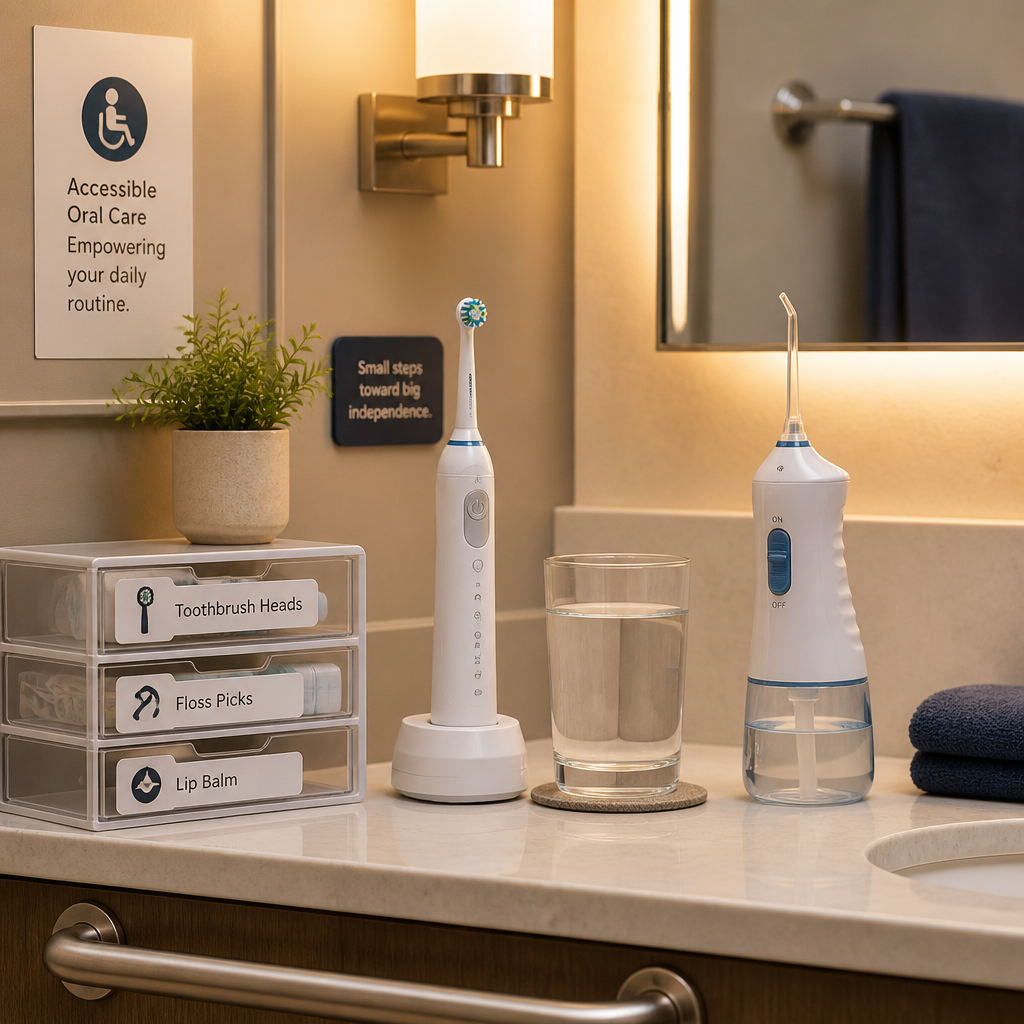
Sitting down to brush, rather than standing at a basin, reduces postural instability and the risk of a fall. Using a mirror at seated eye level helps maintain visual feedback when proprioception is unreliable. Anchoring the elbow on a surface, such as a countertop or the arm of a chair, reduces tremor amplitude during brushing by providing a stabilising fulcrum for the forearm.
Pro tip: For patients with significant resting tremor, try the one-handed technique: use the stronger or dominant side, with the elbow stabilised on a flat surface. This dramatically reduces the arc of tremor without requiring a change in grip or brush type.
Interdental brushes and dental floss present additional challenges because they require even finer motor control than a toothbrush. For people who find floss impossible, an interdental brush with a thicker grip, or a water flosser, offers an accessible alternative. Floss holders that provide a handle reduce the dexterity required and may help in early-stage Parkinson’s.
Caregiver-Assisted Oral Hygiene
As Parkinson’s progresses, independent oral hygiene becomes less reliable and eventually insufficient. Caregivers, whether family members or care home staff, take on an increasingly central role. This transition is often underplanned. Most caregivers receive little or no formal guidance on how to assist with oral hygiene, and many people with Parkinson’s resist having their teeth cleaned by someone else, particularly in care settings.
In practice, the most effective caregiver technique is to approach from behind or to the side rather than from directly in front, which can feel threatening. Using a silicone fingertip brush allows the caregiver to maintain full tactile control without requiring the person with Parkinson’s to open their mouth widely. Narrating each step before doing it gives the person warning, reducing the startle response and the likelihood of jaw clenching.
For people with Parkinson’s in care settings, the oraNurse range is available through the NHS supply chain, making it accessible for community nurses, care home staff, and district nursing teams who are responsible for the oral care of residents who cannot manage independently.
Denture care is a separate but related concern. Parkinson’s-related changes in jaw muscle tone and involuntary oral movements can affect how dentures fit, cause wear, and increase the risk of denture-related stomatitis. Dentures should be removed at night, cleaned thoroughly, and stored in water or a denture cleanser. Denture adhesives can help with stability but do not substitute for regular professional review of fit.
Comparing Oral Hygiene Tools for Parkinson’s
| Tool | Best Suited For | Key Limitation |
|---|---|---|
| Super soft manual toothbrush with small head (e.g. oraNurse) | All stages of Parkinson’s. Ideal where the person can still grip a handle. Protects tender, inflamed gums. Compact head reaches posterior teeth with restricted jaw opening. | Still requires wrist motion and grip. Less effective if rigidity or tremor is severe. |
| Oscillating-rotating electric toothbrush with large grip | Early to mid-stage Parkinson’s where grip is possible but fine wrist motion is compromised. Removes the technique requirement by doing the mechanical work automatically. | Can be difficult to hold in advanced tremor. Some models feel noisy or vibrating in ways that heighten sensory discomfort. Higher cost. |
| Silicone fingertip toothbrush (e.g. oraNurse) | Advanced Parkinson’s, caregiver-assisted brushing, people with significant oral sensitivity. Provides full control to the caregiver with gentle silicone contact on gum tissue. | Less effective for independent use. Requires a willing caregiver with correct technique. Not a replacement for fluoride toothpaste used with it. |
Working with Dental Professionals
People with Parkinson’s should be seeing a dentist at least every six months, and ideally more frequently as the disease progresses. The standard annual check-up interval is not appropriate when disease progression can change oral health status significantly between visits.
Before a dental appointment, caregivers and patients should inform the dental team about current motor symptoms, including the nature of tremor, dyskinesia, and any history of jaw clenching or involuntary mouth movements. This allows the team to prepare appropriately, whether that means shorter appointment blocks, a different chair position, or adjusted instrument placement.
Appointments scheduled in the morning, approximately 60 to 90 minutes after a levodopa dose, tend to be more manageable because motor function is closer to its peak. Prolonged dental work should be broken into multiple shorter sessions where possible, since fatigue compounds motor difficulty significantly.
Dental professionals should be aware that Parkinson’s medications interact with some dental anaesthetics and other drugs used in dental settings. A full current medication list should be shared at every appointment. NHS dental teams and community dental services have a role to play in proactive monitoring of this patient group, and referral pathways to specialist services should be used when independent oral hygiene has broken down entirely.
Pro tip: If you are a dental professional with a patient with Parkinson’s, recommend the oraNurse unflavoured toothpaste and super soft brush combination at the same appointment. These are not niche specialist products. They are specifically designed for the sensory and physical barriers your patient is facing, and they are available directly and through NHS supply.
Frequently Asked Questions
What is the best toothbrush for someone with Parkinson’s disease?
A super soft toothbrush with a small head and a comfortable grip is the best manual option for most people with Parkinson’s. The ultra-soft bristles protect tender gum tissue from the erratic pressure caused by tremor, and the compact head navigates around restricted jaw opening. For people who can still grip a handle but struggle with wrist motion, an oscillating-rotating electric toothbrush is a strong alternative. In advanced stages where independent brushing is unreliable, a silicone fingertip toothbrush used by a caregiver is the most practical solution.
Why is dry mouth such a problem for people with Parkinson’s?
Saliva is the mouth’s primary defence against tooth decay. It buffers the acids produced by plaque bacteria, remineralises early enamel damage, and physically washes food debris from tooth surfaces. When saliva production is reduced, as it is in a significant proportion of people with Parkinson’s, enamel is exposed to continuous acid attack without this natural protection. The result is accelerated decay, particularly along the gum line and on exposed root surfaces. Dry mouth also makes swallowing harder and can worsen dysphagic symptoms. Dry mouth products like Bioxtra are so important to save the teeth if a dry mouth is suspected.
Should someone with Parkinson’s use a flavoured toothpaste?
Not if they experience any gag sensitivity, swallowing difficulty, or discomfort with strong tastes. Standard mint toothpastes contain flavourings that intensify sensory responses in the mouth, which can trigger the gag reflex or cause genuine distress in people with dysphagia. The SLS foaming agent in most toothpastes compounds this by increasing the liquid sensation. An unflavoured, non-foaming toothpaste such as oraNurse removes these barriers while still delivering full fluoride protection. There is no clinical reason to persist with a flavoured toothpaste if it is making brushing harder.
How can a caregiver help someone with advanced Parkinson’s brush their teeth?
The most effective approach is to use a silicone fingertip toothbrush with unflavoured, non-foaming toothpaste, approaching from the side or behind rather than face-on. Narrating each step before doing it reduces the startle response and resistance to mouth opening. The caregiver should use gentle, circular movements along the gum line and inner tooth surfaces, and avoid applying excessive pressure. Sessions should be kept short and calm, particularly for people with cognitive involvement, and should ideally take place at a time when the person is rested and not in a peak-rigidity phase of their medication cycle.
How often should someone with Parkinson’s see a dentist?
At minimum every six months, and more frequently if oral health is already compromised or if the disease is progressing rapidly. People with Parkinson’s are at elevated risk of dental caries, gum disease, and denture complications. Waiting a full year between appointments leaves too much time for reversible problems to become irreversible. Dental visits should be planned around the medication schedule, with appointments booked during the window of best motor function, typically 60 to 90 minutes after a levodopa dose.
Is there a specific fluoride strength recommended for people with Parkinson’s?
Adults with Parkinson’s should be using a toothpaste with at least 1450 ppm fluoride, which is the standard adult recommendation and the highest strength available in standard retail toothpastes. In cases where caries risk is elevated, a dentist may prescribe a higher-strength fluoride toothpaste. The oraNurse unflavoured toothpaste is available in both 1000 ppm (for children under three) and 1450 ppm (for adults and children over three), making it straightforward to use the clinically appropriate strength without compromising on flavour or foaming tolerability.
References
- Parkinson’s Foundation: Dental Health guidance for people living with Parkinson’s disease
- Parkinson’s UK: Information on mouth and dental issues associated with Parkinson’s
- npj Parkinson’s Disease: Peer-reviewed review of oral health implications in Parkinson’s disease
- Parkinson’s Foundation Fact Sheet: Dental health strategies and practical tips for people with Parkinson’s
- PubMed Systematic Review: Parkinson’s disease and oral health prevalence of dental biofilm, gum disease, and caries